Showing posts with label online lessons. Show all posts

Friday, October 9, 2020

NatureGlo's eScience

Disclaimer: I received a FREE copy of this product through the HOMESCHOOL REVIEW CREW in exchange for my honest review. I was not required to write a positive review nor was I compensated in any other way.


Our family loves learning about science and the world around with a natural, hands-on approach. That's why I was pleased to review NatureGlo's eScience, a site filled with nature-based online math and science unit studies.

Gloria Brooks has over 20 years of eclectic teaching with child-directed learning. She has helped students all over the globe to fall in love with the natural world while also covering other subjects. By leaving dry textbooks behind and heading into nature, her goal is to ignite passion and curiosity to produce lifelong learners. She created the NatureGlo's eScience MathArt and Science Course Bundle as a one-stop, nature-based eLearning center for ages 10-18.


NatureGlo's eScience (NeS) offers 31 courses divided in 5 categories:
  • MathArt
  • Marine Biology
  • Herps (reptiles and amphibians)
  • Botany
  • Geology


The topics that are taught vary greatly and cover all sorts of interesting things: Galapagos tortoises, deep sea creatures, polygons and patterns in nature, giant redwood trees, gray wolves, rock hounding, Komodo dragons, chameleons, tide pools, queen conchs, Leonardo da Vinci, geometric snowflakes, and more. There's even a one-lesson class on bubbleology. 

The classes are easy to use. Once you begin a course, a list of the lessons is given, showing what is included. Many of the courses contain a PowerPoint slideshow, pre-lesson activity, main lesson videos, and activities.


The lessons may contain instructions, reading texts, downloads, videos, and additional links. The main lesson videos are pre-recorded live classes that Gloria has done with her students. They can be a bit awkward to watch as an outsider. There are pauses as you wait for a student to respond along with the feeling of being left out during discussions in which you can't partake. My kids enjoy when Gloria is teaching, but are somewhat aloof with the interaction of the students.

As you finish each lesson, there is a Mark Complete button to click. That will cross off the lesson from the list and highlight a checkmark next to it. There is also a bar to show progress along with the percentage that is completed for the entire course.


My middle child (10 years) is my biggest nature kid. He especially loves learning about animals and can rattle off multiple facts about all sorts of creatures. He's currently working through the
Herps Zoology: Poison Dart Frog, Python, and Caiman course. He has completed a Venn diagram, colored realistic pages, watched people handle pythons, learned that there's more than one type of reticulated python and that poison dart frogs lay their eggs and then transfer the tadpoles to water, and is working on drawing a caiman.

My daughter (12 years) is my artistic child. Of course, she was drawn to the MathArt courses and The Geometric Beauty of Snowflakes. She learned that there are triangular flakes and ice needles and created snowflakes out of popsicle sticks.


The dashboard has all the record-keeping: courses, achievements, certificates, grades, and more. You can see the date a course was started, the percentage that's been completed, and the grade. If your child doesn't click that Mark Complete button at the bottom of the lessons, none of that information will be recorded. Ask me how I know, ha.

I allow my kids to choose which classes they want to complete, but if you're looking for a more formal schedule for study, Gloria has created a RoadMap of courses. Following this plan will take you on a learning journey through all of the mathart and science lessons in a systematic way.


My kids can work through the courses mostly by themselves. Some of lesson pages feel distracting because of the amount of information on each page. My son was confused by all the links on the DK Find Out! sections. Also, we had issues with various videos and links and would get error codes such as 404 Not Found, Sorry the file you have requested does not exist, Video unavailable, and File is in owner's trash. We have also had videos that have either not played at all or have taken an extremely long time to load.

Despite the issues, we have enjoyed the information in the classes. Whenever possible, we just look for a similar video or print coloring pages from a different source. I do wish there were more hands-on activities though. If you'd like a virtual tour the site and all it has to offer, there is a video that explains it in detail.


My son told me, "I really like the slideshows and videos that show the animals." If you, too, want to delve deeper into MathArt and Science classes in a self-paced, natural way, you should check out NatureGlo's eScience.


You can connect with NatureGlo's eScience on the following social media sites:
Facebook
Twitter
Instagram

You can read more reviews of NatureGlo's eScience on the Homeschool Review Crew blog.


Pin It

Thursday, July 30, 2020

Experience Biology

Disclaimer: I received a FREE copy of this product through the HOMESCHOOL REVIEW CREW in exchange for my honest review. I was not required to write a positive review nor was I compensated in any other way.

Since my oldest child is in high school, I appreciate when we get reviews that focus on the advanced subjects. He was planning to take a biology class starting this fall, so when the opportunity came from Journey Homeschool Academy to use their Experience Biology: Upper Level course, we jumped at the chance to start early.

Luke and Trisha Gilkerson from Intoxicated on Life are focused on raising kids God's way. They believe in "nurturing your children's bodies, cultivating their minds, and inspiring their souls." They have been public speakers for over 15 years and guide parents through topics such as screen time, anger, sex education, discipline, Scripture memorization, and more. They also believe it's possible to have a balanced approach to high school science while learning at home and that the process can be characterized by both excellence and fun. Using these guidelines, they have created the Experience Biology course.


Experience Biology, taught with a Biblical worldview, contains everything your student needs for a high school credit class with approximately 180 hours of study.

  • Video Lessons -- 2 engaging teaching lessons every week for 35 weeks
  • Comprehension Quizzes -- weekly quizzes along with quarterly exams, graded score given immediately
  • Lab Assignments & Research Questions -- weekly hands-on lab experiments with videos and thought-provoking questions to deepen the scientific concepts
  • Reading Assignments -- optional weekly reading assignments from The Riot and the Dance: Foundational Biology

Luke teaches the lesson videos, while Trisha guides the step-by-step lab videos. Both of them are engaging and easy to follow. I'll be honest, my son was not thrilled with the idea of a biology class. He thought he would be learning only about plants and animals and had no interest in studying either one. The very first lesson video grabbed his attention though. He stopped it multiple times to tell me some tidbit of information that he learned. The first quarter of biology covers things on the cellular and molecular level which can be more difficult to understand because it doesn't relate to visible objects, but Luke does a great job explaining the concepts.


The labs ensure that there is hands-on, interactive learning nearly each week. At least 15 labs are needed to count the class for a science lab credit, so there are many options to choose which ones work best for your family. There is a custom kit that you can purchase if you want the full experience, or you can buy individual supplies a la carte from the course's wish list. You can also see a list of needed supplies for each lab so you can prepare in advance. Animal dissection isn't on the schedule for many weeks, but we're looking forward to that! Other labs include looking at multiple slides with the microscope, replicating the process of meiosis and reproduction in imaginary creatures, creating a classification system, observing various plant life and their parts, examining carbon dioxide exhaled from the lungs, and more.

All the resources your student needs come as digital downloads with the course such as the parent curriculum guide, student guide book, and student lab guide. There are also individual answer keys for both student books, research questions, diagrams, and a sample lab report. If you don't want to print the books yourself, there is also the option to buy full-color copies of both the spiral-bound student guidebook and the student lab guide.


The Student Management page lets me see how my son is doing at a glance. It shows me what percentage of the program he has completed along with each of the weekly quiz scores. He has to turn in the research questions and lab work to me, so between those and the online grades, it's easy to make sure he stays on track.

Even if the only thing I had to say about this course was that my son likes it, I would still think it's a good program. He knows what he likes and often asks why he needs to learn something if he doesn't think he will need it in the future. Yet, Experience Biology has won him over! He doesn't complain about the work and is interested in the videos. He's a little off track with our lighter summer schedule, vacation, and summer camp, but he's already learned a lot.


Here's what he had to say about it:

"I like that it's very straight forward with multiple examples. I like how it's a combination of a
video of him talking while showing other videos and pictures. It's very well done
and easy to understand. I've already learned a lot."


On top of his enthusiasm though, it is a truly great program. The videos are engaging, the information is complete, and the grading and tracking is simple to follow, but my favorite part is the labs. I love that the class is called Experience Biology because it's so fitting! Our learning style in our home is based on experiencing learning. We incorporate hands-on education every day because I believe in the importance of my children learning by doing. When I took biology in high school, we learned from a dry textbook and lectures. The only two labs I can remember at all were dissecting a flower and dissecting a frog. I am pleased that my son will have a thorough study. Experience Biology: Upper Level helps the student make practical applications based on factual learning in an interesting, thought-provoking manner.

If you're looking for a science course for your children, I highly recommend Journey Homeschool Academy.


You can connect with Journey Homeschool Academy through Intoxicated on Life on the following social media sites:


Some of my Crewmates were able to review the elementary biology course and the elementary astronomy course. You can read more reviews of the science curricula from Journey Homeschool Academy on the Homeschool Review Crew blog.


Experience Biology: Elementary Level, Upper Level and Experience Astronomy: Elementary {Journey Homeschool Academy Reviews}
Pin It

Tuesday, October 22, 2019

Creating a Masterpiece


If I had to describe my daughter in two words, I'd choose reader and artist. We often receive review products to satiate her book obsession (or at least attempt to keep up with it, ha), but lately we've been using a program that appeals to her crafty side.

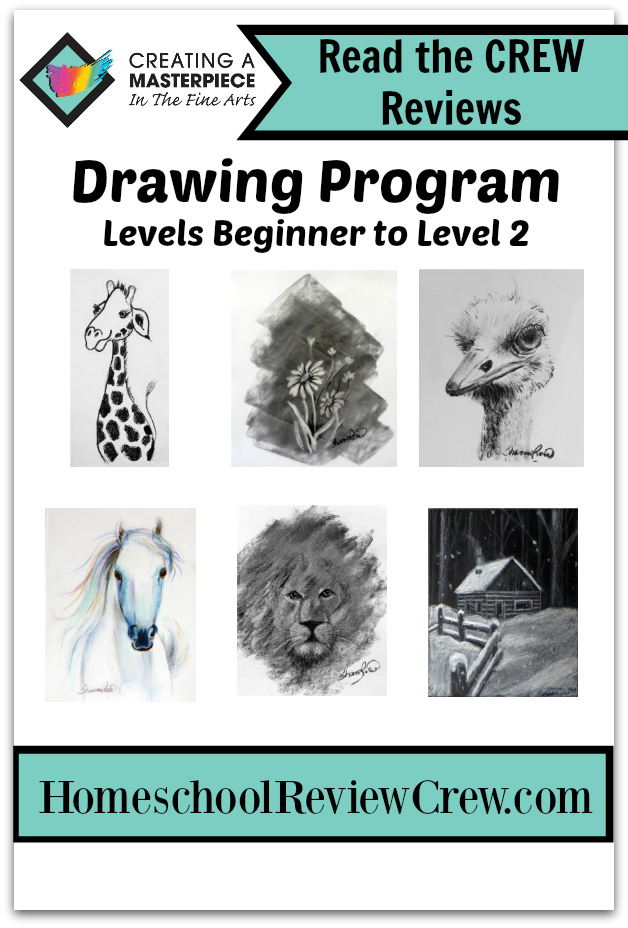
She told me recently that she wanted to get better at drawing. She's used some books and a couple drawing videos for kids, but she's reached a point where she is ready for lessons that are more complex. I was happy that she received a one year subscription to an online Drawing Program from Creating a Masterpiece.


Creating a Masterpiece was established by master artist Sharon Hofer. Her mission is to help students of all ages to produce "beautiful, masterpiece quality artwork." Her step-by-step teaching videos have helped thousands of students gain confidence as they learn the skills to succeed in creating fine art.

With over 20 years of teaching in the classroom, Sharon has much experience, not just in creating her own artwork, but in conveying those skills to others, as well. Her courses cover a wide variety of  mediums including acrylic, balsa carving, copper tooling, faux metal working, glass mosaic, oil pastel, silk painting, wood burning, and more. Along with the core program, students can choose to learn about artists and recreate their work through the art history course. For those who would like to learn visually through text instead of video, there is also a collection of step-by-step art books covering both a range of history and specific projects and techniques.


The drawing program that my daughter is using is divided into 4 sections:

  • Beginning, 8 projects
  • Level 1, 7 projects
  • Level 2, 6 projects
  • Level 3, 8 projects

A subscription to the course allows access to all projects in every level for your entire family. Each lesson shows a picture, the type of medium used, and the name of the piece.


Students will learn how to plan, develop, and enhance their projects through Sharon's guidance. As they progress through the levels, they will be able to apply their techniques more intricately as they hone their skills. They will learn things such as incorporating value, both two- and three-point perspective, showing movement, blending, highlighting, and more. Sharon teaches not only how to preform the technique, but why to do it, as well.

Clicking on a project will take you to a new page that lists a description that may include interesting facts, a supply list, and the number of lessons. The lessons link at the bottom will produce another page with even more information including the teaching videos, suggested color swatches, supplies, helpful tips, and simple sketches of the highlights of the lesson.


I have been so impressed watching my daughter draw with this program! The lessons are self-paced, so she's been working through them as the desire strikes. The realistic drawings are so beautiful that I plan to have her make one specifically to hang in our house. Sharon does a fantastic job teaching. She's calm, encouraging, and pleasant.

My husband also enjoys sketching (that's where our girl got her talent) and sometimes watches videos of drawing to relax. I admit, I never really saw the appeal until I watched a few of Sharon's videos myself. It's almost therapeutic. She claims that drawing is a skill that anyone can learn. Watching her do it makes me a believer.


One thing that pleases me is that my daughter has started to recreate her drawings, not by re-watching the videos, but from looking at her completed projects or simply from memory. I love that she's truly learning the techniques.

Something that she learned from the Moonstruck cat project was to "work small" to keep it simpler. She's been putting that into practice the last few days, trying to control her lines better in a smaller space. I love watching her advance her skills as she continues to practice.


Here's what my girl had to say:

The lessons are easy-to-follow and fun. I like that the projects aren't just pencil.


My daughter is enjoying learning techniques using pencil, colored pencil, and charcoal with this Drawing Program. I'm excited to watch her skills improve as she continues with this course.


You can connect with Creating a Masterpiece on their website and Facebook.

You can see other homeschoolers' drawings by reading the reviews on the Homeschool Review Crew blog.
Learning to Draw {Creating a Masterpiece Reviews}
Crew Disclaimer
Pin It

Wednesday, September 18, 2019

Online Times Alive


Memorizing multiplication facts is something every student needs to do, but that doesn't mean it has to be boring. We were able to review a six-month Online Times Alive subscription from City Creek Press, Inc. that teaches the "times tables the fun way."

City Creek Press, Inc. has been producing engaging teaching materials since 1992. Judy Liautaud, the creator of the company, was determined to help student learn math facts in a fun and meaningful way. Her unique method, which connects stories and songs to number facts, has been helping students ever since. Not only do they learn the facts faster, but they retain them, too. Now, the company offers 20 original products (including an iOS app that some of my crew mates also reviewed) that make learning fun and memorable for children. 


The Online Times Alive program is based on Judy's book, Times Tables the Fun Way Book for Kids. It teaches all the multiplication facts 0-9 through a combination of stories, movies, songs, and games.

Numbers are personified through the stories in order to make the facts easier to remember. For example, 3 x 8 = 24 is shown as a bat flying through a cave and finds the King of Snakes on a throne. Each multiplication sequence has its own story to trigger recollection.


The facts for 0, 1, 2, 5, and 9 are taught in groups as a whole for each number family, because there are simple tricks to learn them. The other numbers are taught individually since they can be trickier. Each lesson is broken into parts and are displayed on the lesson list with symbols for their types: movie, song, paint, quiz, test. This list will also show which lessons the student has viewed and which he has completed.

The Online Times Alive subscription is valid on one Mac or PC, but keeps track of an unlimited number of students. Progress, scores, times, and date of completion is recorded for each student by clicking the Progress Report button under the lesson list.

I'm not sure why, but the program did not record my kids' data. Even though we signed in with the exact same names each time, nothing was marked. It didn't affect how we used it as my kids could easily remember where they left off.


I had two of my children use the program as a refresher before school started again to combat any summer slide. My 11-year-old has always struggled with math and memorizing multiplication facts. This summer, I insisted she buckle down and learn these pesky tables once and for all. She worked through the lessons in a matter of days. Though she determined it seemed a little too juvenile for her, she never complained. She didn't feel confident that it made much difference, but when I quizzed her just now, she answered each one correctly and with only a slight hesitation. She did also practice flashcards over the summer months, but she said that there are facts that she knows specifically from the Times Alive stories.

My 9-year-old is the opposite of his sister. Math has always come easy to him. It was his favorite subject until just recently when he claimed he no longer liked it. These kids. They always keep us guessing, right? I had him work through program to freshen those facts. I do not notice a difference in his response time nor his remembrance of certain facts. Not every program works for everyone, and that's ok.

 
Online Times Alive makes learning multiplication facts fun by teaching them in a different way than simply drilling number sequences. The stories are kinda silly and random, and while I think it would make it confusing, it seems to help the facts stick in young minds. I'm interested to use the program with my boys who are too little to be learning multiplication in their typical math lessons to see how well it would work for them.

If  learning the times tables the fun way seems like a good fit for your family, you can use coupon code lovetolearn to waive the signup fee and getting started today.


You can connect with City Creek Press, Inc. on the following social media sites:
Facebook
YouTube
Instagram


You can read more reviews of this program also learn about their iOS app to see how it worked in other homeschool families on the Homeschool Review Crew blog.

Online Times Alive {City Creek Press, Inc. Reviews}

Crew Disclaimer
Pin It

Thursday, May 30, 2019

Supercharged Science ~ Physics


It seems like we've gotten an abundance of science materials recently. And while one might think we wouldn't need another one, I couldn't pass up the opportunity to review e-Science Homeschool Science Curriculum from Supercharged Science. You see, we first became acquainted with Supercharged Science 8 years ago when we used the site to find experiments we could recreate. Since then, we've joined in on multiple online teleclasses, reviewed the e-Science program, and performed lots and lots of the experiments.  

Aurora Lipper, the founder of Supercharged Science, is a rocket scientist and mechanical engineer. After earning a Master's, working at NASA, and lecturing at the college level, she discovered that kids did not have the same passion for science as she did. She realized that the problem was related to the teaching process, not the material. She determined to figure out a better way to teach science--a way that would appeal to the kids while both educating and inspiring them. Her methods were instantly a hit, and Supercharged Science was born.


This award-winning science curriculum offers complete programs from K-12th grades that either meets or exceeds most science standards. It is a video-based, online science curriculum that explains "topics to kids in a practical and real-world way." The videos then guide them step-by-step through the activities and experiments that focus on the concepts learned. Because it is self-teaching, students can work through the materials at their own pace and choose from the plethora of activities which ones interest them the most. Aurora calls this the "easy way to teach science," because she does all the teaching herself using her unique 3 step method. You don't have to have an advanced science degree to give your children a strong science foundation.

The curriculum is divided in 2 ways: topics and grade levels. There are many options to using this. You can work through the topics units in order for a full course. Or if your child is currently fascinated by light or magnets or chemistry (a favorite in our house!), you can easily find the content about those topics to supplement your curriculum. There are even conversion charts to complement dozens of science curricula. The charts list which activities and experiments on Supercharged Science line up with the chapters in the other curricula to amplify the learning. Another option would be to follow the plans for a specific grade level.


We are entering a new phase as our oldest is officially in high school now. I thought that this would be a perfect high school science course for him since it is thorough and complete, not to mention an easier teaching option as we enter this uncharted territory. I clicked on Grade Levels and then Advanced Topics. The high school topics, which are appropriate for advanced 5th-8th graders as well, include physics, astrophysics, electronics, chemistry & chemical reactivity, biology, and alternative energy. There is a video on the page that explains what science high school topics should cover in which order and why. I was surprised to see that she recommends physics in 9th grade as that was an elective course my senior year in high school. I personally took biology as a freshman, but since I am not a professional scientist, I trusted her expertise and started my son in the physics course.

The curriculum, no matter the topic or age level, is perfect for all kinds of learners. It incorporates readings, experiments, exercises, and videos to make a full, hands-on approach to learning science concepts. Physics, like the other advanced topics, also includes lab worksheets to test real-life examples and to prepare students for college. There are data tables, charts, graphs, math exercises, and more. The course depends on math, engineering, and technology to teach applicable aspects of physics that students can observe themselves. The projects include working robots, observations with telescopes, launching rockets, using lasers, making musical instruments, creating electrical circuits, and more. 


Using the course is simple. My son started with the introduction and from there just clicks through the lessons. Each lesson has a text portion and video with comments from other learners and Aurora at the bottom. There are links for worksheets, exercises, and the like within the lessons. Because physics is based in math, the videos teach the math step-by-step along with the science as it is needed. This helps students understand why various math concepts are important and how they relate to real life.

There are no lesson plans that spell out exactly what to do each day (especially since this is a self-teaching program that meets many different intentions of use), however, the course has 50 sections divided into 14 chapters. There are more than 500 videos for the course and many labs. It is reasonable to spend a week covering 1-2 of the sections.

Aurora's teaching style makes both science and math easy to understand. Her passion is evident, not only through her videos, but in her commitment to her program and her students. If you have any questions, you can either leave a comment on the site or send an email, and she will reply within a day. She truly wants kids to understand science and fall in love with it. I love her philosophy of making learning fun and hands-on. I firmly believe that people--kids and adults alike--learn and understand best when they do something themselves, not just read or listen.

There are many free resources on the site including more than 30 experiments, an online class, and various tips throughout. Many different teaching options are available in addition to e-Science Homeschool Science Curriculum including single subject DVD lessons and mastery programs that contain all the materials as well as instructions that you need. 

Learning about acceleration during Driveway Races.
Right now, the site can be a bit frustrating to navigate, but they are in the process of updating it, making it easier to use. I've gotten a sneak peak of the new format and can't wait for it to be complete! The site will contain all the same great content, but with a better setup.

No matter if you need a supplemental program or a full curriculum for science, e-Science Homeschool Science Curriculum is sure to meet your need.

I'm thankful that we have Supercharged Science to give my son a strong understanding of physics as we start our high school journey.


You can connect with Supercharged Science on the following social media sites:


You can read more reviews of this online science program covering both topics and grade levels on the Homeschool Review Crew blog.

e-Science Homeschool Science Curriculum {Supercharged Science Reviews}
Crew Disclaimer
Pin It

Thursday, April 18, 2019

CrossWired Science


My kids love science and learning about the world around them. They are always pleased when we receive science products to review, like this brand new website called CrossWired Science. We've been learning all about Sound, and Fluid Dynamics.

The goal of Crosswired Science is to help people "see the glory of the Lord . . . and to reach those who do not yet know Him." By combining Scripture with many different resources, reading materials, and experiences, they strive to help families learn together about God's power and intelligence in His creation and to grow in that knowledge. They are not just studying science, but true Science, "the very carefully thought-out handiwork of the Almighty God." You can read about their 17 educational goals in depth on their site. They may have recently launched this new site, but they have big plans for it.


Each course is based around a "global topic." Both Sound and Fluid Dynamics have 29 lessons that cover a month or so of science. Within each topic are many different learning options, making the material "crosswired" through many subject areas. Think of it like a unit study about various science themes. The idea is to integrate the sciences--Life, Earth, Physical--to teach a "deep science" for a strong knowledge base. 

The student first chooses either the First Timers or Second Timers option, meaning a younger student who is new to the material is going to be learning it for the first time, whereas an older student or graduate would probably benefit from the second option. The videos are the same for both, but the questions vary in difficulty. After that, the student can pick a global topic course and find the lesson page.

There are 8 core videos for each global topic which act as the main teaching materials. Mixed within those are blocks of additional activities including experiments, research topics, general links with more videos, field trip suggestions, book lists, and devotionals. There is also a section called U-Choose that offers ideas for any style of learning as a "science free-for-all." Things like coloring pages, games, projects, cooking, notebooking, speeches, webinars, and more. There are also Digging Deeper and Gold Dig sections. These portions are extensive written materials about various topics within the main course. Each link is filled with snippets of information and eye-catching pictures. In fact, there is one Digging Deeper segment about bats which includes photographs that are both fascinating and disturbing at the same time. God's creation is amazing! If a student doesn't finish the material in one sitting, he can click on a letter link and be take directly to where he left off instead of scrolling through all the material.


Fluid Dynamics covers the flow of something or "fluids in motion (aerodynamics, hydrodynamics etc). For example, how the dorsal fin helps a shark to swim, how a bird's alula feathers help it fly and land, why dogs make such a mess when they drink water, and more. Students will learn about Bernouli's Law, how carburetors work, how there are more aerodynamics in the human nose than there are in a fighter jet, and other interesting facts. There are sections on astronauts, giant slugs, how lungs work, the cause of thunder and lightning, composting, and more. There are dozens of experiments including making a multistage rocket, dissecting a fish, rubber band plans, and toilet paper blowers.

The Sound course is all about vibrations and how they move through liquids solids, and gases. Some of the things students will learn are how Leonardo da Vinci practiced sonar, how infrasound was used in WWII, how the syrinx is used in bird calls, and all about the inner workings of the ear. There is more information about how sound is created and used in people, animals, machines, and the world around us. The devotionals show what you can learn from the Bible through croaking frogs and a whale and a worm. 


The CrossWired Science curriculum is very eclectic. It uses many excellent resources that have been produced by others that can be found on the internet, printed in books, or ideas for home. It is applicable for any student K-12th grade and can be as as both a full curriculum or as a supplement (it currently contains 3 months of material, but will eventually offer 6 full years of science courses).

The videos can be from 2 minutes to 28 minutes in length and everything in between (though it does seem as though most are less than 10), so it's feasible to fit one into any schedule. There are also quizzes and worksheets for review, a place to take notes, and sections to record summaries and whatnot. The site keeps track of the progress through the course. While the videos build off of each other, the other materials could be completed in any order. The parent account has access to answer keys, grades, and the calendar with a suggested schedule.


We've taken a gentle approach with CrossWired Science. I have three kids (ages 13, 11, 9) working through the curriculum. One chose to work through Sound, one chose to learn about Fluid Dynamics, and the third has been using both courses. They use the program a few times a week and pick and choose their activities. They all enjoy the learning videos which are a combination of people teaching the material, photos, and graphics. They are whimsical and packed with information. 

The kids have completed worksheets and quizzes on the computer, colored pictures, made musical instruments, and read and watched many interesting things. The boys have plans to build  a working helicopter this weekend with their dad. 


Here's what my kids had to say about CrossWired Science:

"I like learning about Fluid Dynamics. I think it's really cool when air goes into your nose 
that it goes into three place. It's amazing. Oh, and it's so cool that the alula feathers act the second they're needed for bird to land perfectly. The exact second! God is amazing!" 

"I like watching all the videos."

"There's not a lot of review in the lessons, so it's easy to forget things."


It's important to remember that CrossWired Science is a very new website. Things are still being tweaked and there are plans to add much more to the site. Just in the past few weeks that we have been using it, aspects have been improved, features have been added, and content has increased. It's a great site for families who appreciate the freedom to adapt their learning to their interests and needs. Many of the suggestions are vague and do not give much direction. For instance, for games in the U-Choose section, it lists purchase a game, make up your own game, see "Game Design" under Research and Review. If you're looking for a curriculum that spells out exactly what you need, this might not be the best option for you.

However, if you love flexibility in your education, CrossWired Science offers many possibilities. You can try a sample unit to get a feel for the program and even save $5 off of a subscription with code 5offCWS. I'm excited to see what they'll offer in the future.


You can read more reviews of this science program on the Homeschool Review Crew blog.

Crew Disclaimer
Pin It