Showing posts with label foreign language. Show all posts

Thursday, September 13, 2018

Picta Dicta Review


My kids are intrigued by foreign languages. We've dabbled in Latin learning a few times in the past, but never found a curriculum that my kids truly understood and loved. Honestly, I was not interested in revisiting our study of the language just yet. I was sure any curriculum would be met with frustrations and complaints after a couple weeks. So when I heard that we had the opportunity to review Picta Dicta Natural World from Roman Roads Media, I had no intentions of actually wanting to try it.

So why am I writing a review of it? Because I watched this video on their YouTube channel and immediately knew this curriculum was different.     
Roman Roads Media publishes classical Christian curriculum. By relying on master-teachers of classical education and incorporating video technology, they are able to produce high-quality products that are "accessible, affordable, and flexible for the Christian homeschooler." Their curriculum is characterized by excellent instruction and enhanced with visual aids and examples. Along with multiple Latin choices, they offer many other courses as well, such as logic, rhetoric, poetry, old western culture, and more.

Picta Dicta Natural World is a self-paced Latin program for elementary-age students. It focuses on teaching vocabulary in order to give learners a good foundation of the Latin language. By drilling 400 nouns from the natural world, the program ensures that the learning is both practical and applicable. The words cover the following topics:

  • Basic Animals
  • Fruits, Berries, and Nuts
  • Anatomy I
  • Land Forms and Terrain
  • Small Animals
  • Parts of Trees and Plants
  • Human Anatomy II
  • Water
  • Birds I
  • Growing Things
  • Sky and Weather
  • Animal Anatomy
  • Sea Life
  • Trees
  • Hand and Foot
  • Constellations
  • Exotic Animals
  • Flowers and Herbs
  • Vegetables and Legumes
  • Human Anatomy III
  • Birds II
  • Insects, Arachnids, and Worms
  • Sign and Habitat
  • Light and Fire
  • Metals and Stones
  • Ground Cover and Vegetation  


The course is offered at various levels of difficulty and the lessons themselves are self-paced, which means that the curriculum remains both achievable and challenging. In addition to Latin, the curriculum weaves bits of literature, history, and science into the lessons.

The program utilizes a multi-sensory approach with the philosophy of See It, Hear It, Understand It. It combines colorful, hand-drawn images along with audible pronunciations and English definitions and translations to help the student fully grasp the vocabulary.

I have one child working through the course at the Reader I level and two children following the Reader II level. The teaching style is the same for both levels, but the difficulty varies slightly. The Reader I has 8 lessons for each topic followed by 5 lessons of accumulative review, whereas the Reader II generally has 5 lessons followed by another 5 lessons of combined review. I also have plans to work through the Express level myself, which is an accelerated version of the curriculum. There are additional choices for children who cannot yet read and the parent who does not want to complete the drills but wants access to the materials.


The program teaches the words through various means. An example of the Reader II lesson games is as follows:

  • Learn Latin -- learn the vocabulary words and read short stories that describe them in their ancient role
  • Latin Picture -- use Latin words with English descriptions
  • English -- label the picture in English
  • Spell Latin -- translate the Latin word and type it in English
  • Review Latin -- translate the English word and type it in Latin
There are also two versions of a crossword puzzle for each topic that you can download and print. The easier version lists the Latin word as the clue and the English word as the answer; the more difficult version is the opposite.


My kids have been doing so well with this program! They are loving learning new words and the ease at which they are doing so. Even the 3-year-old is heard walking through the house saying words like "asinus" and "gallina" (and it's super cute, if I do say so myself). I appreciate that they're learning to decode words by recognizing the morphemes in Latin and finding them in English words. In fact, they were impressed when I was able to guess animals by their Latin equivalent in this way. For instance, I guessed horse for equus because of equestrian, dog for canis because of canine, and others. I also knew gallina for chicken because of studying Spanish in high school. Being able to understand English better is one of my favorite reasons for my children learning Latin. 
 
Picta Dicta Natural World is a fantastic program to teach hundreds of words in Latin, no matter your previous experience with the language. With a strong vocabulary foundation, learning grammar and grasping the language as a whole becomes much easier. I am excited to continue with this curriculum and watch my children grow as they learn Latin. 


You can connect with Roman Roads Media on the following social media sites:


If you'd like to learn more about the products offered by Roman Roads Media, please read the reviews on the Homeschool Review Crew blog.


   
Crew Disclaimer
Pin It

Thursday, August 18, 2016

Foreign Languages for Kids by Kids


¡Hola! My kids were super excited about this review from Foreign Languages for Kids by Kids. It had been a while since we've formally studied a foreign language together, and they had been asking to learn one.

While there's something so empowering about speaking and understanding a language other than your native one, the learning process can be intimidating. I was pleased when the opportunity came to use the Starter Set 1 for Spanish. You see, I took 3 years of Spanish in high school. By the last year, once we walked in the room, we could speak only Spanish. Not a single word of English could be uttered. I felt confident that I could teach my children, as well, especially with the help of an award-winning program.


The Start Set 1 is a complete 20-week curriculum that contains everything you need to introduce your family to the Spanish language.

  • DVD 1 -- The first 3 videos (of an 8-part series) of the program: Basketballs Aren't for Breakfast, The Little Magic House Part 1, The Little Magic House Part 2.
  • 3 Workbooks -- One workbook to correspond to each video.
  • 3 Teacher's Guides -- One guide to accompany each workbook.
  • Stickers -- Spanish vocabulary words from the first video.
  • Flashcards -- One color-coded set including graphics and vocabulary for each of the videos.
  • Go Squish! (included free for a limited time) -- Spanish Go Fish type of card game.
The videos of Foreign Languages for Kids by Kids are the main teaching tool of the program. Everything is completely in Spanish and preformed by kids (with an adult voice off-screen occasionally). The teaching style is a combination of immersion and visuals with plenty of humor and fun. It teaches words and sentences that are practical and used in everyday life in a fun, easy way.

 
The Teacher's Guide could not be simpler to use. Each lesson is broken down by activities and lists approximately how long it will take to complete. Nearly every day starts with watching a video or portion of a video. There are many learning exercises throughout that both reinforce the vocabulary in the videos and teach additional information about Spanish-speaking countries, like geography, foods, idioms, accent marks, traditions, fun facts, and more. There are also hands-on and gross motor activities.

The guide give specific directions for each activity, but also leaves the lessons open for the flexibility that homeschoolers love so much. It gives alternate suggestions, gives grace to those who might not grasp the language as quickly, and is filled with positive reinforcement.


The workbooks are bold, full-color books. Along with some of that additional information I described already, they are packed with fun activities.

  • matching
  • crossword puzzles
  • word scrambles
  • multiple choice
  • secret codes
  • word searches
  • missing letters
  • fill in the blank
  • creative writing
  • . . . and so much more
Between the impressive variety of activities in the books and the bold color of the pages and pictures, the kids never get bored. The directions are written first in Spanish and then in English. The side-by-side helps the kids understand and decipher words without specifically being taught. There is a complete, matching answer key for the exercises at the back of each book. The books also increase in difficulty just like it does in subsequent videos.

 
To say that my kids love this program would be an understatement. The first day, they wanted to watch all 3 videos. Of course, at the time, they couldn't understand a single word other than hola and gracias. Still, there were smiles and laughter throughout the entire thing. The videos follow a family with 3 boys as they go about their day. The first video takes place during breakfast and teaches words such as apple (manzana), orange (naranja), bread (pan), and eggs (huevos) along with a few more complicated things like where is it? (¿dónde está?) and here it is (aqui está).

The dialogue is simple and stream-lined. Instead of asking "do you want an apple," one brother holds an apple in front of another and simply says, "¿Manzana?" As more vocabulary is introduced throughout the videos, the dialogue becomes more complicated. The words are taught through visuals and repetition, so the kids aren't left confused. My kids were walking around speaking Spanish words the first day I played the DVD.

 
Seriously, my little ones (10, 8, 6, 4) beg to do their Spanish lesson every day. It's fun listening to them walk around the house pointing out what they know and incorporating the language into their conversations. I love when my 4-year-old tells me, "Mommy, I me gusta you." I know it's not a proper translation or combination of the languages, but it shows me that he's understanding and applying it to his own life.

The kids love everything about this curriculum--videos, workbooks, Go Squish! card game, flashcards, stickers, everything. We've had a lot of fun together doing the lessons. The only somewhat negative I can even say is that because the workbook pages are glossy it can be difficult to write on with some utensils and that if you leave the stickers on certain surfaces for a month they can leave a residue that you have to clean (this one is my fault, oops).


The products from Foreign Languages for Kids by Kids are quality resources. The Spanish Start Set 1 has been a huge hit in our house. It's not only successfully taught my children the words that are used in the videos in a fun way, but has also encouraged them to learn more on their own. They're often asking me the Spanish equivalent of a word. It's amazing all the information that I've remembered from my high school days just by using these videos. We're also using my Spanish/English dictionary on nearly a daily basis.

We're still working out way through the second video and accompanying workbook. I see us studying Spanish through Foreign Languages for Kids by Kids for a long time. The kids love it; I love it; and it works.   


If you'd like to see how other homeschool families used this product, please read the reviews on the Schoolhouse Review Crew blog. 


Crew Disclaimer
Pin It

Thursday, July 7, 2016

Once Upon a Time in Latin


My kids are fascinated with foreign languages. It had been a while since we formally studied one, so I was pleased when a review for Laurelwood Books became an option. The idea of speaking and understanding a language not common in our area is especially appealing to my oldest (10 yr). While he has dreams of learning the Elvish language (yes, seriously), he was equally excited about studying Latin. He's pleased because it's a dead language; I'm pleased because of the benefits that stem from it.

Latin may not be one's native language any longer or be continually evolving, but its influence can be found all over. Not only will understanding Latin be beneficial for learning the Romance languages (Spanish, Portuguese, French, Italian, and Romanian), but it will give a better understanding of English, as well. I have fond memories of learning morphemes (the smallest part with meaning of a word). We'd sit around the table making up our own words by combining prefixes, suffixes, and roots.  Throughout the years, he taught me that I could have a basic understanding of almost any word (and could even understand many foreign words), as long as I had a grasp of the individual parts. Many of our morphemes stem from Latin and can be found in various areas of study, like medicine, astronomy biology, history, dentistry, law, and mathematics, to name just a few. It's because of this connection to our own language that I was excited to use Olim, Once Upon a Time in Latin: Derivatives I.


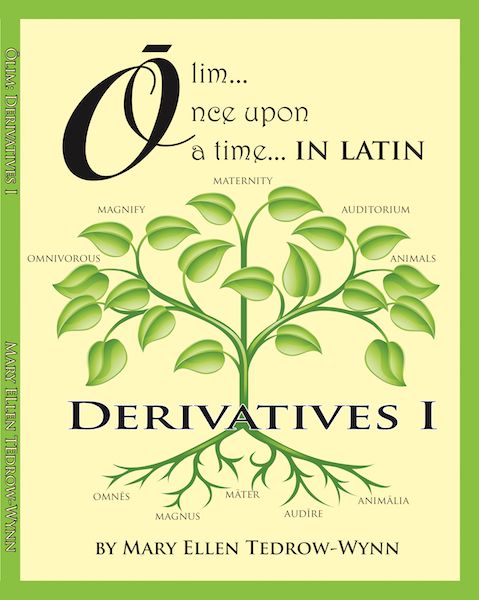
Derivatives I focuses on studying Latin words and the English words we derive from them. It can be used as a stand-alone vocabulary builder or as a complimentary resource to any Latin program. In fact, the words used in this curriculum are pulled directly from the first three volumes of Olim, Once Upon a Time in Latin reader series by the same author.

A two-week schedule is recommended for each lesson of 10 vocabulary words.

Week 1
Day 1: Trace Latin and English Words
Day 2: Exercise I: Fill in the Blank
Day 3: Exercise II: Matching
Day 4: Exercise III: Story with Blanks

Week 2
Day 5: Exercise IV: Multiple Choice
Day 6: Exercise V: Write Your Own Story
Day 7: Crossword or Word Search Puzzle
Extras: Write Derivatives (every 5 lessons)


There is a detailed pronunciation guide in the beginning of the book. It breaks down each letter and its sound, explains double letters, and lists rules for accents and syllables. It also describes macrons, the diacritical mark indicating a long vowel.

The Latin vocabulary words in the book fall into 3 categories: verbs, nouns, and adjectives. For each word, the book lists the Latin word(s), the meaning, and the English derivatives.

1. dicere, dīcit, dīxit (v)                  to say, (he) says, (he) said           diction, dictionary
2. prīmus, prīma, prīmum (adj)       first                                             primary, premier
3. exīre (v)                                    to go out, exit                              exit


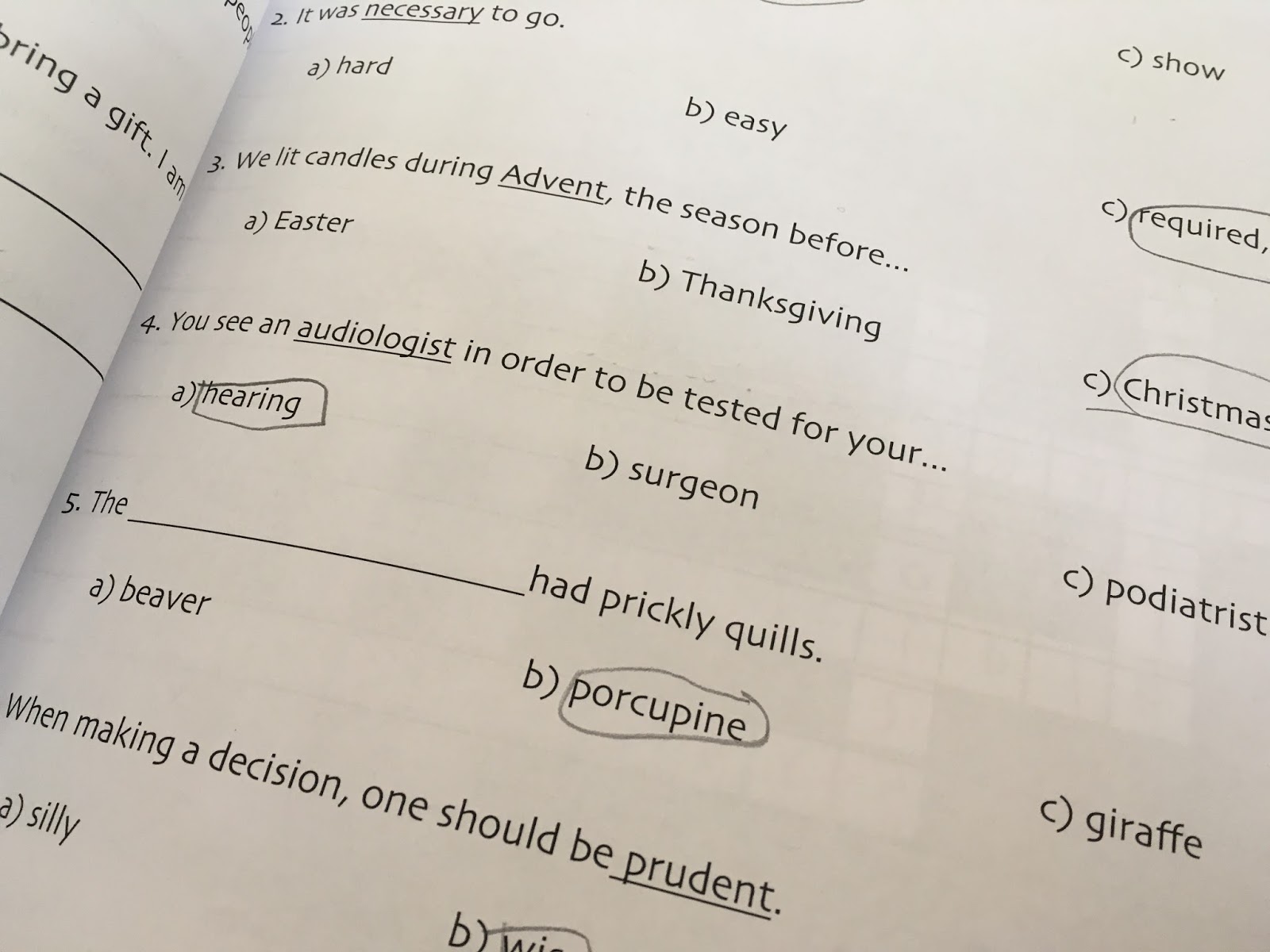
The exercises are fairly simple. My son completes them in 5-10 minutes each day. He's a little disappointed as he thought he'd be learning to speak Latin, rather than just learning random words. We did look up some videos so we could hear how it's spoken. The pronunciation guide is helpful, but he needed to hear it to fully understand. He doesn't appreciate the benefits of what he is learning just yet. I've tried explaining that this book is truly helpful in understanding English and decoding words he doesn't know. He just gives me one of those looks in return. I know, I know, one day he'll appreciate it, ha. Until then, I will have him continue to complete the exercises, if for nothing other than the English vocabulary he's studying. He is still interested in speaking Latin. I think this book would be a wonderful resource to use alongside an actual Latin curriculum.  

If you're looking for a good way to learn some Latin words and see how they've influenced the English language, Olim, Once Upon a Time in Latin: Derivatives I is a good option.


You can connect with Laurelwood Books on their website and Facebook.  


You can read more reviews of this book or of one of the many other resources reviewed by other homeschoolers on the Schoolhouse Review Crew blog.


Crew Disclaimer
Pin It