Showing posts with label grammar. Show all posts

Thursday, June 13, 2019

Middle School Lightning Literature


I am excited every time we get to review things that focus on reading. The foundation of our schooling is literature based, so the kids spend a large portion of their school day lost in a book. While I do appreciate the need for some fluff in their reading, we rely on quality writings most of the time. That's why when the Homeschool Review Crew had the opportunity to choose one of many products offered by Hewitt Homeschooling Resources, I was immediately drawn to the Gr 8 Lightning Lit Set. Not only does their Lightning Literature & Composition series focus on whole books and classical literature, but it also teaches deep reading and writing skills.

Hewitt Homeschooling offers a balanced, flexible, and complete approach to home education. They believe that the best option is home school, not school at home, by providing hands-on activities and great literature. Their goals are to combine excellent academics with character development, to instill a strong work ethic, and to cultivate a spirit of community service.


There is a Lightning Literature & Composition level for every student from grades 1-12. For the elementary and junior high years, the curriculum is grade-specific; for the high school years, it is based on a time, place, topic, or author per semester. The early levels focus on a variety of books to instill a love of reading and gently incorporate grammar skills. By the advanced levels, the students will be introduced to exciting authors, strengthen their comprehension skills, and concentrate on strong writing exercises. 

I chose the Gr 8 Lightning Lit Set by Elizabeth Kamath for our oldest child. Even though he will be starting high school classes in the fall, this is his first experience with the Lightning Lit courses. I knew this would be a good challenge for him, because while he reads a lot, we haven't spent too much time on his writing abilities. 


The course utilizes 6 classic books with an additional collection of short stories and poems.

  • Treasure Island by Robert Louis Stevenson
  • A Day of Pleasure by Isaac Bashevis Singer
  • A Christmas Carol by Charles Dickens
  • The Hobbit by J.R.R. Tolkien
  • My Family and Other Animals by Gerald Durrell
  • To Kill a Mockingbird by Harper Lee
  • Stories and Poems for Extremely Intelligent Children (various authors) by Harold Bloom 

The books, written between the early 1800s through the mid 1900s, cover both fiction and nonfiction and take the reader on a journey from a Greek Island to Middle Earth to the high seas to a home in Poland to a small town in Alabama and more. The stories were chosen to combine both fun and enlightening works as they introduce the student to a world beyond his immediate experience. 

The complete set includes the curriculum and all necessary reading materials, but for the purpose of this review, we received only the following curriculum books:
  • Student's Guide
  • Workbook
  • Teacher's Guide


The Student's Guide is the textbook of the course. It contains all the teaching materials as the lessons are written directly to the student. The chapters of the Student's Guide alternate between a classic book from the list and a portion of the Stories and Poems book. Each chapter follows the same format:
  • Introduction -- a brief biography of the author(s) in the lesson; an explanation of the lesson
  • While You Read -- questions or aspects to consider while reading 
  • Vocabulary List -- various words from the story divided by chapters and a brief definition of each
  • Comprehension Questions -- questions to help discern the student's attention to and understand of the reading material 
  • Literary Lesson -- "the heart and soul" of the curriculum; teaches concepts such as figurative language, character, symbolism, imagery, and more
  • Mini-Lesson -- one per chapter; can relate to the reading or introduce a composition skill; most chapters involve writing a research report
  • Writing Exercises -- may pertain to the literary lesson, research paper, or essay; students should complete one or more of the suggestions listed


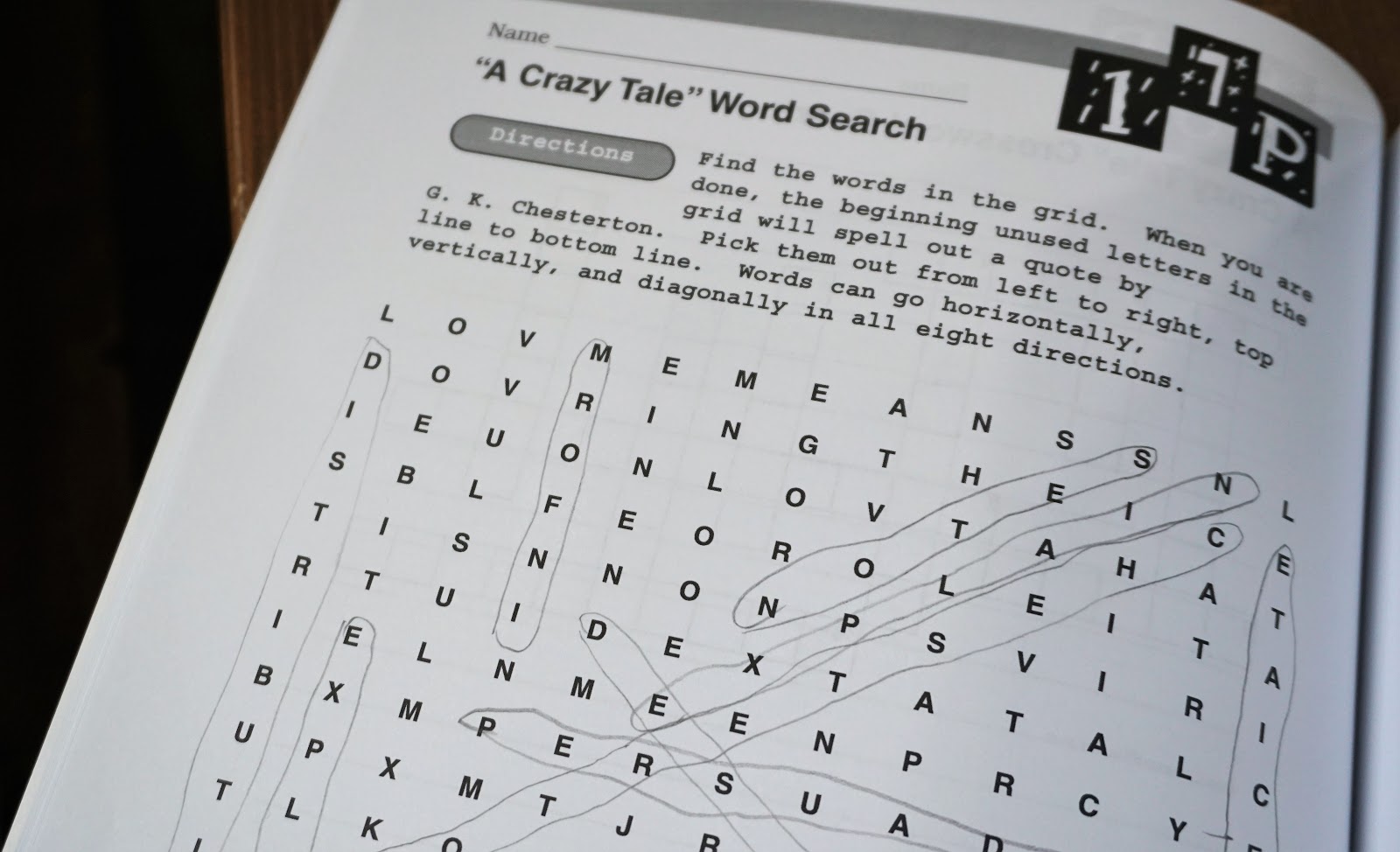
The Workbook is a 277-page, consumable book that complements the Student's Guide. The pages should be completed after the reading has been done but before the writing assignments. There are 7 types of exercises: relating to the literary lessons, relating to the mini-lessons, thinking skills, grammar and mechanics, literary analysis, puzzles, and extra-challenge. There can be more than one type in a chapter or none of one type at all. The first ones are required, but the last two exercises (puzzles and extra-challenge) are optional. The elective exercises include word searches, crossword puzzles, and various language arts topics. The number of exercises varies per chapter, but there is a total of over 100 exercises throughout the course. 


The Teacher's Guide is a must-have addition to the curriculum. Not only does it contain all of the answers to the workbook pages, but has additional teaching helps and valuable tips to aid struggling students.

The format is identical to the Student's Guide, making it simple to follow along. The beginning of the book gives and explanation of the course and its components, explains the importance of both reading and writing, and lists a weekly schedule for the curriculum with check boxes.


In the 6 weeks that my son has been using this curriculum, he has read "A Crazy Tale" from Stories and Poems for Extremely Intelligent Children and Treasure Island. He has learned about an author's purpose in writing, taking notes, setting, and rewriting in his own words. He has practiced capitalization and apostrophes; described sights, sound, touch, smell, and taste for various settings in the house; identified bias, analyzed literature; determined fact or opinion; and more. In the coming weeks, he will learn about free verse and ballad, sharing culture through nonfiction, citing sources, character development, narration, figurative language, sentence structure, and much more.

There is a great variety of exercises throughout the book that include short answer, multiple choice, underlining, and markings along with the longer assignments. It's a good combination that teaches the concepts without making my son feel overwhelmed. I've already seen an improvement in not only his writing abilities but his confidence, as well. I'm excited about the possibilities as we progress through the materials.


I have been thoroughly impressed with the Gr 8 Lightning Lit Set. I appreciate the combination of strong, classical literature with a thorough teaching of composition and writing. I feel confident that Hewitt Homeschooling Resources will benefit my son as he enters his high school years.


You can connect with Hewitt Homeschooling Resources on the following social media sites:
Facebook
Twitter
Pinterest
YouTube
Instagram

My crewmates and I had many options to review including other levels of Lightning Lit, a few My First Reports, and various high school courses. You can read those reviews on the Homeschool Review Crew blog.


Lightning Literature, My First Reports, State History Notebook & Joy of Discovery {Hewitt Homeschooling Resources Reviews}
Crew Disclaimer
Pin It

Friday, April 5, 2019

Fix It! Grammar


When my oldest child told me years ago that Fix It! Grammar was his favorite part of his school day, I knew I found a winning grammar curriculum. I was thrilled to have the opportunity to review it again with another child.

It might surprise people that we don't focus on a great deal on grammar curriculum. After all, I do have an English major, taught high school English classes before my homeschooling days, and truly love the language. However, my kids spend a large portion of their school day reading literature. Doing so, they naturally learn proper sentence structure, writing styles, and enriched language skills. I like to teach parts of speech in a fun, gentle way by incorporating games like Mad Libs into our days. Still, I do believe it is important to have some formal grammatical instruction to supplement their learning. I have tried a few different curricula, but none seem to fit my style of teaching like this Fix It! Grammar book from Institute for Excellence in Writing (IEW).    


IEW is known throughout the homeschooling community for their exceptional writing materials. Their mission is to equip parents with methods and materials to help their students become confident and competent communicators and thinkers. Their teaching style has been proven to be effective for all ages and levels of ability. 

What I personally love about the Fix It! Grammar curriculum is that it is not a traditional program. Instead of learning a rule and then practicing it in a bunch of random sentences, students work through a fairy tale bit by bit. This method of tackling real-life sentences with limited instruction, teaches students to think about their writing and apply the grammar rules to their own work. This method gives the student a better understanding of the material, helps him to retain the knowledge, and gives the assignments a sense of purpose.

Another aspect that makes this curriculum unique is that the student gets to be an editor. As he works through each lesson, he looks for the mistakes and corrects them, along with marking specific notations such as parts of speech, phrases, and clauses. As he progresses through the lessons and learns more grammar rules, the sentences contain more errors. By the end, he will also be able to mark the part of speech for nearly every word in the story.


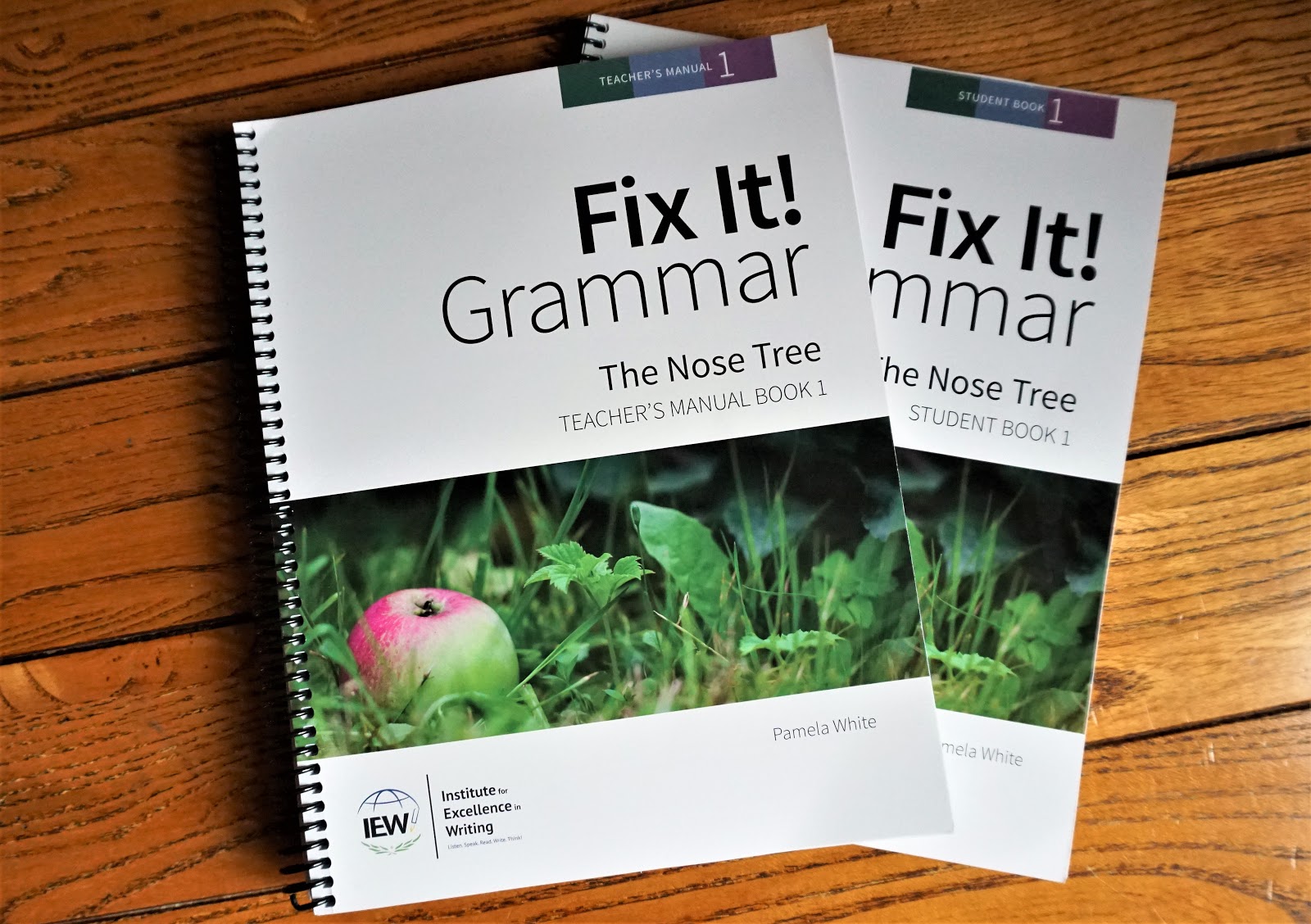
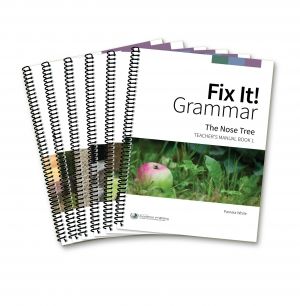
For the curriculum, you will need a copy of The Nose Tree Student Book, a spiral notebook, an envelope or the like to hold the review cards, and the Teacher's Manual. The purchase of the Teacher's Manual includes a downloadable Student Book, but there is also the option to purchase a printed, spiral-bound book, as well.

The set-up for the teacher is simple. Prepare the spiral notebook with the two sections (one in front for the rewrite of the story and one in back for the writing of vocabulary), cut out the appropriate review cards (in the back of the student book) for the week, and teach new concepts at the beginning of each week.

So, how does it work? The student is given one sentence of the story each day. There are multiple things that he does with that one sentence:

  • Look up the bold word in a dictionary and write in the vocabulary section of the notebook which definition best fits the story  
  • Mark and fix the sentence, using the review cards as reminders
  • Rewrite the sentence in the rewrite section of the notebook

New grammar cards are added each week. For instance, week 1 starts with the indent paragraph symbol (¶), nouns (n), homophones and end marks. Week 2 adds articles (ar), week 4 adds quotations, and so on. 

To put it in perspective, here is the sentence for day 1, week 1:

¶ Did you ever hear the story of the three poor soldiers

  1. The first thing the student does is look up the bold word and write it and the best definition in the vocabulary section of his notebook. My daughter wrote down poor: lacking sufficient money.
  2. The second thing is to mark the sentence, using the grammar review cards. She put an (noun) above story and soldiers. She also put a question mark at the end of the sentence.
  3. The final thing is to rewrite the sentence in the rewrite section of the notebook, remembering to indent because of the paragraph symbol. 

As a comparison, here is a sentence from the final week of the book:

the doctor put on the cloak, wished the king and his court farewell, and was with his to/two/too companions directly 

Here, the student needs to start a new paragraph in the rewrite based on there being a new topic in the story instead of following the paragraph symbol, knows to capitalize the first word, can choose the correct homophone, will put an ending period, and should be able to mark the part of speech for every word.

The process should take about 15 minutes a day, 4 days a week for a total of 33 weeks. The course is intended to be a teaching tool, and not graded assignments as the parent should be modeling the editorial process and helping the student as needed.

We are currently halfway through week 5. Of course, the sentences have already gotten a little longer and more complex. Along with nouns, my daughter can also recognize articles, pronouns, and who-which clauses. She has also learned rules about quotation marks. 

The spiral-bound Teacher's Manual makes the material simple to teach even if you personally struggle with all the crazy, irregular rules of the English language. The format is easy-to-read, and the directions are clear. There are also many notes throughout the lessons that include teaching tips, advanced words that haven't been taught yet, and various other concepts. The back of the book contains a scope and sequence and a glossary which includes in-depth descriptions of parts of speech, sentences, clauses, phrases, punctuation. additional rules and concepts, and stylistic techniques. 


The Nose Tree is the first book in the Fix It! Grammar curriculum which is intended for 3rd-12th grades. Because the remaining 5 books in this set require this foundational book, it is reccomended that students start with The Nose Tree, though there is an optional placement test your student can take.

My daughter is in 5th grade. Since this is her first experience with Fix It! Grammar, I started her at the beginning. She find the lessons simple and could probably finish the entire book in a few weeks if I let her. She likes writing her own stories and is a voracious reader. Naturally, she is thoroughly enjoying working through this fairy tale and rewriting it. But her favorite part? The vocabulary. She gets excited every day when she sits with her giant dictionary and searches for her word. Queried, divulged, forlorn, pitiable, pilfered, laden, and stoutly are some of the rich vocabulary that is highlighted. I love hearing her incorporate these new words in her everyday speech. 


When I first told my girl that Fix It! Grammar was coming, she was somewhat disappointed, because she didn't want "extra" work. She was hooked from that very first lesson though. Just like her older brother, she says that the book is fun and is the first subject she completes each day. 

Here's what she told me about the curriculum:

"I like that it has a story that I work through instead of just random words. Oh, and I love the vocab!"


The Fix It! Grammar series from Institute for Excellence in Writing (IEW) is a fantastic grammar curriculum. I have used this first book with 2 of my children successfully and was reminded how much I am impressed with it. In fact, I am planning to continue through the series with my oldest kids and soon start my 9-year-old in The Nose Tree using the downloadable Student Book that came with my Teacher's Manual.   

If you're looking for a curriculum that truly works and is applicable to both grammar skills and writing skills, Fix It! Grammar is highly recommended. 


You can connect with IEW on the following social media sites:


Make sure to head to the Homeschool Review Crew blog to read more reviews of the different books in this curriculum. 


Crew Disclaimer
Pin It

Wednesday, June 27, 2018

Hake Publishing Review


I love language arts. I'm one of those people that laugh at grammar jokes and plays on words. I majored in English in college and taught it at the secondary level. I may or may not silently correct people when they speak grammatically incorrect. Yeah, I'm one of those.

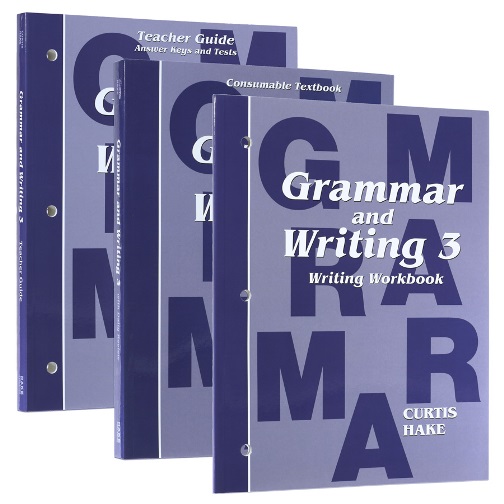
It's funny to see what kids pick up on. (Hey, did you noticed I ended that sentence with a preposition? Just because I love the language and all the finer points of it doesn't mean I speak formally all the time, ha.) Because my kids are around me all day, they have naturally learned many grammar rules without having been officially taught. Also, because the majority of our schooling is based on literature, they learn much about sentence structure and grammar rules simply through reading. However, there are some things that I do believe should be specifically taught, whether it's the hows, whys, whens, or whatnot. That's why I was excited to hear that Hake Publishing recently published their Hake/Saxon Grammar and Writing 3 curriculum. 


Stephen Hake, the founder of Hake Publishing, began writing for Saxon math in 1984 and is the main author for the 3rd-8th grade textbooks. He believes that students will succeed with a language arts program based on Saxon's style of incremental development and continual review. Their curricula currently covers grades 3-8, but has been used successfully to help students even older.

The homeschool version of each level contains 3 parts:

  • Student Textbook
  • Student Writing Workbook
  • Teacher Guide

The student textbook is a consumable, softcover book that include daily lessons, review sets, and tests. There are 111 lessons that cover capitalization, punctuation, parts or speech, sentence structure, spelling rules, correct word usage, and dictionary skills.  The lessons begin with a grammar meeting which is designed "to strengthen listening skills, to model correct word usage, to practice new vocabulary, and to develop effective speaking and writing habits." After that, the new lesson is introduced along with practice exercises. Finally, the student completes the review set of exercises on his own, receiving help as needed.


The writing workbook contains 21 writing lessons that are to be assigned on test days. The workbook's purpose is to help the student develop good writing by practicing recording his thoughts and ideas on paper. It enhances skills such as brainstorming, active and passive voice, topic sentences, facts and opinions, persuasive writing, and more. 

The teacher guide is a scripted manual for leading the lessons. It includes the grammar meeting question along with the daily vocabulary words. As far as the actual lesson and exercises, it simply states to read it together and work through the examples and practice sections. The actual exercises are not included, so the teacher needs to be looking at a student textbook for those. This book also contains the answer key for the textbook and the writing book along with the masters for the tests and extra practice worksheets and the accompanying answer keys.


My 10-year-old daughter is the one who has been working through this book. Even though she is in 4th grade, I thought this would be a good option for her since this is her first formal introduction to learning grammar and because Saxon (which this is modeled after) is known to have a higher level of teaching. I was pleased to see how well she's doing with this. Many weeks into the curriculum, she still hasn't struggled with any of it. The lessons take maybe 10 minutes to work through.

One thing that is somewhat impractical is the grammar meeting sections. Since the narrative is written for a classroom setting, it is a bit awkward to read as is. As homeschoolers, we are used to adapting curricula to meet our needs, but I would think that something that is marketed as a homeschool version would already be adapted. Also, since the teacher guide does not include the actual exercises, it is not beneficial other than the masters and answer keys, in my opinion.


The curriculum itself is working well in our home. The lessons include review along with new concepts, and they are not too long. I love the addition of the vocabulary and Latin root words as they are vital in understanding definitions and etymology. 

If your child benefits from the teaching style of Saxon math books, he might thrive with the depth and complexity of the Hake/Saxon Grammar and Writing 3 curriculum.


You can read more reviews of this curriculum on the Homeschool Review Crew blog.


Crew Disclaimer
Pin It

Wednesday, August 2, 2017

English on a Roll


I am always happy to review new products that might excited my little ones. I'm a huge believer in making learning fun, especially in the younger years, so we incorporate hands-on learning all the time. I know many people don't enjoy learning the nitpicky rules of the English language, but I've always loved it and chose Secondary English as my college major. Though I ended up teaching only one year of high school English classes before coming home full-time, I now have the privilege of passing on the love of the  language to my own kids. But how can learning (or even teaching) grammar be fun for those who don't naturally enjoy it? The English Grammar Teaching Method from English on a Roll is designed to meet that need.


English on a Roll was created by Linda Hopkins Koran in 2001, when she was teaching an ESL (English as a Second Language) class. None of the 25 students spoke English, and most of them were illiterate. After searching for something to help her communicate with the students and finding nothing that worked, she began to develop a program that quickly helped them build sentences in English. English on a Roll has been helping students ever since.   

"Languages are like intricate puzzles, each with unique rules and structure. Once the basic fundamentals of a language are understood, communicating becomes much simpler and more successful.” ~ Linda Hopkins Koran

The English Grammar Teaching Method is a multisensory program that uses color-coded cubes to teach English grammar. By combining visual, auditory, and kinesthetic learning styles, the program becomes a full approach that reduces errors and aids in the understanding of the language. Students learn syntax by manipulating the 40 cubes to create sentences and phrases. Because each cube contains only one type of word, students are able to find the correct choice more easily and learn parts of speech by association. The cubes (along with two blank ones) are divided into the following types and coordinating colors:

  • Pronouns: blue
  • Question Words: green
  • Nouns: dark blue
  • Articles: dark blue
  • Prepositions: dark blue
  • Verbs: red
  • Adverbs: orange
  • Adjectives: purple
  • Conjunctions: black
  • Punctuation: black    


Each cube has one word on a side and contains a "cluster" of similar words. For example, The subject pronouns cube has I, you, he/she, it, we, and they. The common preposition cube has at, for, to, from, with, and of. The cube for all forms of have lists have, has, had, having, and to have. Familiarizing yourself with the cubes and colors will make both teaching and learning easier.

A detailed teaching textbook is included with the cubes. Very little preparation is needed on the part of the teacher, because everything is laid out in the text. Each lesson follows the same format:
  • Prep: shows the needed cubes, pages to copy, and materials
  • Notes & Vocabulary: teaching tips and new vocab
  • Teach the Concepts: detailed teaching instruction using the cubes and handouts
  • Games/Conversations: games to review the new concepts
  • Written Exercises: reproducible exercises for more practice
 
 
English on a Roll was written with the classroom setting in mind, but it can easily be adapted to be used one-on-one. I had gotten this set to work with my kindergartner. Since I read that this could be used as young as 5-years-old and those learning to read, I assumed there were letter cubes along with the words cubes. The website clearly states that the curriculum is for grammar, so the misunderstanding is solely my own. The lessons start simply by teaching the pronouns and singular/plural. There is a reproducible with stick figure examples that can be copied if using with multiple students, but we just used it directly in the book. Lesson two has the addition of the Be verbs. The student learns which combinations can be made, such as I am, you are, he is, they are, ect.. The 37 lessons continue in this fashion. Each cube that is added opens up multiple new combinations and teaches new concepts.

Since my boy is a learning reader, we've been taking it slow. I think it's important to have a solid foundation of phonics before introducing too many sight words. I work through the lessons with him, giving him as much help and direction as he needs. He loves playing with the cubes and finding the words he wants to make the appropriate combinations. Even though I personally think this curriculum would be better suited to an English-speaking student who can already read, this truly is written in a way that can gently be used even with non-readers. Of course, it also works well with those who are learning English as a second language.


English on a Roll is a great hands-on product that teaches English grammar in a fun game-like way. If you'd like more detailed information of the curriculum, you can request free sample chapters and watch a demo of an actual lesson.


You can connect with English on a Roll on their Facebook page and website


You can read more reviews of this product on the Homeschool Review Crew blog.

Crew Disclaimer
Pin It

Wednesday, August 24, 2016

Jolly Literacy Review

As a mom, I get to teach my kids all sorts of things. One of my favorite things though is teaching my little ones to read. It was exciting when I taught first grade years ago in a private school and I got to help those students learn to read; how much more exciting it is now being able to help my own children. Hearing them sound out the letters, watching as they recognize the word, seeing their faces light up as they realize they are reading--I love it all!

Not everyone is as enthusiastic as I am about the reading process though. That's why it's important to find a phonics program that works for you. I didn't use any curricula to teach my first 3 kids, but instead used my own methods. My number 4 is now 4-years-old and is ready to begin learning. Since we had the opportunity to review Jolly Phonics and Jolly Grammar from jollyliteracy.com and just2ducks LLC, I thought it would be interesting to teach him from the beginning with this curriculum.


The Jolly curriculum is meant to be just that--jolly. Happy, cheerful, fun. It was designed with young children in mind and uses a multi-sensory approach. The set includes the following materials:
  • Jolly Phonics Teacher's Book in print letters
  • Jolly Phonics Student Book 1, 2, and 3
  • Jolly Grammar 1 Teacher's Book in print letters
  • Jolly Grammar 1 Student Book
  • Jolly Songs in print letters


The Phonics Teacher's Book is an all-in-one guide book for the three student phonics books. It's filled with tips, how-tos, and the daily lesson plans. Each day's tasks are marked by bullet points with a brief explanation. A word-for-word script is not given, allowing for plenty of flexibility and encouraging your own personality to lead. The book is divided in four sections (comprehensive introduction & explanation of teaching method and lesson guides for students books 1, 2, and 3). Each section is conveniently color-coded on the edges, making it simple to find what you need. 

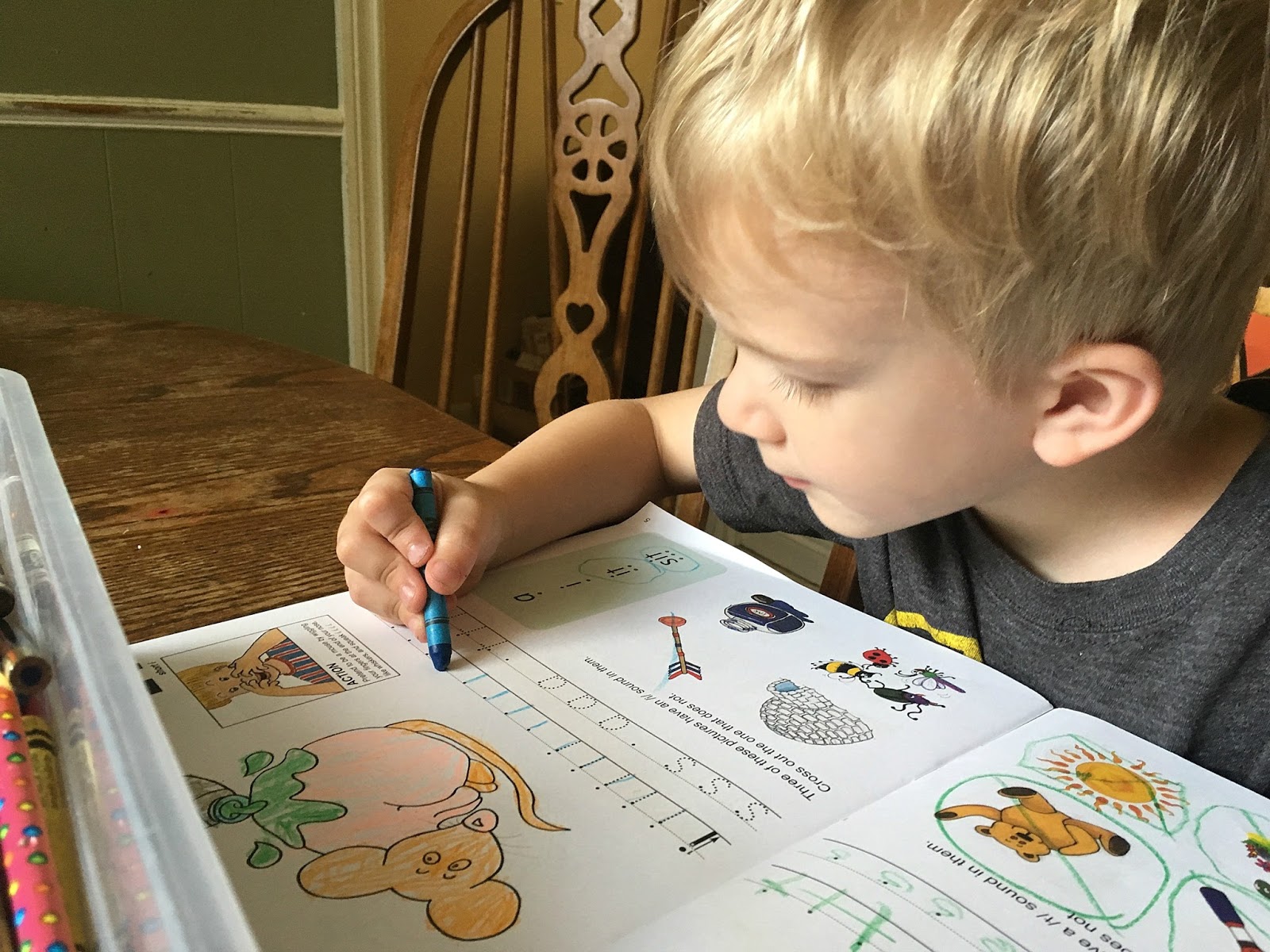
The Phonics Student Books are the individual workbooks for the student. Book 1 focuses on teaching the main 42 sounds of the English language. They learn to recognize, write, and read. Book 2 provides the student with numerous opportunities to practice reading and writing the sounds they just learned. It also introduces common alternative spellings for sounds, explains capital letters, and teaches some tricky words. Book 3 builds upon the reading and writing skills taught in the first two books. The students gain a greater understanding of alternative letter-sound spellings, teaches more tricky words, and encourages writing independence. All the books are filled with pictures, colors, and many activities to keep the student's interest.


The Grammar Teacher's Book is divided into two parts: introduction to the curriculum & explanation of teaching method and a thorough, structured lesson plan for the course. The curriculum builds on and reinforces the skills taught in the phonics books. It is designed to introduce grammar, teach spelling, improve vocabulary and comprehension skills, and extend phonic knowledge. The format of the lesson plans is the same as in the phonic teacher's book.

The Grammar Student Book is an 80-page student workbook. The pages are thick, colorful, and bursting with grammar activities. It carries over the action exercises from the phonics books and encourages fun with learning. There are pages for coloring, tracing, matching, drawing, dictionary use, dictation, and more.

The Songs Book has 40 original songs that teach the most common sounds in the English language. Each song is set to a familiar children's tune, like Twinkle, Twinkle, Little Star; The Farmer in the Dell;Old MacDonald, and Skip to My Lou. Motions are given to help the child remember the words and make it fun. A CD is also included. 


Since my little guy is just starting out, the very beginning of the lessons was the perfect place for him. The lessons are short, which works out well with his short attention span. Each lesson teaches a new sound through a short story, letter formation, recognition of sound through pictures, and sound practice. By the third lesson, the student is forming his first word. My son knows his letters and sounds, but since this book isn't solely about teaching only the 26 letters of the alphabet, he's already learning about "special sounds" like or, th, oo, and sh.

Although he does know the basic sounds of letters, I hadn't worked on blending those sounds to make words before this point. When we got to lesson 3, he had to combine the sounds he had learned. I was shocked when he simply read at and sat! Allowing simple reading in the beginning of the book was encouraging to both him and me. From then on, he has begged daily to do his books.


We're only about halfway through book 1, but this has been working very well for us. He enjoys the lessons, likes the stories, and has fun acting out the songs. I appreciate the short lessons and the quality of the materials. I am excited about the later books as they really branch out in terms of variety. I think the materials from jollyliteracy.com is helping me add another strong reader to our family.  


You can connect with jollyliteracy.com on the following social media sites:
Facebook
Twitter
Pinterest


You can read more reviews of jollyliteracy.com on the Schoolhouse Review Crew blog.
Crew Disclaimer
Pin It

Friday, April 22, 2016

Writers in Residence Review


I enjoyed writing stories as a child. I grew up and took writing classes for my English major in college. Now, I write for our blog. My husband wrote stories, too, and continued even as he got older. I have multiple poems he's written me over the years, as well. {swoon} Our daughter writes stories often and has her own notebook specifically for them. Our oldest son though? Hates writing. When we talk about his writing assignments, I always get the typical response, "Why do I need to learn this?" He think because he doesn't want to become an author that he shouldn't need to hone his writing skills. I've tried to show him how practical it is to put your thoughts into written word, whether he wants to write a sermon, fill out a resumé, send a letter, go to college, get certain jobs, along with other examples. I couldn't seem to get through to him, so I was hoping maybe Writers in Residence from Apologia Educational Ministries would help.     

Apologia Educational Ministries is well-known in the homeschool realm for their science curricula and other biblical worldview products. This Christian company believes "that every educational subject in your home school can and should be taught from a biblical worldview built on the solid foundation of God’s Word and centered on Jesus Christ." It's always best to use products that reinforce your beliefs. We have loved everything we've gotten from Apologia in the past, so I was looking forward to this product, as well.
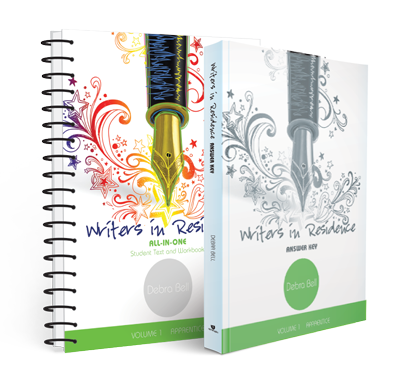
Writers in Residence is a new language arts curriculum created by Debra Bell. This all-in-one student text and workbook will guide your students through the entire writing process. Along with learning how to create engaging stories and essays, they'll learn sentence structure, the parts of speech, punctuation, capitalization, and grammar. Instead of focusing solely on the four traditional forms of writing (personal, expository, persuasive, and narrative), this curriculum teaches the student how to combine several forms of writing as it is more practical.

There are four types of writing projects throughout the course:
  • I Remember -- Students write about experiences they had.
  • I Imagine -- Students write high-interest, creative writing assignments in the form of fiction.
  • I Investigate -- Students use research skills to write a form of investigative journalism.
  • I Think -- Students write persuasive essays  and defend them with logical reasoning, facts, and examples.      

The program is divided into six units with multiple modules each. 

Unit 1: When I Was Young -- Writers use their memories as a source of ideas.
Unit 2: Very Truly Yours -- Writers use their imaginations.
Unit 3: My Family Hall of Fame -- Writes should write what they know.
Unit 4: My Favorite Author -- Learning to think deeply.
Unit 5: The History of Me -- Learning to dig into your past.
Unit 6: Zap! Pow! Kazam! --Learning to create great characters.
The Writers in Residence curriculum is intended for 4th grade and older, but is flexible enough to be used with multiple ages at a time. A sample schedule is given at the beginning of the book. This tool makes it very easy for my son to know what assignments need to be completed each day and helps him to not get overwhelmed by the size of the very large book.
Speaking of large, this book is packed full of not just assignments and directions, but all sorts of little tips and snippets of information. The book is engaging and colorful. It grabs your attention with its format and isn't a typical "boring" textbook.


An Answer Key book is also included with the all-in-one student book. This key contains all the answers for the student activities in which there are specific answers, like the punctuation and capitalization exercises, answers to reading assignments, definitions, and more. The answers are shown in green type on pages that look identical to the student's book.

Both books are easy to use. My son is being challenged by the assignments, but not to the point of frustration. We had a few very rough days in the beginning, but because the lessons build on previously taught concepts and skills, he is becoming more confident in his writing. I still cannot say that he enjoys writing, but he is starting to accept that it's a necessary skill to know. In fact, the other day he told me that he read that he needed to learn to write properly so he could make quality scripts for his stop motion videos. Hey, it's a start! Whatever it takes to grab his attention in learning this skill works for me.  


I am pleased with the content of Writers in Residence. It's thorough and systematic and is written in a way that my 10-year-old can understand. The assignments are interesting and not overwhelming. I have seen improvements in both my son's writing and his confidence. While he may never completely enjoy the writing process, I do believe this book is making a difference in helping him to accept it.


You can connect with Apologia Educational Ministries on the following social media sites:
Facebook
Twitter
Pinterest
Instagram

If you'd like to see how other homeschool families used this program, please read the reviews on the Schoolhouse Review Crew blog.
Crew Disclaimer
Pin It

Tuesday, September 30, 2014

Fix It!


I know, I say it every time I talk about any English-type of curriculum, but it's true: I love grammar. I love parts of speech and punctuation, diagramming sentences and listing homonyms. I admit to correcting others in my head when they make mistakes (and, yes, I even mentally correct my own writing for the blog, ha). I always laugh at grammar jokes and am so proud when my children speak properly. So, naturally, you'd assume that I started formally teaching my little ones grammar at very young ages, right? Wrong. I've said before that our main curriculum focuses mainly on reading for learning. We don't have separate classes for English, science, and history, but instead, learn about these subjects through the books we read. Of course, the kids hear me speak proper grammar (mostly) and mimic what they hear. We also practice language arts with fun games, like mad libs.

When I heard that Institute for Excellence in Writing (IEW) was offering us one of their grammar products to review, I was tempted get an advanced level for myself--for fun! But, alas, I knew that it would be better for my 8-year-old to start systematically learning grammar. We received Fix It! Grammar: The Nose Tree (book 1) both the student book and the teacher's manual.      

To a grammar nerd, like myself, this book is a lot of fun. The purpose is for the student to look for the mistakes in the lessons and fix them. It's like being an editor of a book! What I really appreciate about this book is that it teaches the concepts through a real story and not random sentences. Seeing how it all works together gives the student a better understanding of the material, helps him to retain the knowledge, and gives the assignments a sense of purpose. 

The student will need the Nose Tree book, a notebook with two sections (rewrite and vocabulary), and an envelope to hold the review cards. The set-up for the teacher is simple. Prepare the notebook with the two sections, cut out the appropriate review cards (in the back of the student book) for the week, and teach new concepts at the beginning of each week.

So, how does it work? The student is given one sentence of the story each day. There are multiple things that he does with that one sentence:

  • Look up the bold word in a dictionary and write in the vocabulary section of the notebook which definition best fits the story  
  • Mark and fix the sentence, using the review cards as reminders
  • Rewrite the sentence in the rewrite section of the notebook

New grammar cards are added each week. For instance, week 1 starts with the indent paragraph symbol (¶), nouns (n), homophones and end marks. Week 2 adds articles (ar), week 4 adds quotations, and so on. 

To put it in perspective, here is the sentence for day 1, week 1:

¶ Did you ever hear the story of the three poor soldiers


  1. The first thing the student does is look up the bold word and write it and the best definition in the vocabulary section of his notebook. Jake wrote down poor: lacking sufficient money.
  2. The second thing is to mark the sentence, using the grammar review cards. He put an n (noun) above story and soldiers. He also put a question mark at the end of the sentence.
  3. The final thing is to rewrite the sentence in the rewrite section of the notebook, remembering to indent because of the paragraph symbol. 
 

We are currently 5 weeks into the book. The sentences are longer and more complicated and there are more things to mark and fix. Of course, the rest of the book continues in this fashion. By the end of the 33 weeks, the student will be finding pronouns, clauses, coordinating conjunctions, and more. He will also be familiar with words such as elegant, divulged, immense, laden, forlorn, as well as many others.

The teacher's manual is full of information and contains everything you need to teach this to your child, even if you don't hold a grammar degree. I, personally, did not reference it often. There were times when it came in handy though, like when I wanted Jake to mark certain words as nouns. The book refers to them as advanced words, meaning words can look like one part of speech but be acting as another. Obviously, my 8-year-old hasn't learned these concepts yet. It was helpful to be reminded of that.

 
The Nose Tree book has been working very well in our house. As of now, the lessons are taking Jake only about 10 minutes to complete (that is, as long as he doesn't get distracted looking up other definitions, too, haha). When I first mentioned to him that the curriculum was coming, he said, "What? I don't need help with English. I snuck a peek! {hysterical laughter} I did that on purpose!" Yes, even my child thinks grammar jokes are humorous. (In case you missed it, snuck is not a word. Sneaked is the correct form.) Since working through the book though, he has told me that this is fun and his favorite part of school. That's my boy!

Fix It! Grammar: The Nose Tree student book (3rd grade+)  costs $15 and the teacher's manual is $19. Even though I have not used the teacher's manual daily, it is very important to have and I would recommend purchasing them together. Both books are spiral-bound. 

The Fix It! Grammar series has a total of 6 books. If you're not sure which to order, there is a placement test on the IEW site


Are you interested in how other families used this book or another one of the books in the series? You can head to the Schoolhouse Review Crew blog to read more reviews.

Crew Disclaimer
Pin It