Showing posts with label language arts. Show all posts

Friday, February 22, 2019

IXL Learning


Our family benefited from IXL Learning years ago, so I was pleased to receive a full annual membership to all IXL subjects to review again. Our experience had been with the math and language arts materials, but the company has expanded. They have since added science, social studies, and Spanish courses, as well. 

IXL Learning is an online educational website. They strive to create the best educational resources possible and are passionate about using technology for teaching and learning alike. Their products are used by millions of students to practice skills and advance their education. Since its release in 2007, IXL has become the most popular subscription-based learning site for pre-k to high school. With over 7,000 skills, there is something for everyone.


I was able to set up accounts for my kids ages 10, 9, 6, and 4. The process and quick and easy. Each child got to pick an icon to add to their profile, which is always an exciting feature. From there, each student can take a diagnostic test to determine mastered skills or can immediately start practicing.

One aspect of this program that I appreciate is that a student is not locked into a specific grade level, but instead can access all of the content on the site. For instance, two of my boys are proficient at math. I have moved them up for that subject, but kept them at grade level for others. It's easy to adapt the lessons for each student.

Since we're using the site as a supplement to our other materials, I let the kids choose which areas they would like to work. My 10-year-old is already learning Latin, so I was surprised when she immediately was drawn to the Spanish section. She has had very little Spanish instruction and there are no teaching lessons included with this site, yet that hasn't discouraged her from working through this category. After a student answers a question, the site either congratulates him for answering it correctly or explains why it was incorrect. This is what she has been using for instruction. She has been working through a section, looking at the answers, and learning from that. I admit, it's not the most productive way to learn, but she has done all this on her own. I am all for independent learning and am pleased with her drive and excitement.


My 9-year-old loves math and science, so that is where his focus has been. I have him working in two different grades for the subjects, but the site keeps track of that for him. All he has to do is click on the subject and it pulls up where he left off. The skills can be completed in any order. Since learning about animals is his passion, he began in that section. A student can hover over a link to get a glimpse of the skills with preview questions which is helpful when he wants to pick and choose instead of working in order.


I am choosing the daily skills for my 6-year-old. He is very much like his older brother and interested in math and science. Science and social studies are available for grades 2-8, whereas math and language arts cover grades pre-k-high school, I decided to try him at the higher level for science (along with the math I have already explained) since there is no first grade option. After a few skills in language arts, I determined that he needed to move up in that, too. Currently, he is working a grade level higher in all subjects. I like that I can easily alter the questions to meet our needs.

My 4-year-old cannot navigate the site on his own. He does know to click on the blue speaker icon to hear the question read aloud and how to choose his answer. Sometimes though, the submit button is not visible on the screen and the page needs to be scrolled down a little. I have found it easiest and the least frustrating for him if someone sits and works with him, reading the questions, clicking on his answers, and submitting his choice. It's not ideal, but it works.


I can track my kids' progress on the site in my parent profile. The site shows me scores, trouble spots, minutes practiced, questions answered, skills reviewed, and more. In addition to this data, I also receive emails with various achievements, such as hours practiced, skills mastered, and questions answered. There is a link to a PDF that allows me to print a personalized certificate each time.

Those achievements along with many others also are listed in the child's profile. My kids love checking their awards as each time they earn one, they get to unlock a surprise. The awards vary within each subject and grade. They collect things like balloon animals, badges, books, key chains, stuffed animals, nesting dolls, and other virtual prizes.


IXL uses a SmartScore system to measure a students progress toward mastery, instead of focusing on percentage grades. In other words, if he gets an answer correct, he earns a number of points; if he gets one wrong, he loses points. This scoring method encourages a student to keep working until he reaches excellence, though he can end a lesson at any time.

My children are doing well with this learning site. They are challenged with the material and motivated by the awards. I love that they can use the site on their own and that I can customize it to fit individual needs of my kids.

If you're looking for a way to boost your child's academic potential, IXL Learning is a good choice.


You can connect with IXL Learning on the following social media sites:


Be sure to head to the Homeschool Review Crew blog to read more reviews of this website from other homeschool families.


Crew Disclaimer
Pin It

Wednesday, June 27, 2018

Hake Publishing Review


I love language arts. I'm one of those people that laugh at grammar jokes and plays on words. I majored in English in college and taught it at the secondary level. I may or may not silently correct people when they speak grammatically incorrect. Yeah, I'm one of those.

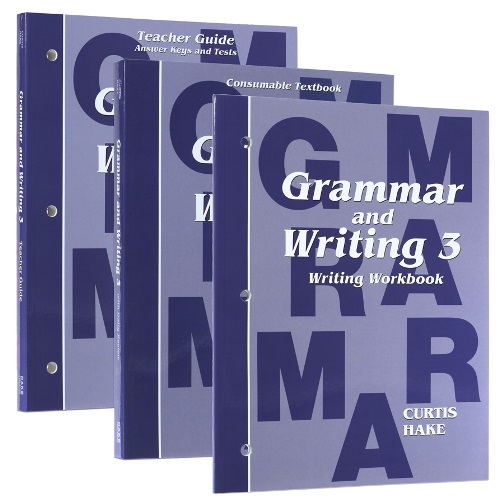
It's funny to see what kids pick up on. (Hey, did you noticed I ended that sentence with a preposition? Just because I love the language and all the finer points of it doesn't mean I speak formally all the time, ha.) Because my kids are around me all day, they have naturally learned many grammar rules without having been officially taught. Also, because the majority of our schooling is based on literature, they learn much about sentence structure and grammar rules simply through reading. However, there are some things that I do believe should be specifically taught, whether it's the hows, whys, whens, or whatnot. That's why I was excited to hear that Hake Publishing recently published their Hake/Saxon Grammar and Writing 3 curriculum. 


Stephen Hake, the founder of Hake Publishing, began writing for Saxon math in 1984 and is the main author for the 3rd-8th grade textbooks. He believes that students will succeed with a language arts program based on Saxon's style of incremental development and continual review. Their curricula currently covers grades 3-8, but has been used successfully to help students even older.

The homeschool version of each level contains 3 parts:

  • Student Textbook
  • Student Writing Workbook
  • Teacher Guide

The student textbook is a consumable, softcover book that include daily lessons, review sets, and tests. There are 111 lessons that cover capitalization, punctuation, parts or speech, sentence structure, spelling rules, correct word usage, and dictionary skills.  The lessons begin with a grammar meeting which is designed "to strengthen listening skills, to model correct word usage, to practice new vocabulary, and to develop effective speaking and writing habits." After that, the new lesson is introduced along with practice exercises. Finally, the student completes the review set of exercises on his own, receiving help as needed.


The writing workbook contains 21 writing lessons that are to be assigned on test days. The workbook's purpose is to help the student develop good writing by practicing recording his thoughts and ideas on paper. It enhances skills such as brainstorming, active and passive voice, topic sentences, facts and opinions, persuasive writing, and more. 

The teacher guide is a scripted manual for leading the lessons. It includes the grammar meeting question along with the daily vocabulary words. As far as the actual lesson and exercises, it simply states to read it together and work through the examples and practice sections. The actual exercises are not included, so the teacher needs to be looking at a student textbook for those. This book also contains the answer key for the textbook and the writing book along with the masters for the tests and extra practice worksheets and the accompanying answer keys.


My 10-year-old daughter is the one who has been working through this book. Even though she is in 4th grade, I thought this would be a good option for her since this is her first formal introduction to learning grammar and because Saxon (which this is modeled after) is known to have a higher level of teaching. I was pleased to see how well she's doing with this. Many weeks into the curriculum, she still hasn't struggled with any of it. The lessons take maybe 10 minutes to work through.

One thing that is somewhat impractical is the grammar meeting sections. Since the narrative is written for a classroom setting, it is a bit awkward to read as is. As homeschoolers, we are used to adapting curricula to meet our needs, but I would think that something that is marketed as a homeschool version would already be adapted. Also, since the teacher guide does not include the actual exercises, it is not beneficial other than the masters and answer keys, in my opinion.


The curriculum itself is working well in our home. The lessons include review along with new concepts, and they are not too long. I love the addition of the vocabulary and Latin root words as they are vital in understanding definitions and etymology. 

If your child benefits from the teaching style of Saxon math books, he might thrive with the depth and complexity of the Hake/Saxon Grammar and Writing 3 curriculum.


You can read more reviews of this curriculum on the Homeschool Review Crew blog.


Crew Disclaimer
Pin It

Friday, April 22, 2016

Writers in Residence Review


I enjoyed writing stories as a child. I grew up and took writing classes for my English major in college. Now, I write for our blog. My husband wrote stories, too, and continued even as he got older. I have multiple poems he's written me over the years, as well. {swoon} Our daughter writes stories often and has her own notebook specifically for them. Our oldest son though? Hates writing. When we talk about his writing assignments, I always get the typical response, "Why do I need to learn this?" He think because he doesn't want to become an author that he shouldn't need to hone his writing skills. I've tried to show him how practical it is to put your thoughts into written word, whether he wants to write a sermon, fill out a resumé, send a letter, go to college, get certain jobs, along with other examples. I couldn't seem to get through to him, so I was hoping maybe Writers in Residence from Apologia Educational Ministries would help.     

Apologia Educational Ministries is well-known in the homeschool realm for their science curricula and other biblical worldview products. This Christian company believes "that every educational subject in your home school can and should be taught from a biblical worldview built on the solid foundation of God’s Word and centered on Jesus Christ." It's always best to use products that reinforce your beliefs. We have loved everything we've gotten from Apologia in the past, so I was looking forward to this product, as well.
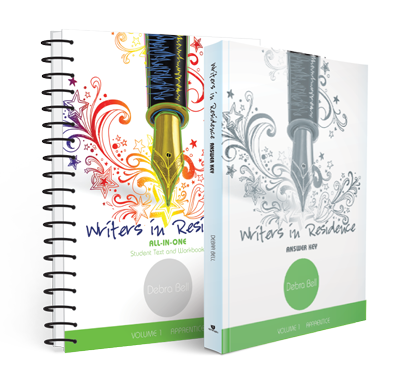
Writers in Residence is a new language arts curriculum created by Debra Bell. This all-in-one student text and workbook will guide your students through the entire writing process. Along with learning how to create engaging stories and essays, they'll learn sentence structure, the parts of speech, punctuation, capitalization, and grammar. Instead of focusing solely on the four traditional forms of writing (personal, expository, persuasive, and narrative), this curriculum teaches the student how to combine several forms of writing as it is more practical.

There are four types of writing projects throughout the course:
  • I Remember -- Students write about experiences they had.
  • I Imagine -- Students write high-interest, creative writing assignments in the form of fiction.
  • I Investigate -- Students use research skills to write a form of investigative journalism.
  • I Think -- Students write persuasive essays  and defend them with logical reasoning, facts, and examples.      

The program is divided into six units with multiple modules each. 

Unit 1: When I Was Young -- Writers use their memories as a source of ideas.
Unit 2: Very Truly Yours -- Writers use their imaginations.
Unit 3: My Family Hall of Fame -- Writes should write what they know.
Unit 4: My Favorite Author -- Learning to think deeply.
Unit 5: The History of Me -- Learning to dig into your past.
Unit 6: Zap! Pow! Kazam! --Learning to create great characters.
The Writers in Residence curriculum is intended for 4th grade and older, but is flexible enough to be used with multiple ages at a time. A sample schedule is given at the beginning of the book. This tool makes it very easy for my son to know what assignments need to be completed each day and helps him to not get overwhelmed by the size of the very large book.
Speaking of large, this book is packed full of not just assignments and directions, but all sorts of little tips and snippets of information. The book is engaging and colorful. It grabs your attention with its format and isn't a typical "boring" textbook.


An Answer Key book is also included with the all-in-one student book. This key contains all the answers for the student activities in which there are specific answers, like the punctuation and capitalization exercises, answers to reading assignments, definitions, and more. The answers are shown in green type on pages that look identical to the student's book.

Both books are easy to use. My son is being challenged by the assignments, but not to the point of frustration. We had a few very rough days in the beginning, but because the lessons build on previously taught concepts and skills, he is becoming more confident in his writing. I still cannot say that he enjoys writing, but he is starting to accept that it's a necessary skill to know. In fact, the other day he told me that he read that he needed to learn to write properly so he could make quality scripts for his stop motion videos. Hey, it's a start! Whatever it takes to grab his attention in learning this skill works for me.  


I am pleased with the content of Writers in Residence. It's thorough and systematic and is written in a way that my 10-year-old can understand. The assignments are interesting and not overwhelming. I have seen improvements in both my son's writing and his confidence. While he may never completely enjoy the writing process, I do believe this book is making a difference in helping him to accept it.


You can connect with Apologia Educational Ministries on the following social media sites:
Facebook
Twitter
Pinterest
Instagram

If you'd like to see how other homeschool families used this program, please read the reviews on the Schoolhouse Review Crew blog.

Crew Disclaimer
Pin It

Tuesday, September 30, 2014

Fix It!


I know, I say it every time I talk about any English-type of curriculum, but it's true: I love grammar. I love parts of speech and punctuation, diagramming sentences and listing homonyms. I admit to correcting others in my head when they make mistakes (and, yes, I even mentally correct my own writing for the blog, ha). I always laugh at grammar jokes and am so proud when my children speak properly. So, naturally, you'd assume that I started formally teaching my little ones grammar at very young ages, right? Wrong. I've said before that our main curriculum focuses mainly on reading for learning. We don't have separate classes for English, science, and history, but instead, learn about these subjects through the books we read. Of course, the kids hear me speak proper grammar (mostly) and mimic what they hear. We also practice language arts with fun games, like mad libs.

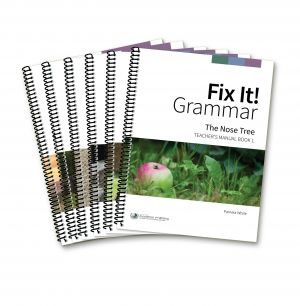
When I heard that Institute for Excellence in Writing (IEW) was offering us one of their grammar products to review, I was tempted get an advanced level for myself--for fun! But, alas, I knew that it would be better for my 8-year-old to start systematically learning grammar. We received Fix It! Grammar: The Nose Tree (book 1) both the student book and the teacher's manual.      

To a grammar nerd, like myself, this book is a lot of fun. The purpose is for the student to look for the mistakes in the lessons and fix them. It's like being an editor of a book! What I really appreciate about this book is that it teaches the concepts through a real story and not random sentences. Seeing how it all works together gives the student a better understanding of the material, helps him to retain the knowledge, and gives the assignments a sense of purpose. 

The student will need the Nose Tree book, a notebook with two sections (rewrite and vocabulary), and an envelope to hold the review cards. The set-up for the teacher is simple. Prepare the notebook with the two sections, cut out the appropriate review cards (in the back of the student book) for the week, and teach new concepts at the beginning of each week.

So, how does it work? The student is given one sentence of the story each day. There are multiple things that he does with that one sentence:

  • Look up the bold word in a dictionary and write in the vocabulary section of the notebook which definition best fits the story  
  • Mark and fix the sentence, using the review cards as reminders
  • Rewrite the sentence in the rewrite section of the notebook

New grammar cards are added each week. For instance, week 1 starts with the indent paragraph symbol (¶), nouns (n), homophones and end marks. Week 2 adds articles (ar), week 4 adds quotations, and so on. 

To put it in perspective, here is the sentence for day 1, week 1:

¶ Did you ever hear the story of the three poor soldiers


  1. The first thing the student does is look up the bold word and write it and the best definition in the vocabulary section of his notebook. Jake wrote down poor: lacking sufficient money.
  2. The second thing is to mark the sentence, using the grammar review cards. He put an n (noun) above story and soldiers. He also put a question mark at the end of the sentence.
  3. The final thing is to rewrite the sentence in the rewrite section of the notebook, remembering to indent because of the paragraph symbol. 
 

We are currently 5 weeks into the book. The sentences are longer and more complicated and there are more things to mark and fix. Of course, the rest of the book continues in this fashion. By the end of the 33 weeks, the student will be finding pronouns, clauses, coordinating conjunctions, and more. He will also be familiar with words such as elegant, divulged, immense, laden, forlorn, as well as many others.

The teacher's manual is full of information and contains everything you need to teach this to your child, even if you don't hold a grammar degree. I, personally, did not reference it often. There were times when it came in handy though, like when I wanted Jake to mark certain words as nouns. The book refers to them as advanced words, meaning words can look like one part of speech but be acting as another. Obviously, my 8-year-old hasn't learned these concepts yet. It was helpful to be reminded of that.

 
The Nose Tree book has been working very well in our house. As of now, the lessons are taking Jake only about 10 minutes to complete (that is, as long as he doesn't get distracted looking up other definitions, too, haha). When I first mentioned to him that the curriculum was coming, he said, "What? I don't need help with English. I snuck a peek! {hysterical laughter} I did that on purpose!" Yes, even my child thinks grammar jokes are humorous. (In case you missed it, snuck is not a word. Sneaked is the correct form.) Since working through the book though, he has told me that this is fun and his favorite part of school. That's my boy!

Fix It! Grammar: The Nose Tree student book (3rd grade+)  costs $15 and the teacher's manual is $19. Even though I have not used the teacher's manual daily, it is very important to have and I would recommend purchasing them together. Both books are spiral-bound. 

The Fix It! Grammar series has a total of 6 books. If you're not sure which to order, there is a placement test on the IEW site. 


Are you interested in how other families used this book or another one of the books in the series? You can head to the Schoolhouse Review Crew blog to read more reviews.

Crew Disclaimer
Pin It