Showing posts with label vocabulary. Show all posts

Tuesday, June 16, 2015

Dynamic Literacy Review


I have fond memories of learning morphemes with my dad. We'd sit around the table making up our own words by combining prefixes, suffixes, and roots. One of us would say a "word" and the other would figure out the definition by breaking down the morphemes (the smallest part with meaning of a word). It was practical teaching. Throughout the years, he taught me that I could have a basic understanding of almost any word (and could even understand many foreign words), as long as I had a grasp of the individual parts. So, imagine my excitement when I had the opportunity to review a curriculum that focuses on teaching affixes.

WordBuild: Foundations, Level 1 is the first of a series of vocabulary products offered by Dynamic Literacy.  It's perfect for 3th-5th graders (or 5th-9th graders needing remedial work) as it moves past the learning of phonics and on to comprehension of words. The curriculum builds on students' prior knowledge by adding prefixes and suffixes to words they know. Once they are familiar with the process, they will be able to break down more difficult words and infer the definition. I love the way Dynamic Literacy describes the importance and potential of learning this way:
 
Learn 3 roots . . . and you know 3 words.
                                              Learn 3 suffixes . . . and you know 12 words.
                                              Learn 3 prefixes . . . and you know 48 words.       
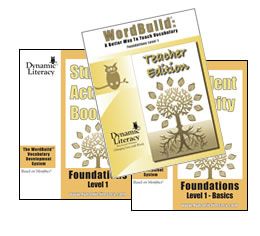
Foundations has 3 parts: Basics Student Activity Book, Student Activity Book, and Teacher Edition.

The Basics Student Activity Book is a 20-page booklet that is used as a gentle introduction to prefixes and suffixes. The cute, colorful graphics throughout the book are used to help students form compound words and understand how the same portions of words are used and combined to make new words.

The Student Activity Book is the meat of the curriculum. This workbook (184 pages) teaches 30 prefixes, suffixes, and combinations. There are 5 types of exercises for each affix: affix square (combining an affix with a root and determining the definition), affix adder (combing an affix with more roots and writing both the definition and  sentence), magic square (matching words and definitions), word search, and fill in the blanks. 

The Teacher Edition contains all the solutions for the activity book, but it is so much more than an answer key. It includes more information about the topic, ideas for further study, discussion questions, review pages, and an in-depth teaching guide.


I focused on Jake (4th grade) for this set, since he fits the prime age and skill range. While he was the one to complete the assignments, I found my younger children joining in on the verbal lessons. What can we add to house to make new words? Doghouse. Birdhouse. Treehouse. Clubhouse. Dollhouse. Schoolhouse. Even the little ones enjoyed thinking of words. The Basics Student Activity Book was fun to complete. The lessons seemed more like games than work to my son, since they were like word puzzles that he had to decipher. Though the Student Activity Book was more challenging, he is liking it, as well. Since it is written for a 5-day schedule and we school 4 days a week, we combine 2 exercises one day so we can study 1 affix every week.

I like that the book is making him process the information to break down and combine the different parts of words. The only downfall I have with the program is the lack of review in the Student Activity Book itself. There are review pages in the Teacher Edition after every 5th affix, but I would like to see more review in the student's book. People retain information better with repetition. I am trying to point out the prefixes we've learned thus far as we use them and try to incorporate them more in our daily conversations.

Overall, I think this is a wonderful program that I expect will help my children understand how to decipher the meaning of unknown words and give them a good foundation for language.


You can connect with Dynamic Literacy on the following social media sites: Facebook, Twitter, and Pinterest.


If you'd like to read more reviews of this product or one of the other products offered by Dynamic Literacy, please head to the Schoolhouse Review Crew blog. 


Crew Disclaimer
Pin It

Tuesday, October 29, 2013

VocabularySpellingCity Review


Jake (7) struggles with spelling. He writes a page summary of his reading every day. And every day, I read over his work and have to decipher what it says. Generally, I can figure it out because most of his misspellings are simply the word spelled out phonetically (ie dun for done, wut for what.) I can ask him various questions, like what says Ī at the end of a short word (y) and when do you use ck (at the end of a short vowel word) to solve some of the issues, but there are so many sight words that just have to be learned by rote. English is a tough language to learn. That's why I was excited to try a premium membership for VocabularySpellingCity.

VocaularySpellingCity is an online teaching tool for K-12. The award-winning, game-based program focuses on vocabulary, spelling, writing, and language arts. It can be accessed through a mobile app for tablet or smart phone or online via computer and interactive whiteboard. 


Though there are many options available with a free account, the Premium Membership includes much more:
  • Vocabulary, writing, spelling, and language arts activities
  • Access to ALL games and interactive Flash Cards
  • Student progress tracking
  • Automated testing and grading
  • Personalized learning with assignments for differentiated instruction
  • Student logins with no commercial ads

To set up our account, I logged in as the Parent and chose spelling lists for each of my kids. There are so many options for lists! Dolch, geography, science, math, compound, etc. -- and multiple subcategories in each, both for topics and grade level. In fact, there are 50,000 words in the data base and 60,000 sentences. You can also create your own word lists if you already have a weekly list from another source or if there are specific words you want your child to learn. After I narrowed down the lists of words, I created accounts for my kids. From there, you can add assignments to each student. 

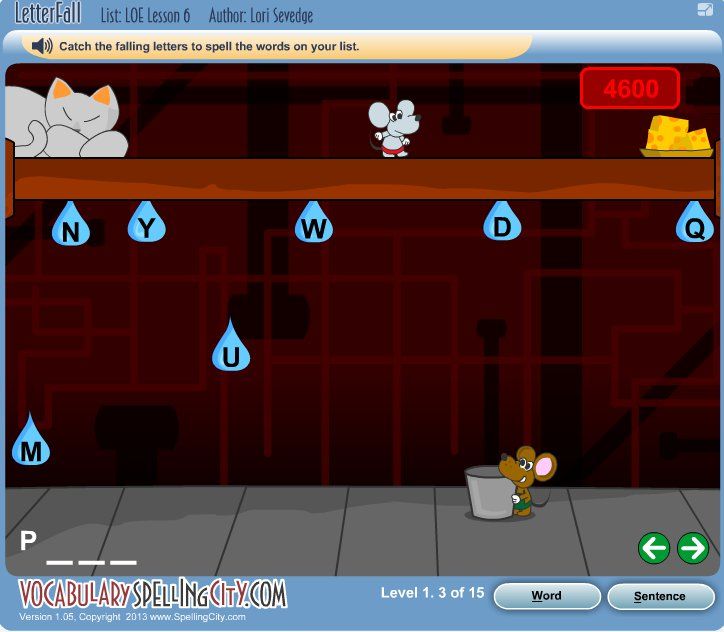
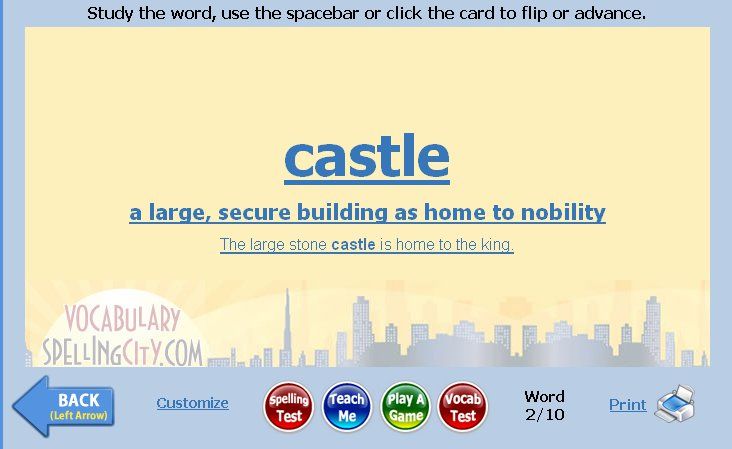
There are various ways for the child to review the lists. The Teach Me section reads the word, spells it, repeats it, gives a definition, and repeats it again. The Flash Cards part shows the word on the screen and reads it. The Play A Game portion is definitely the favorite. It is filled with many review-style games like word match, hangmouse, word search, letter fall, word-o-rama, word unscramble, word find, and much more. The Vocab Test shows a definition on the screen and four options. The student reads the definition and the choices and clicks on the answer. The Spelling Test has two parts: practice test and test. The actual test can be completed only once.   


My kids enjoyed learning how to spell using this program. Jake (7) liked to memorize all the words from his list, play a couple games, and take the test that same day. Each time, he scored 100%. I tried to explain to him that he was supposed to spend multiple days reviewing the same words to ensure that he truly learned them. He just thought it was cool that he was able to memorize them so quickly. I didn't want to hinder his excitement, so I allowed him to continue knocking lists off quickly. I did quiz him orally over the weeks in order to cement the spellings in his mind. I also made the lists more difficult to challenge him.

Alyssa (5) felt very grown-up learning her spelling words. Each day, she would get a piece of paper and pencil and write down her words. Then, she would work on the review and games. She learned about 1 list a week. She randomly spells words for me now with a big smile on her face.

We also took advantage of creating our own lists. Both children loved being able to tell me which words they wanted to learn. Jake chose things like blood, Bruce (Wayne), and hardware, while Alyssa opted for baby, girl, and love. I also added words to their lists that I knew they struggled with or needed to learn.     


My little ones have enjoyed using this the past few weeks, and their spelling has improved for sure. VocabularySpellingCity costs $29.99 per year for up to 5 students. If you'd like to try it out first, it's easy to sign up for a free account. They also offer an entire page full of videos to help you along with a teaching resources page.  


Also, you can read more reviews on the Schoolhouse Review Crew blog.


Pin It