Showing posts with label The Critical Thinking Co. Show all posts

Friday, June 12, 2020

Creative Problem Solving

Disclaimer: I received a FREE copy of this product through the HOMESCHOOL REVIEW CREW in exchange for my honest review. I was not required to write a positive review nor was I compensated in any other way.


One of the reasons we homeschool is that we want our children to be able to think for themselves, to be able to problem-solve to find a solution. That's why we love when we get to review for The Critical Thinking Co.. We want to develop those critical thinking skills in our children to prepare them for life, not simply teach them facts from a book and how to pass a test. We strive to give our kids the tools necessary to make clear, reasoned judgments by teaching them to identify and evaluate evidence to guide their decision making through life.

The Critical Thinking Co. is "committed to developing students' critical thinking skills for better grades, higher test scores, and success in life." They offer many books and curricula to prepare students, not by teaching through drill and memorization, but instead by teaching in a way that empowers the mind. In the past, we've used a variety of their products from a critical thinking detective book to a phonics program to an analogies software. This time, I was excited to use Creative Problem Solving Level 1 with my little ones.


I often say that my kids got my husband's engineering mind. He is able to see a problem and find a viable solution. At home, at the store, with gadgets, everywhere--he's able not only to recognize an issue but also to figure out how to fix it. The kids naturally have inherited that cleverness, and I want to encourage their ingenuity and allow it to grow.

The Creative Problem Solving book is perfect to bolster that process. It is designed for grades PreK-2 and makes finding solutions fun for little ones. In fact, the first day we used it, one of my boys told me, "Mom, thank you! This is so much fun!"


Unit 1, The Magic Pencil, gives kids 28 challenging situations in which they need to creatively solve a problem. For instance, they need to draw a way to protect a boy from the school bully, stop a bee from stinging a child, help a turtle win a race, save a special tree from being chopped down, and more.

My boys (ages 5, 8, 10) have been working through this unit. I am not exaggerating when I say that it is one of their favorite things! I knew my 8-year-old would love it (after all, he is my child who will sit and doodle all over his pages, drawing elaborate machines that accomplish tasks), but I was pleasantly surprised just how much the other boys like it, as well. In fact, when they are finished with their challenge for the day, they often draw their own scenarios for each other to finish, like helping the mouse get over the wall to get the cheese and helping the astronaut get safely back to his ship. Not only is Creative Problem Solving encouraging them to use their imaginations to solve problems, it's inspiring them to let their creative juices flow in deeper ways, also. In fact, they were having so much fun with these simple exercises, that their 12-year-old artsy sister even joined in on the fun. She puts much thought into her solutions and enjoys adding minute details.


The other units of the book build on The Magic Pencil concept. There are sections creating creatures to survive in specific locations, choosing super powers to help in proposed difficulties, drawing aids to meet the needs of aliens, inventing gadgets, determining the steps to take in an emergency, and more.

I like the Enigma unit which shows various random drawings and asks the child what it might be and then to draw it. There are also mind riddles and puzzles at the back of the book. Many pages have lines for writing why the student chose what he drew and why he thinks it will work.


I appreciate that the pages are open-ended. Sometimes--many times--there is more than one way to solve a problem in life. It is no different in these scenarios. One child drew ropes connecting a broken branch to another branch like a swing so a sloth wouldn't fall and get hurt, another drew a connecting piece like the branch was repaired, and another drew people on the ground holding a giant blanket.  Some of the stories are silly (who honestly needs to worry about a flying shark who shoots teeth with  a tranquilizing potion?), but that only adds to the fun! The more unlikely the situation is, the more creative the child needs to be. 


Here's what my kids think of the book:

"I love it! I love all the pages!"

"I like it! Drawing the pictures is really fun!"

"I think it's pretty cool that you can solve the problem using anything that will work."

"I like that it's creative and every answer is different. I like finding the funniest way to do it."


Creative Problem Solving is designed to be a stand-alone activity book that students can complete on their own. I chose the paperback book because I like physical copies, but there is the option of an eBook, as well. Honestly, that would have been easier than photocopying the pages in the book (the Critical Thinking Co. does allow reproduction within one home), but the perforated pages of the paperback make it easier to remove and send through a printer. Since the kids have already asked for additional copies to rework certain pages, that is probably the better option for me.

Creative Problem Solving Level 1 has been a huge hit with our family. I love that my kids are strengthening their critical thinking skills and having fun while doing it.

Happy kids. Happy Mom. The perfect supplement.


You can connect with The Critical Thinking Co.™ on the following social media sites:


You can read more reviews of this book or learn about one of the other materials reviewed by my Crewmates on the Homeschool Review Crew blog.


Creative Problem Solving, Dare to Compare Math, Mastering Logic & Math and Who Is This Kid? Colleges Want to Know! {The Critical Thinking Co.™ Reviews}
Pin It

Friday, May 10, 2019

Pattern Explorer


One of the reasons we homeschool is that we want our children to be able to think for themselves, to be able to problem-solve to find a solution. That's why we love when we get to review for The Critical Thinking Co. We want to develop those critical thinking skills in our children to prepare them for life, not simply teach them facts from a book and how to pass a test. We strive to give our kids the tools necessary to make clear, reasoned judgments by teaching them to identify and evaluate evidence to guide their decision making through life.        

The Critical Thinking Co. is "committed to developing students' critical thinking skills for better grades, higher test scores, and success in life." They offer many books and curricula to prepare students, not by teaching through drill and memorization, but instead by teaching in a way that empowers the mind. In the past, we've used a variety of their products from a critical thinking detective book to a phonics program to an analogies software. This time, I chose Pattern Explorer Beginning to focus on math proficiency.


My 9-year-old is a math whiz. When he was younger, he would amaze us by completing complicated math equations in his head and would often solve math problems just for fun. Whereas his two older siblings cringe at the thought of extra math work, he gets excited. I knew this book would be perfect for him.

Mathematics is full of patterns, so it's only natural to strengthen those pattern-finding abilities to hone math skills. If a student can train his mind to find patterns in numbers, shapes, sequences, images, and the like, he will be better prepared for complex math concepts and operations.  The Pattern Explorer Beginning book is designed to help students transition from concrete to abstract thinking by signaling the brain to recognize patterns. The book has 88 pages and 40 individual exercises. There are 5 different types of drills which, of course, follow a repeating pattern through the book:

  • Pattern Predictor
  • Equality Explorer
  • Sequence Sleuth
  • Number Ninja
  • Function Finder


Each exercise is independent of the others and increases in difficulty as the book progresses. Though the same 5 types of drills are repeated 8 times, the variety of the activities keeps the book intriguing. There are equations, tables, shapes, numbers, and pattern pictures. The questions encourage math concepts that involve more than just patterns; they review liquid and space measurements, time, operations, and more. There are simple instructions on each page and space for figuring out the answers. 

My little guy has been completing an exercise 3-4 days a week, which means we're just about at the halfway point in the book. Because we received the digital version of the book, I printed out the pages and keep them with our other schoolwork. The Pattern Predictor drills fill two pages because of the extra space required to draw out the stages, but the other types fit on a single page each. My boy will work on the day's drill on his own and usually complete it without any help from me. At that point, I will check his work either by solving the patterns myself (because he can't have all the fun!) or by comparing it to the solutions in the back of the book. 


There is also a hints section in the back of the book. Though I haven't needed to reference it myself the few times he's needed a tiny bit of help in understanding the patterns, it would be very beneficial for parents or even students themselves who need guidance in solving the activities. The short hints give just enough information for the student to be steered in the right direction and figure the rest out himself. I appreciate that the hints are completely separated from the answer pages so that one does not accidentally see the solution while looking for a hint. 


This is what my 9-year-old told me about this book:

"I really like it! My favorite kind is the Pattern Predictor. I like 
drawing out the stages to see what comes next."

Pattern Explorer Beginning has been a huge hit with my third grader. He is doing so well at understanding the patterns and solving them. Some of the drills are a piece of cake to him, while others require him to think a little more. I love that he's being challenged and that he's having fun in the process. There are additional books in this series identical in format to this one but geared toward grades 5-7 and 7-9. I'm interested to see how well he would do with the next book after he finishes this one.

If you're interested in strengthening critical thinking skills in your children, I highly suggest taking advantage of coupon code TOSCREW19 which gives you free shipping plus 15% off any size order and expires 12/31/19.

To get an idea of all that they have to offer, you can sign up to receive free critical thinking puzzles delivered to your inbox by signing up on their site. My kids enjoy these weekly puzzles. Since you can choose which grade level(s) you receive, my kids each get a fun learning activity designed specifically for their age.


The Critical Thinking Co. provides not only engaging and thought-provoking materials, but ones that are interesting and enjoyable, as well.


You can connect with The Critical Thinking Co. on the following social media sites:


The Critical Thinking Co. offers so much more than math products. Some of my Crewmates reviewed things such as a book filled with tips and techniques to improve writing skills, a detective book to evaluate evidence and strengthen vocabulary skills, a book to prepare students for vocabulary in the SAT, and more.

You can read those reviews on the Homeschool Review Crew blog.
Crew Disclaimer
Pin It

Wednesday, June 6, 2018

Critical Thinking Detective Review


One of the reasons we homeschool is that we want our children to be able to think for themselves, to be able to problem solve to find a solution. It is our job to prepare them for life, not just memorize facts from a book. While rote memorization is profitable in certain areas, we don't want to solely rely on that method for our children's education. We strive to give our kids the tools necessary to make clear, reasoned judgments. In other words, we want to develop their critical thinking. Critical thinking has been defined as "the intellectually disciplined process of actively and skillfully conceptualizing, applying, analyzing, synthesizing, and/or evaluating information gathered from, or generated by, observation, experience, reflection, reasoning, or communication, as a guide to belief and action." Or more simply, identifying and evaluating evidence to guide decision making. What better way to strengthen their critical thinking than by using products from a company with the same name.

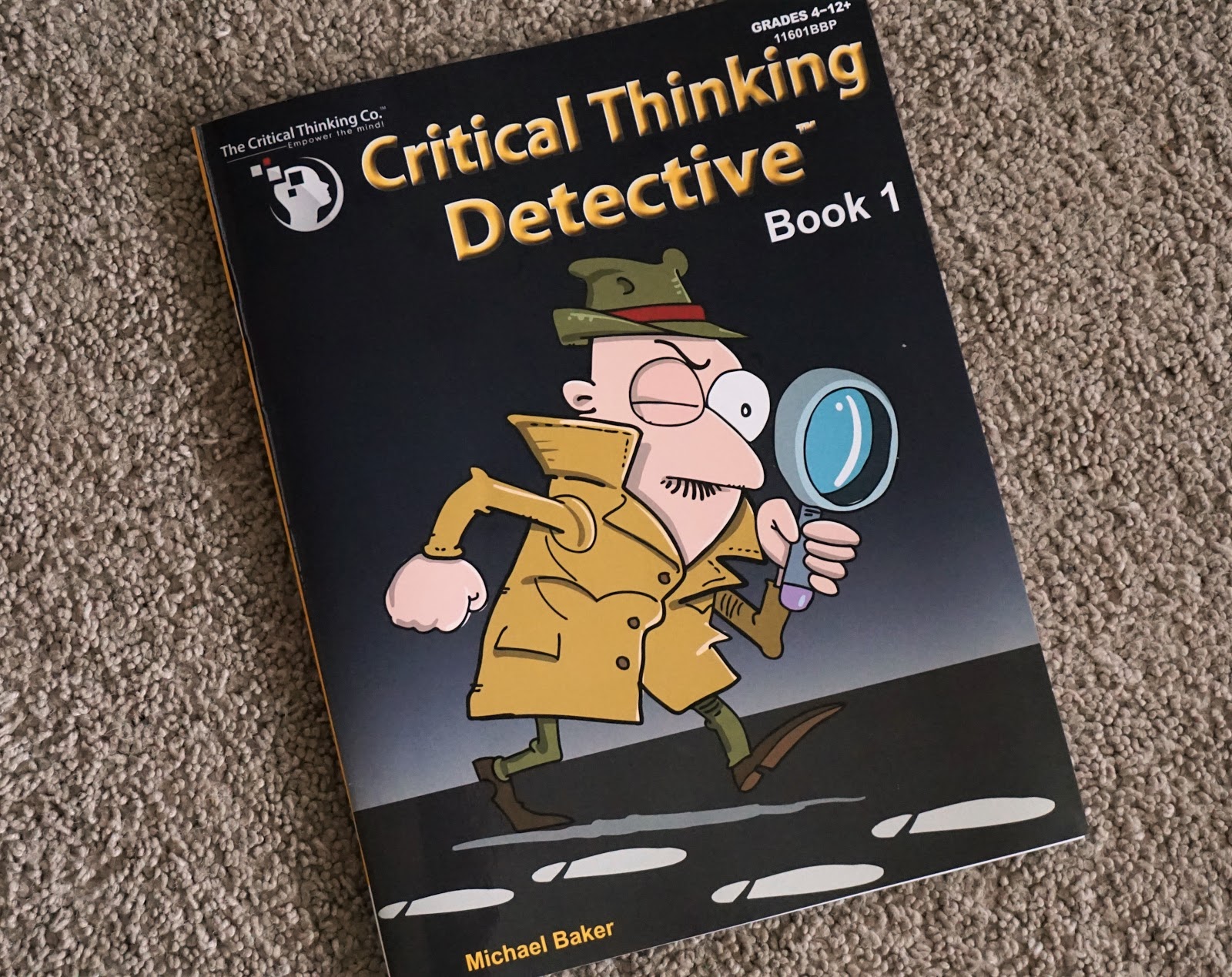
The Critical Thinking Co. is "committed to developing students' critical thinking skills for better grades, higher test scores, and success in life." They offer many books and curricula to prepare students, not by teaching through drill and memorization, but instead by teaching in a way that empowers the mind. Critical Thinking Detective Book 1, written by Michael Baker, is one such book.


This critical thinking book lets your child be the detective. It's filled with 12 cases in which to evaluate evidence and solve the crimes. The mysteries ensure that the students "read carefully and analyze and synthesize information to guide their decision-making." The book is recommended for grades 4-12, and though it is easy-to-use, it requires the student to pay attention to details and study the evidence.

My kids love mystery books and enjoy various series that focus on them, so I wasn't surprised that as soon as I got the book from the mailbox, my 12-year-old snatched it up. I was thrilled at his enthusiasm, but hindsight showed me that it wasn't the best decision.

When I sat down with my older kids (12, 10, 8) a few days later to work through the mysteries, I learned that my oldest already knew all the answers. He had read through each scenario. That in itself wouldn't have been a bad thing, I mean, I am all for independent learning and self-directed studies. The problem is that he quickly read the information, made an under-developed guess, and checked the answers. He did not take the time to fully strengthen his critical thinking skills.

He sat with the rest of us as we worked through each mystery and was disappointed that he remembered all the culprits and therefore missed out on the fun of solving the crimes. This time though, his critical thinking skills were put to the test, and he was able to reason through the steps of the process.


The book is set up so that each mystery is a two-page spread. The first page describes the situation and lists statements for four suspects. The second page is for notes and solutions. There is room to list each suspect and give evidence for their innocence or guilt.

The license for this book states that I have permission to copy each page for use in my home. That is so exciting when you have multiple kiddos! However, we chose to talk through the mysteries together. My kids are at the young end of the spectrum (seeing as one is at the youngest recommended age, one is a couple years too young, and one already knew the answers). I talked them through the first scenario and showed them how to evaluate the facts. I explained why certain suspects were innocent based on the information and proved who was the criminal. The second scheme was much the same, except I asked for their thoughts before giving my input. By the third, the kids were able to solve the crimes on their own. Of course, there were times when they were stumped. I would re-read the line(s) that contained the information they needed to deduce the next piece of the puzzle.


I love the format of this Detective Book. The descriptions are concise. Each sentence is numbered so that you can easily understand the solutions. The crimes are not morbid, but are appropriate for children (all thefts: lunch money, bath robe, plant, football, and even a couple lighthearted ones committed by pets).

The only aspect I don't like is the answer pages. Each mystery is listed and gives reasoning for guilt or innocence, but it also shows the lineup of the suspects with the criminal circled in red. It's tricky to look in the back for the answer of a specific scenario without accidentally seeing another culprit. The book should remove the images altogether and rely solely on the names for answers.


My kids immediately fell in love with this style of learning. In addition to developing their critical thinking skills, this book prompted me to introduce them to logic puzzles. As a child, I greatly enjoyed checking off those little boxes and using deductive reasoning to figure them out. My kids, too, think these puzzles are fun and have solved dozens of them since starting the Detective Book. Any book that encourages my kids to do extra learning is a plus for me.

The Critical Thinking Co. offers so many resources that look like fun. There is a Detective Book similar to this one, but the student solves the crimes by focusing on Vocabulary. In Something's Fishy at Lake Iwannafisha, students solve the crime by using forensic evidence such as fingerprints, ballistics, handwriting, and more. Students can decode riddles by relying on their language skills in Vocabulary Riddles Book 1. Whether you're looking for critical thinking activities, math books, science resources, or even full curriculum for every grade, The Critical Thinking Co.™ is sure to have something to spark your interest.


You can currently take advantage of coupon code TOSCREW18 to receive free shipping and a 15% discount off any size order! You can also sign up to receive free critical thinking puzzles delivered to your inbox by signing up on their site. My kids enjoy these weekly puzzles. Since you can choose which grade level(s) you receive, my kids each get a fun learning activity designed specifically for their age.

Thank you The Critical Thinking Co. for providing not only engaging and thought-provoking materials, but ones that are interesting and enjoyable, as well.


You can connect with on the following social media sites:
Pinterest


You can read reviews of their various products on the Homeschool Review Crew blog.


Crew Disclaimer
Pin It

Wednesday, November 9, 2016

Fun-Time Phonics Review


I am a firm believer in making learning fun, especially in the early years. Many hands-on learning exercises and play-based learning are vital to little ones. I will incorporate some formal education though by following the cues of my children. One way that always grabs their attention is the use of electronic programs. The little ones feel it is a treat to use the computer to do their own school. Programs like Fun-Time Phonics!™ Software - 2-PCs Win Download from The Critical Thinking Co.™ are perfect for these times. It allows the child the privilege of using the computer, while learning in the process.

The Critical Thinking Co.™ has been "committed to developing students' critical thinking skills for better grades, higher test scores, and success in life" since 1958. Their award-winning products help students achieve better results through highly effective lessons that sharpen the mind. They teach reading, writing, mathematics, science, and history in a fun, easy-to-use way. Their methods aren't based on drill and rote memorization, but techniques that empower the mind to get the student to think. Michael Baker, the company's president said, "If we teach children everything we know, their knowledge is limited to ours. If we teach children to think, their knowledge is limitless." One of the reasons we homeschool is that we want our children to be able to think for themselves, to be able to problem solve to find a solution. It is our job to prepare them for life, not just memorize facts. We strive to give our kids the tools necessary to make clear, reasoned judgments. The programs from The Critical Thinking Co. are designed to do the same thing.  


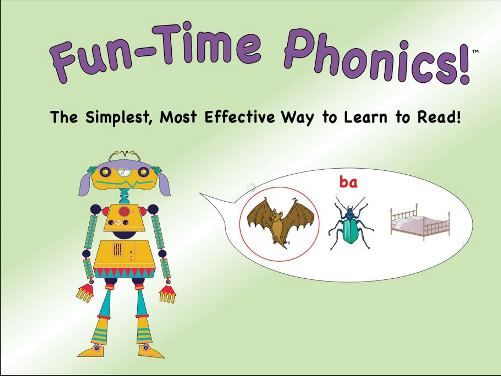
Fun-Time Phonics is a comprehensive reading program based on data from the National Reading Commission. Cute robots teach the lessons, guide the activities, and engage students through listening, thinking, speaking, and reading. The lessons portray that spoken words are comprised of individual sounds, and that those sounds are written with letters, through the emphasis  of sound/spelling patterns, vocabulary, and comprehension. 

The program is divided into 4 sections:
  • Section 1 -- This first section teaches that words are made up of sounds and focuses on beginning sounds, ending sounds, vowel sounds, and words that rhyme.
  • Section 2 -- This part teaches the short vowel sounds and the letters that make the sounds.
  • Section 3 -- These activities get the student to understand that different sounds are made based on the consonants and short vowel sounds that are used.
  • Section 4 --  This final area combines all the skills that have been taught, and the student learns to read his first words.


My 4-year-old has been the one using this program. He and I sit together at the computer and do the lessons together. The program explains the lessons in a fashion that a student could work on it on his own, but since my guy is at the very beginning stages, I prefer to be there with him for further explanation and encouragement. Each lesson starts with brief instructions and then many examples. For instance, the first lesson teaches the letter T and its sound. Then, there are 15 opportunities to choose the /t/ sound out of 3 choices. One of the robots articulately pronounces each picture word so the student can hear them. After the child clicks his choice, there is either positive reinforcement through clapping and cheering or simply a reply letting him know he picked an incorrect option.

The lessons are simple and short. The format is repetitive, and therefore, my little guy loses interest after a bit. I wish there were some different activities in the lessons. Also, when he gets an incorrect answer, it doesn't tell him which one was correct. It just tells him that he was wrong. I would like to see it do both. For example, the program says, "Pup does not rhyme with hop," and that's all. I wish it would say something like, "Pup does not rhyme with hop. Drop. Hop. Drop rhymes with hop."


It's really easy to move around through the program to find which lessons your child needs to practice. You just log into the admin section and choose the lesson. Otherwise, it will start you at the beginning and proceed through them on its own. You can also see your child's progress on each section and add more users.

All in all, I think the program is fine and a good job of teaching the aspects of reading. It's just not my favorite option. I really wish there was more variety. We'll still continue to use Fun-Time Phonics!™ Software - 2-PCs Win Download as a supplemental program at times, but I will not require it as part of our weekly schedule.


You can connect with The Critical Thinking Co.™ on the following social media sites:
Google+

The Crew was able to review many different products offered by The Critical Thinking Co.™. If you'd like to read more reviews of this program, other components of the Reading, Writing, and Arithmetic Before Kindergarten!™ program, or reviews of some physical books, please visit the Homeschool Review Crew blog.

Crew Disclaimer
Pin It

Wednesday, November 11, 2015

Surfing the Net: Science Review


The internet is a wonderful tool. we use it almost daily to find recipes, research homeopathic remedies, catch up with friends, shop, and so much more. You can look up pretty much all information that you can possibly think of. While that can be beneficial, it can also be a hindrance. The internet is also destructive and full of horrific things. We have very specific guidelines in place for our children when they use the computer. One of those rules is that they are not allowed to preform their own searches. Too many weird things can be the result of those innocent searches. I am reminded of one time a few years ago. Our oldest child (who is 9 years old now) typed a few simple words directly into the address bar because he "wanted to see what came up." That thinking has the potential of a very bad outcome. If they need to find information, their father or I preform the search, find an appropriate source, and hand it off to the child. Now that our son is older now, I felt it was time to teach him how to safely preform internet searched on his own.

The Critical Thinking Co. is "committed to developing students' critical thinking skills for better grades, higher test scores, and success in life." They offer many books and curricula to prepare students, like Surfing the Net: Science, which is exactly the type of resource we needed to teach our son.


Surfing the Net uses free, internet resources and reproducible worksheets to teach science concepts to 3-6 graders. It teaches them to research information and broaden their understanding of the web as an information resource. The topics covered in the book include animals, atmosphere, ecosystems & habitats, energy, geology, plants, and space.

Each topic covers critical thinking in the following ways:
  1. Defining: Students use key word searches to gather general information from the internet using text, videos, charts, or images and answer questions.
  2. Describing: Students use key word searches to gather specific information from the internet using text, videos, charts, or images.
  3. Analyzing & Synthesizing: Students used the information they gathered to fill in a graphic organizer and write a paragraph.
  4. Expanding Knowledge: Students collect additional information about something specific about the topic and may write paragraphs about it.
  5. Investigating: Students form their own question and find the answer through additional research.

The first part of each activity begins with a key word search section. For instance, the very first question of the book reads, Use the key words in each question to find the answers on the Internet:  "Amphibians are ectothermic. How do habitats affect ectothermic animals?" The problem we ran into right away is that there is no help with the key words. Yes, there is a click-through video that the student watches before starting that briefly touches on key words, but that is all. I think it would be so much more beneficial if the key words were written in bold, at least for the first topic or so, to help the student understand key words. The purpose of the book is to teach the student to research. Also, there is no information about what types of websites are good for information. Many times, sites that anyone can ask a question and anybody can give a response--whether he knows what he talking about or not--showed in the top list of searches. I had to teach my son what kind of sites are good for information and what kind are untrustworthy. Don't get me wrong, I am very involved in teaching my children these things (I do homeschool, after all), but I think there should be some teaching about that in the book itself or through better training videos.

The remaining questions for the activities direct students to specific URLs to find information. Icons next to the questions easily show what kind of activity is involved.

Honestly, I think the concept of the book is a good one, but I don't believe there is enough in it to actually teach the student about searching. Many of the questions sent my son searching all over websites to find specific answers. I was able to direct him to where he could find the answers on the page because I can skim read, whereas he hasn't learned that yet and still reads word-for-word. Even some of the designated URLs had him looking for another link within them to eventually find what he needed. The process was daunting. All in all, it was a frustrating experience for us both. Maybe it would be easier or more appealing to an older child, but, unfortunately, it did not work well for my 9 year old.


You can connect with The Critical Thinking Co. on the following social media sites:
Facebook
Google+
Twitter
Pinterest


If you'd like to see how other homeschool families used this book or one of the other products offered by The Critical Thinking Co., please read the reviews on the Schoolouse review Crew blog.

Crew Disclaimer
Pin It

Tuesday, March 17, 2015

The Critical Thinking Co. Review


One of the reasons we homeschool is that we want our children to be able to think for themselves, to be able to problem solve to find a solution. It is our job to prepare them for life, not just memorize facts from a book. While rote memorization is profitable in certain areas, we don't want to solely rely on that method for our children's education. We strive to give our kids the tools necessary to make clear, reasoned judgments. In other words, we want to develop their critical thinking. Critical thinking has been defined as "the intellectually disciplined process of actively and skillfully conceptualizing, applying, analyzing, synthesizing, and/or evaluating information gathered from, or generated by, observation, experience, reflection, reasoning, or communication, as a guide to belief and action." Or more simply, identifying and evaluating evidence to guide decision making. What better way to strengthen their critical thinking than by using products from a company with the same name.

The Critical Thinking Co. is "committed to developing students' critical thinking skills for better grades, higher test scores, and success in life." They offer many books and curricula to prepare students. We've been using Math Analogies Beginning Software, a Windows program designed for kindergarteners and first graders to enhance their critical thinking skills. 

An analogy is a likeness or comparison between two things. Analogies play an intricate role in the solution of problems such as memory, perception, and decision making. And since problem-solving is a fundamental part of mathematical development, understanding analogies is an important skill that gives young students a good foundation for learning math.


Alyssa (6 yr) was the one practicing the analogies. I set her up with the program and helped her through the first few questions. They start with simple picture comparisons and work toward more difficult word  connections. Like typical analogy questions, the : is read as "is to" and the :: is read as "as".  So, in the example two : 2 :: one : ? is read as two is to 2 as one is to. Once I explained to Alyssa that she needed to find the connection or similarity between the pictures, she got right to work.

The program shows a simple screen with each question. On the top is the analogy; on bottom are the choices. To answer the problem, you drag your choice to the question mark. If you answered correctly, the word correct is shown in green font. If you answered incorrectly, the word incorrect is shown in red font.


There are many different things that are used for the comparisons: shapes, numbers, letters, cake with candles, smiley faces, coins, time, measurements, and more. The many choices keep the program interesting. The first day, Alyssa did 75 problems before questioning if she could be done. When you begin, you click on the First Attempt button. We weren't sure exactly how it worked at that point. I assumed it would be a few questions and then the lesson, per se, would be over. After that, I had her complete 25 analogies a day as part of her math work. On the 5th day, she was done almost the moment she began. Once she hit that 152nd problem, it sent her back to the main page. She was then able to click on the new Second Attempt button. That time, she completed 9 problems. The third attempt gave her 1 single analogy. The program is designed to repeat missed problems. Once you answer all 152 problems correctly, you have completed the program.

Alyssa easily completed this by herself. There were a couple times when she didn't quite understand what it was asking of her, but the simple design was not overwhelming at all. Some of the analogies made her really think about the answer. I loved watching her as she figured them out. Problem solving is what it's all about. The only thing I wish that would be different is having the option of multiple users. I had wanted a couple of my boys to try it out, but it only allows 1 user at a time. If you want someone else to complete the program, you have to cancel out all the work that has been done. It's easy enough to do, but it would be nice to be able to use it with more than one student at a time.

I think this is a good program and would like to see the higher levels of the analogy software. I like that it makes the student think. It's a wonderful foundation for those young learners.


If you'd like to read more reviews of this program or one of the many other products from this company, head to the Schoolhouse Review Crew blog.


You can connect with The Critical Thinking Co. on the following social media site:
Pinterest


Crew Disclaimer
Pin It