Showing posts with label letters. Show all posts

Thursday, April 23, 2020

Focus on Fives Kindergarten Curriculum

Disclaimer: I received a FREE copy of this product through the HOMESCHOOL REVIEW CREW in exchange for my honest review. I was not required to write a positive review nor was I compensated in any other way.


I love when we get to review materials that are geared toward early education. Learning with little ones is always such an exciting experience! Everything is a new adventure that is filled with endless possibilities. 

I often have people ask me what curriculum I use for kindergarten. Honestly, I am a big believer in learning through play and taking a more relaxed approach to education in the younger years. Hands-on play and learning by doing are vital, but it is also important to teach written skills. I was intrigued by the BJU Press Focus on Fives kindergarten curriculum from BJU Press Homeschool and couldn't wait to get started with my little one.


BJU press first started writing curriculum that is both biblically and academically sound in the early 1970s. Over the next few years, textbooks for all elementary grades and various secondary courses were completed. They became the first publisher to respond to the needs of home education in 1982 and have been "giving Christian educators the tools they need to teach from a biblical worldview and help young people be prepared to live a godly life" ever since.  

I personally used some BJU Press curriculum materials during my junior high and high school years. I was eager to see what they offered for the opposite end of the spectrum as I worked with my 5-year-old.   


The Focus on Fives curriculum set is designed to help kids develop the skills they need through age-appropriate introductions of science, social studies, handwriting, phonics, and reading. The program instills a multi-sensory approach as it incorporates visual, auditory, tactile, and kinesthetic learning activities. Kids need to see, hear, touch, and move!

The full curriculum includes the following materials:

  • Worktext
  • Phonic Practice
  • Phonics and Review Cards
  • Phonics Flip Chart
  • Reading Books
  • Write Now! Handwriting
  • Teaching Visuals Flip Chart
  • Teacher's Edition

The Worktext contains over 400 pages of learning worksheets. The first two-third of the book has a page to accompany each lesson. There are exercises that involve writing letters of the alphabet, circling correct answers, drawing lines to matches, coloring, cutting and pasting, dot-to-dot, and more. Each unit begins with a letter to the parent explaining the scope, tips, and optional books and is separated by color-coded tabs at the bottom of the pages.

The end of the worktext contains supplemental materials including a kindergarten diploma, cutouts that are needed for specific lessons, and checkup pages (similar in format to a quiz) that correspond to the units and have the same color-coding at the bottom.


The Phonics Practice workbook is filled with pages that provide practice of phonic skills and word families. This book, like the Worktext, has an open spine to make it easier to remove the pages for the student and color-coded tabs to match each unit. This one follows similar fine-motor skills for the exercises, but varies in content. The phonics book focuses solely on words--reading, recognizing, writing--the worktext also relies on pictures and relationships such as differentiating between seasons, practicing size comparison, noting animal qualities, and more.


The Phonics and Review Cards are approximately 2.5" x 5.5" on glossy cardstock. These flashcards include the letters of the alphabet with multiple examples and high-frequency words. There is also a card for each of the mascot characters that are used throughout the lessons that can be cut out and glued to a craft stick.


The Phonics Flip Charts has nearly 125 pages of visuals used for teaching. Though the website lists a spiral-bound collection, my version consists of loose, glossy cardstock pages. Included are alphabet charts, high-frequency word cards, phonics characters, mascot characters, word family cards, phonics songs charts, handwriting wall charts, spelling cards, and phonics charts. The majority of the pages are double-sided with additional teaching information on the back. The pages are numbered in the bottom right side corner for easy organization. 


Teaching Visuals Flip Chart is a spiral-bound collection of visuals that are used in the lessons. The covers are sturdy cardboard while the pages are very thin. There are 46 pages that show students healthy habits, insect life cycles, nursery rhymes, musical instruments, landscapes, seasons, history, and more. The back of each page lists the lesson it's from along with teaching helps and information.

While I appreciate the notes on the back, it would be more beneficial to have them on the back of the previous page, so I can have access to that while my child can still see the picture.


There are 34 Reading Books included with the curriculum. Each book is a 9" x 6" paperback with full-color pictures that fill the pages. The books are numbered on the fronts and follow the same color-coded unit tabs of the other materials. The back of the books are colored to match the unit, as well.

The first two books have no words but rely on picture reading with discussion starter questions found in the teacher's book. The third book, which is read in lesson 15, introduces rebus reading where a picture represents a more complicated word. Starting with book 4, the students will be reading full sentences, beginning with one 2- or 3-word sentence on a page and progressing through full paragraphs on each page. The last page in each book lists trickier words to note along with a quick phonics review from the story.


The Write Now! Handwriting book is the only black and white in the set. Almost every lesson is a half sheet and generally has places to write letters, then words, and eventually sentences and includes a small picture to color. There are also a handful of dot-to-dot pages that feature either lowercase or capital letters.


There are 6 parts to the Teacher's Edition. There is a spiral-bound book for each unit with a paperback cover on the front and a hard cover on the back. As expected, the book matches the unit color, keeping everything consistent and easy to use. The introduction of each teacher's book contains the same information: goals, learning center ideas, routines, assessments, tips, instructional materials, and more. There is also a lesson plan overview for the unit that lists the pages needed for each resource along with the objectives of each lessons.

The teacher's edition books are packed full of teaching information. When I taught first grade many years ago, I had a teacher's manual for each subject. With the Focus on Fives curriculum, all of the information for the day's lessons is kept in one place.  There are sections for each topic that list the needed materials along with bulleted notes of what to teach. The last page of each lesson gives suggestions for extended activities: story and rhyme time, arts and crafts, learning center, motor skills, science, heritage studies, show and tell, songs, Bible connection, language arts, and more. The back of each book contains additional teacher resources including instructional aids and reproducibles, creative writing prompts, songs, and more.


My little guy and I have been working through the curriculum 3 days a week. He's not officially in kindergarten until the fall, so we're taking a slower approach to formal education right now. The curriculum is written for a classroom setting with enough activities and learning to fill a kindergartner's school day. I love that there are so many options that make it easy to find what works for us.

He enjoys completing the Worktext and Phonics Practice pages, hearing the listening stories, in the teacher's book, and the hands-on and motor activities. His favorite part is the snack of the week which coordinates with the lessons, such as a graham cracker firetruck while learning about firemen, apple and marshmallow mouths to enhance the dentist lessons, chocolate turtles while learning about the pond, "dirt" cupcakes for learning about the garden, tropical fruit cups for Hawaii, and other yummy treats.


One thing that I'm excited about is starting the post office section next week. With all that is going on (or not going on, ha) with our stay-at-home order, we've been trying to reach out to people in other ways. Since we can't physically be with our friends, I've been having the kids send mail. These lessons are perfect as they teach about zip codes, how mail is sorted, how to write letters and thank you notes, the history of mail delivery, using stamps, how to send packages and letters, and more. There is even a suggestion to send a missionary a care package. Other activities include sorting letters of the alphabet written on envelopes into capital and lowercase mailboxes, making stamps out of carrots and marking mail, pretending to be mail carriers, explaining how many of the books of the New Testament are letters, and crafting a mail carrier hat.

Focus on Fives is a full curriculum that teaches much more than reading and writing. The 6 units for the year cover a vast amount of topics through supporting activities: All Around the Town (community helpers), Bookshelf Friends (books, hymns, nursery rhymes), Ants to Elephants (animals, insects, pond, farm), Mountains High to Oceans Deep (landscapes, sharing the Gospel, America), Blue Skies and Gray (seasons, weather), Garden Paths and Wandering Trails (places).

The curriculum begins with identifying letters and recognizing their sounds and teaches students the skills necessary to read full sentences such as "He sent His Son to die for men." It works on rhyming words, compound words, short and long vowel words, and consonant blends. It teaches writing skill such as forming letters and proper pencil hold, but also tracing, punctuation, and copywork. It also teaches valuable motor and life skills, too--all while making learning an enjoyable experience.


If teaching all the components seems overwhelming, BJU Pres Homeschool will be offering online learning course videos beginning this summer. The videos are an hour long and incorporate a variety of learning activities for your little one. You can preview sample videos to determine if they're right for your family.

The BJU Press Focus on Fives curriculum is packed full of resources, activities, and ideas that are sure to help your child be prepared for first grade. There are many options for each lesson to ensure that you find the perfect balance for your growing learner.


You can connect with BJU Press Homeschool on the following social media sites:


You can see how other homeschool families used this curriculum by reading the reviews on the Homeschool Review Crew blog.

BJU Press Focus on Fives {BJU Press Homeschool Reviews}
Pin It

Wednesday, May 23, 2018

T Is for Tree


Our family spends much time each day reading between what is required for schoolwork and what is chosen solely for pleasure. Most of the time, the books we review tend to be for the older kids--chapter books, biographies, historical non-fiction, etc.. I love reading those together as a family and appreciate many aspects of studying that kind of literature with my kids. However, there is something so special about cuddling close with a little one and enjoying a picture book. Our newest snuggle-inducing read is T is for Tree: A Bible ABC from Reformed Free Publishing Association.

Reformed Free Publishing Association was established in 1924 as an independent, non-profit organization. Their literature includes commentaries, devotionals, Bible study guides, church history, Christian living, children's materials, educational curriculum, and more. They have a wide selection as their book catalog contains over 70 titles and options of print, audio, and downloadable products.


T is for Tree, written by Connie L. Meyer, is more than a simple alphabet book for little ones. This book focuses on God while teaching the ABCs. Bible verses, truths, and promises in God's Word are woven throughout the pages.

Each letter of the alphabet has its own page. The capital letter is prominent and followed by its chosen word. F is for faith. J is for jewel. R is for ravens. Z is for Zion. A short 3-line poem and Bible passage accompany each letter and are complemented by beautiful illustrations.
  
I've been reading this book with my two youngest children. We don't read the verses every time, as the 3-year-old doesn't always have the longest attention span. Twenty-six pages of letters and short rhymes makes the length perfect for him for special book time in the afternoon, a bedtime story at night, or just some extra snuggle time whenever. I love that not only do my boys like to shout out the letters before I read them, but that the truths of God and His love for us are being cemented in their hearts. 


The poems themselves make this a good book for older children, too. Most typical ABC books are cute and sing-songy, but even though this one rhymes as well, the vocabulary is more advanced. Words like fearsome, wither, suffered, dwelling, and others are used. The syntax is a bit more advanced than preschool age at times, too. As I love to incorporate read-alouds that are above my kids' levels, I appreciate that aspect of this book. It also makes it more enjoyable for an older child to read to a younger sibling.

Some of my personal favorite pages are C, P, and J.


J is for JEWEL

There's rubies, and there's gold;
But far more precious are the lips
That speak with knowledge told.

"There is gold, and a multitude of rubies: but the 
lips of knowledge are a precious jewel." --Proverbs 20:15 


This one has a second group of verses wrapped around the border of the page, too.

"Receive my instruction, and not silver;and knowledge rather than choice gold. 
For wisdom is better than rubies; and all the things that may be desired are not to be compared 
to it." --Proverbs 8:10-11 


So often, our flesh is drawn to want gold and silver and jewels. We want wealth and nice things. But so much more, we should desire knowledge and instruction from God. Wisdom is far more valuable than earthly treasures. To instill that truth in the hearts of my children while they are young is my goal. Weaving those principles in a simple children's book is a bonus.


T is for Tree: A Bible ABC is a beautiful hardcover book that is full of teaching opportunities. Whether you use it to introduce the alphabet, to reinforce biblical truths, as a basis for Bible memorization, or simply as a picture book to enjoy with your child, this one is sure to please.


You can connect with on the following social media sites:


You can read more reviews of this book on the Homeschool Review Crew blog.

Crew Disclaimer
Pin It

Monday, August 21, 2017

Phonics Museum App


Our family loves the Veritas Press Bible programs, so when we had the opportunity to review for the company again, I was excited. They offer materials for much more than Bible classes though, and this time, we we've been learning with their new Phonics Museum App.

Veritas Press was created by Marlin and Laurie Detweiler as a way to give their own children a classical education. After their curricula worked so well for their family, they wanted to make it available to other like-minded parents, as well. Since then, the company has grown to offer full curriculum, a publishing company, an online classical Christian academy, and two classical Christian schools. 
   

The Phonics Museum App is a multi-sensory program that teaches kids to read in a fun, engaging way. The student joins William and Wendy on an adventure through an art museum. Percival, a walking-talking suit of armor guides and encourages them as they look at the paintings, learn their letters, and discover that art can be exciting. They are then introduced to Miss Biddle, the quirky museum curator, as she leads the lessons. She's animated during some of the games and activities, but "comes to life" as she teaches the lessons to the student. Like the other materials from Veritas Press, this app follows the Classical Approach of learning, and not only teaches letters and sounds, but includes bit of information about artists and their works, inventions, history, nature, and more. 

The app was designed for early-readers in the 3-7 year age range, so it contains over 900 games, videos, interactions, real teaching, and memory songs to keep little ones engaged. A typical lesson has around 11 stages.  It always starts and ends with a video and has other activities throughout. For example, it might follow this format: video, song, video, game, video, game, video, game, video, game, video. A student must complete each stage of the lesson before he can move to the next, and he can see what each lesson contains by looking at the numbered easels with the appropriate icons. Sometimes the videos are simply Miss Biddle announcing the next activity, but mostly they are filled with teaching and silliness.  


The Phonics Museum believes in "edutainment," meaning games and learning collide and children don't even realize it. That's why there are 22 games that not only will the student enjoy, but also will learn to read while playing them. The games reinforce the learning by encouraging the student to recognize the individual letters--both upper and lower case along with both printed and written versions--and their sounds. The games are simple, but cute. There is a chipmunk that eats nuts, a frog that catches flies with his tongue, birds that happily splash in a bird bath, a catapult that launches paintballs that decorate the castle, and many more.  

One thing that I appreciate about the teaching is that for the games that focus on the sounds, there is a slight emphasis on the specific letter that is being reviewed. For example, during an M game, the student is supposed to touch the sarcophagus when Miss Biddle says the words that begin with the M sound. Mmustache. Boy. Penny. Mmoose. There is that slight emphasis on the /m/ to trigger the sound for the student. It is not overly done and the student himself might not even recognize it, but subtly it helps.   


My kindergartner is learning to read, so this app came at the perfect time. He loves watching the videos, playing the games, and reading the simple books. He adores Miss Biddle. Seriously, she must be the cutest teacher ever with her bold dress covered in letters, ribbons in her hair, her quirkiness, and her charming personality. She's a bit like Miss Frizzle from The Magic School Bus, but not quite as eccentric and without the transforming bus. Many times I catch even my older kids watching the videos and laughing at the silliness. 

The museum contains 10 floors of interactive fun. The paintings come alive, the characters are silly, and the whole experience is fun. Most importantly though, it helps kids learn their letters and sounds--and ultimately how to put those together to make words--with a solid phonics-based program. I'm excited to watch my little one learn and explore with the Phonics Museum.  


The Phonics Museum App is available through iTunes. It is a complete curriculum on its own, but since it is a spin-off of the physical version, it can also be used as a complimentary aid. If you'd like to see the app in action, there is an informational video on the website.


You can connect with Veritas Press on the following social media sites:


You can read more reviews of this app on the Homeschool Review Crew blog.


Crew Disclaimer
Pin It

Wednesday, November 9, 2016

Fun-Time Phonics Review


I am a firm believer in making learning fun, especially in the early years. Many hands-on learning exercises and play-based learning are vital to little ones. I will incorporate some formal education though by following the cues of my children. One way that always grabs their attention is the use of electronic programs. The little ones feel it is a treat to use the computer to do their own school. Programs like Fun-Time Phonics!™ Software - 2-PCs Win Download from The Critical Thinking Co.™ are perfect for these times. It allows the child the privilege of using the computer, while learning in the process.

The Critical Thinking Co.™ has been "committed to developing students' critical thinking skills for better grades, higher test scores, and success in life" since 1958. Their award-winning products help students achieve better results through highly effective lessons that sharpen the mind. They teach reading, writing, mathematics, science, and history in a fun, easy-to-use way. Their methods aren't based on drill and rote memorization, but techniques that empower the mind to get the student to think. Michael Baker, the company's president said, "If we teach children everything we know, their knowledge is limited to ours. If we teach children to think, their knowledge is limitless." One of the reasons we homeschool is that we want our children to be able to think for themselves, to be able to problem solve to find a solution. It is our job to prepare them for life, not just memorize facts. We strive to give our kids the tools necessary to make clear, reasoned judgments. The programs from The Critical Thinking Co. are designed to do the same thing.  


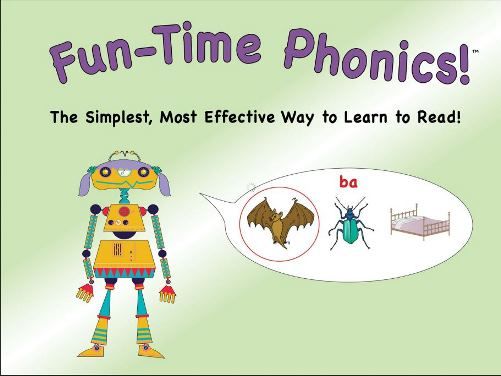
Fun-Time Phonics is a comprehensive reading program based on data from the National Reading Commission. Cute robots teach the lessons, guide the activities, and engage students through listening, thinking, speaking, and reading. The lessons portray that spoken words are comprised of individual sounds, and that those sounds are written with letters, through the emphasis  of sound/spelling patterns, vocabulary, and comprehension. 

The program is divided into 4 sections:
  • Section 1 -- This first section teaches that words are made up of sounds and focuses on beginning sounds, ending sounds, vowel sounds, and words that rhyme.
  • Section 2 -- This part teaches the short vowel sounds and the letters that make the sounds.
  • Section 3 -- These activities get the student to understand that different sounds are made based on the consonants and short vowel sounds that are used.
  • Section 4 --  This final area combines all the skills that have been taught, and the student learns to read his first words.


My 4-year-old has been the one using this program. He and I sit together at the computer and do the lessons together. The program explains the lessons in a fashion that a student could work on it on his own, but since my guy is at the very beginning stages, I prefer to be there with him for further explanation and encouragement. Each lesson starts with brief instructions and then many examples. For instance, the first lesson teaches the letter T and its sound. Then, there are 15 opportunities to choose the /t/ sound out of 3 choices. One of the robots articulately pronounces each picture word so the student can hear them. After the child clicks his choice, there is either positive reinforcement through clapping and cheering or simply a reply letting him know he picked an incorrect option.

The lessons are simple and short. The format is repetitive, and therefore, my little guy loses interest after a bit. I wish there were some different activities in the lessons. Also, when he gets an incorrect answer, it doesn't tell him which one was correct. It just tells him that he was wrong. I would like to see it do both. For example, the program says, "Pup does not rhyme with hop," and that's all. I wish it would say something like, "Pup does not rhyme with hop. Drop. Hop. Drop rhymes with hop."


It's really easy to move around through the program to find which lessons your child needs to practice. You just log into the admin section and choose the lesson. Otherwise, it will start you at the beginning and proceed through them on its own. You can also see your child's progress on each section and add more users.

All in all, I think the program is fine and a good job of teaching the aspects of reading. It's just not my favorite option. I really wish there was more variety. We'll still continue to use Fun-Time Phonics!™ Software - 2-PCs Win Download as a supplemental program at times, but I will not require it as part of our weekly schedule.


You can connect with The Critical Thinking Co.™ on the following social media sites:
Google+

The Crew was able to review many different products offered by The Critical Thinking Co.™. If you'd like to read more reviews of this program, other components of the Reading, Writing, and Arithmetic Before Kindergarten!™ program, or reviews of some physical books, please visit the Homeschool Review Crew blog.

Crew Disclaimer
Pin It

Friday, August 26, 2016

Can Do Cubes


This review goes hand-in-hand with the jollyliteracy.com and just2ducks LLC Jolly Phonics and Grammar review that I posted earlier this week. Like I said before, I loved teaching my first grade students in the classroom to read many years ago, and I love even more teaching my own kids at home now. To me, it's one of the most rewarding privileges of homeschooling the early years. Words are everywhere--books, signs, stores, mail, directions, recipes, letters. Whether it's for entertainment purposes or to increase knowledge, reading is an every-day skill. Literature is the foundation of our schooling, so reading well is vital in our family.

I taught my first 3 kids to read without the use of any curricula. My philosophy for little ones is that they learn best through play. I teach letters through manipulatives, puzzles, games, and typical conversations (saying things like, "Do you see that M on that sign?" and "Look! There's a T just like your name.") Once letters and sounds have been learned, we move to blending into words, using the same methods, adding in writing the words on paper or dry erase board. Any time you can get a little one involved in sensory learning, the lesson is fun, inviting, and productive. These Can Do Cubes are perfect for our style of learning.  


The Can Do Cubes set is used to teach synthetic phonics. The approach, as I described above, begins by teaching simple phonemes (sounds), blending them to make words, teaching complex phonemes, and blending those. The set contains many components to complement any synthetic phonics program.

  • Stage 1 Cubes -- 27 1-inch cubes showing one spelling for each of the 44+ sounds that make up the simple alphabetic code.
  • Stage 2 Cubes -- 30 individual 1-inch cubes along with 2 cubes connected with a string (to represent split digraph sounds) showing the spellings for the 175+ sounds of the complex alphabetic code.
  • Handbook for Stage 1 -- Small spiral-bound book filled with information about reading, such as pre-reading activities, explanation of the alphabetic code, encoding, pronunciation chart, notes, and much more.
  • Handbook for Stage 2 -- An identical book to the other, but filled with helpful instruction of the complex alphabetic code cubes, capital letters and punctuation, reading and spelling activities, phonemes charts, and more.
  • Teaching Learning and "Sounding Out" DVD -- An interactive demonstration of pronunciation and sounding out of words presented by Debbie Hepplewhite, synthetics phonics consultant and creator of the Can Do Cubes set.
  • Phonics Chart -- A large chart that explains phonemes, graphemes, and teaching points for each.
  • Word Charts -- Two large charts that list by cube number the words that can be made.   
  • Teacher's Guide and Template Book CD -- Includes online templates and worksheets in PDF for easy printing.


The cubes themselves are made of hardwood and laser-engraved. The Stage 1 cubes each have a small number at the bottom, indicating its placement of learning.  There are 8 different cubes: 6 of number 1 and 3 of numbers 2-8.  Each number cube is the same and contains all of the sounds for the number. For example, all 6 number 1 cubes have the letters s, a, t, i, p, n.

The Stage 2 cubes show the spelling variations for the 44 sounds. For example, one cube shows the different long a sounds: ai, ay, a, ey, eigh, ea. There are also cube for capital letters, punctuation, double letters, and split vowel digraphs. Each cube type is arranged in a way to make it easy to find.


The Can Do Cubes are listed in the order of the Jolly Phonics curriculum, so it made it easy for us to use the two resources together. My 4-year-old is at the beginning stages of reading and is just learning to blend sounds to make words. While he does enjoy sitting at the table and reading simple CVC (consonant-vowel-consonant) words, he much prefers to "play" with his blocks. The multi-sensory approach works very well for him.

There are many ways in which we use these cubes:
  • I make a sound and he finds the matching letter.
  • I say a word and he finds the letters to make it.
  • I make a word and he reads it.
  • I make a word and he finds the letters to copy it.
  • I put 2 letters and leave a space for another. I say a word and he finds the missing letter.
  • I make a word and he finds all the possible rhyming words.
The possibilities of learning with these cubes are really endless. You can say a word, have the student make it with the cubes, and then write it on paper. Or for even younger kids, you can have them find all the matching letters on the cubes. You could use them in a hangman type game or the child makes a word for you to read. If it involves letters, sounds, or reading, you can use these cubes to do it.


The materials are well-made and fit in the main box, making it easy to keep track of it all. The trays have pull tabs on the sides so you can easily get them out. Even my older kids have enjoyed the cubes, both by themselves and helping their learning-to-reading little brother. I love that the trays list which cubes belong where, especially for those times when the toddler like to dump everything out at once, ha.

If you have a student who is learning to read, struggling with spelling, or just needs a multi-sensory approach, we recommend the Can Do Cubes. 


You can connect with jollyliteracy.com on the following social media sites:

Facebook
Twitter
Pinterest


You can see how other homeschool families used these cubes by reading the reviews on the Schoolhouse Review Crew blog.
Crew Disclaimer
Pin It

Thursday, May 14, 2015

WordsBright Review


My 3-year-old loves letters. He points them out everywhere, like the obvious places: signs, shirts, books, mail, boxes, anywhere there is written word. But what has amazed me for many months is how he can recognize specific letters in random objects: the way a spaghetti noodle is lying on a plate or the shape of a clothespin both closed (A) and open (H) or how the blocks are lying on the floor or paint splatters during a project. He is drawn to the alphabet. I knew he would be excited to read a new book all about letters from WordsBright. 

S is for Smiling Sunrise was written by Vick Wadhwa for his daughter and is intended to be the first of many early learning and educational books. Like the tagline states, this is "an alphabet book of goodness, beauty, and wonder." Each letter is depicted with words that aren't the typical ABC book choices:

A is for Artwork
E is for Evening
K is for Kaleidoscope
T is for Tasty
V is for Virtues    


The words are followed by a cute little poem and picture.

C is for Colors
Speaking words of light
Red and blue, green and yellow
Pink and black and white!


My kids are always excited to get new books. When this one came in the mail, they all huddled on the couch to admire it. My oldest immediately offered to read it to the younger ones. Just as I anticipated, my 3-year-old enjoyed it the most. Each time the page would turn, he'd shout out the letter. "A! B! C!" Then he'd eagerly listen as the poems were read.

We've read the book together many times now, but my favorite is catching my little one reading it on his own. He flips through the pages and says what the letters and words are. I appreciate that the book uses more advanced words like brilliant, zesty, and fragrant. I believe it's important to read some things that are above a child's level in order to expose them to richer vocabulary and learning. The cutesy pictures paired with the word usage is a good combination.


There is also an MP3 that accompanies the book. It is the book itself set to music. Your child can listen and follow along as the song plays. Also included are teaching guides for both pre-K and K-3rd grade. They are filled with age-appropriate ideas for using the book for further learning.


If you're looking for a new, cute book to teach your little ones his ABCs, try S is for Smiling Sunrise.


Would you like to see how other homeschoolers used this book? You can read more reviews on the Schoolhouse Review Crew blog.

Crew Disclaimer
Pin It

Thursday, September 12, 2013

Logic of English


It is no secret that I love English. Grammar, punctuations, words, reading - you name it, I like it. So, when a review came from Logic of English, I knew I wanted to try it.

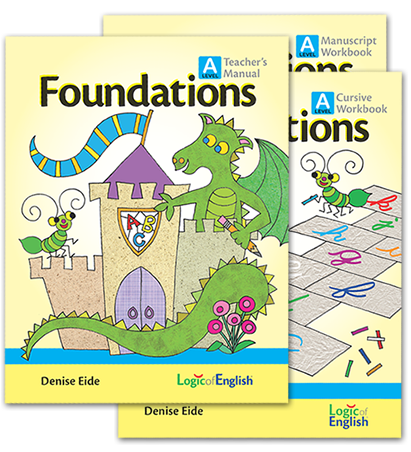
When we received the Foundations A package, I asked Jake (7) to bring it in the house. I heard a grunt and then a laugh before he asked me to get it instead. I teased him about not being strong enough to pick up the box. I mean, how heavy could it be? And then I lifted it up. Boy, was I wrong! I was surprised just how full it was of fun learning resources. Even though the materials are geared toward ages 4-7 and I was planning to use these with Alyssa (5), the boys were pretty impressed with the things, too.

  • Foundations A Teacher's Manual ($38)
  • Manuscript Workbook ($18)
  • Basic Phonogram Flash Cards ($18)
  • Red Manuscript Phonogram Game Cards ($10)
  • Blue Bookface Phonogram Game Cards ($10) 
  • The Rhythm of Handwriting Manuscript Tactile Cards ($28) 
  • The Rhythm of Handwriting Manuscript Chart ($10)
  • Student Whiteboard ($12) 
  • Phonograms App ($2.99)

The Foundations A Teacher's Manual includes 40 lessons and is very thorough. The book covers phonemic awareness, handwriting, and reading. The lessons are scripted so that you could read word-for-word if you so choose. The lessons are a bit long, but are broken into several activities. The beginning of each lesson lists the objectives and needed materials. There are also notes sprinkled throughout the book listing book ideas, teacher tips, and multi-sensory fun, and more. The manual is hard cover, colorful, easy-to-follow, and detailed.
The Manuscript Workbook is a consumable workbook full of fun learning activities. The pages are perforated if you want to tear them out. The book is colorful and has cute pictures that grabbed Alyssa's attention immediately. It also includes many games like bingo, reading basketball, matching, charades, etc. There are also places to practice handwriting. Alyssa loves completing workbook pages. She would have done 15 pages a day had we skipped everything else!


 The Basic Phonogram Flash Cards include the 74 basic phonogram. These large, sturdy cards list the phonograms, pronunciations, and examples. 

The Red Manuscript Phonogram Game Cards and the Blue Bookface Phonogram Game Cards are used throughout the lessons to reinforce the phonograms and have fun. These two cards are the same, except for the color. I have one child whose favorite color is red and another whose favorite is blue. Each child wants everything in his own favorite color. The things that are important to kids!

The Rhythm of Handwriting Manuscript Tactile Cards are great for practicing writing. The writing strokes, lower case letters, capital letters, and numerals are printed with a sandpaper texture. On the back of each card is the complete instruction for formation. All three kids and I had fun tracing the cards just to feel the bumpy texture. 


The Rhythm of Handwriting Manuscript Chart is a reference chart that includes systematic directions for writing each letter. The letters are grouped and color-coded by their initial stroke. It is a helpful tool in teaching proper letter formation.

The Student Whiteboard is a huge 11" x 16" double-sided, durable whiteboard. One side has one big set of handwriting lines, measuring 5 inches, while the other side has a set of 6 lines, 1 inch a piece. Alyssa loves using this board to practice her writing. My children have inherited my perfectionist gene. If she makes a mistake, she gets frustrated and unhappy. I explain that she's only 5 and still learning. Regardless, she's always liked using the whiteboard since it's easy to erase and fix the mistakes. Since this board is so large and sturdy, she can take it anywhere - couch, bed, table - and practice her letters. I think this board is well-worth the price.

The Phonograms App is an on-the-go way to review the phonograms. It let's the student hear the sound, see the phonogram, and touch the matching card. The app consists of matching the card to the sound or a simple flash card review. Alyssa was a little put-off by this originally. Since each sound is listed for phonogram (i = ĭ, ī, ē, y) it was a little overwhelming. I started hitting the correct answer before she could and turned it into a game. She had fun listening and pressing the letters and tried to beat me to them. And sometimes she did! 


Overall, we liked the program. The lessons are a little long. Since Alyssa already knows how to write, we didn't spend much time on the handwriting portion as it was written. We did review the letter strokes in helping her write them properly. She loved using the large whiteboard and the workbook. The colorful pictures and fun games are what she likes most. I appreciate the thoroughness of the program, along with the extra tips and activities. One of the things I love about homeschooling is that if a certain learning style isn't working for your student, you can change it up. Logic of English offers different options that will work. It's detailed, easy-to-use, and complete.


Logic of English offers other products as well. Some of my crew mates reviewed Essentials or Rhythm of Handwriting. You can read the reviews.


Pin It

Tuesday, May 7, 2013

Phonics and Readng with McGuffey App


My kids love using the iPad, and I love giving them educational apps to use. That's why I was excited to review Phonics and Reading with McGuffey from LiteracySoft.

The app is based on McGuffey's Eclectic Primer Revised Edition, the most successful education textbook of all time. The 53 lessons allow the student to learn at his own pace and gives him the confidence he needs to read at a first grade level.


The app is designed to accomplish the following:
  •  Ensure no expert phonics supervisor is needed for students to gain maximum value from the lessons
  • Work for any literacy level 
  • Act as your own personalized tutor, except in a computer 
  • Let students set their own pace, repeating or slowing down lessons as much as they like 
  • Guide your student step-by-step through reading and spelling practice 
  • Provide multi-sense learning including sound, vision, and motion to appeal to a wide variety of learning styles 
  • Utilize the power of synthetic phonics – the dyslexia-busting learning technique 
  • Be simple and easy to use for students at any level

I downloaded it to the iPad (also available for PC) and handed it to Alyssa, my 5-year-old. The set-up was easy. She chose a spot on the user screen and typed in her name. From there, she started the lesson. The app is designed to be the teacher, so my presence was not really needed. I sat with her as she completed the first few lessons, but she often went off by herself after that. (Though that was because she was trying to get away from her noisy brothers!) 

   
I really have mixed feelings about this app. For one thing, when it gives the sound of r in lesson one, instead of saying a true r sound, he says "ruh." It does the same thing with p, b, and g also. Alyssa used to pronounce the sounds correctly when she was sounding out words, but I've noticed her adding that "uh" to the end of the letter. 

Another pronunciation that I don't like is the word a. In this case, the word should be pronounced "uh," but it is said as a long a (ay) sound. 

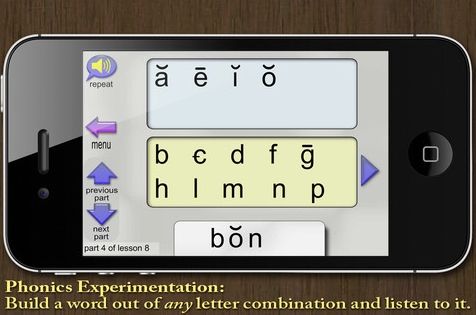
One more thing, and this may just be me being picky, but I'm a little undecided about the phonics blender section in the levels. While Alyssa (and her two brothers) loves switching the letters to make words, I'm not so sure it's helping with the spelling of real words. For instance, since the McGuffey Primer teaches the z sound of s (like in has) before it teaches the typical s sound (like in sat) or before it teaches the z sound, the app teaches it that way as well. So, as the kids were playing around, Alyssa decided to spell Zac's name since when she touched the s, it sounded like z. She wrote sac, but it pronounced it as Zac. Does that make sense? They were able to make many real (and silly) words as the lessons went on, but many times it was not as they were truly spelled. One of them would say, "Look, Mom, I made _____!" And though that's what the voice said aloud, that's not actually what they spelled. For instance, pal would be pronounced as pale because they chose the ā, mon is said as moon, rum becomes room because of the ū, and so on.


But there are some good points that I really like, too. For one thing, it matches up to the McGuffey Primer. We've used some of the McGuffey books with our oldest and now I can use the Primer right along with the app to reinforce what Alyssa is learning. And what's even better is that she likes using the app and even asks if she can do it! Even though little Zachy is only 3, he likes "playing" it, too. They always laugh at the silly little animated graphics and really enjoy making words in the phonics blender. While there are aspects that I don't like, the two of them are learning from it. I have seen an improvement in Alyssa's reading.


The full version of Phonics and Reading with McGuffey costs $19.99. You can also try the lite version or the first 10 lessons on the PC for free and download a free copy of McGuffey's Primer in color to aid in the lessons.


Want to see what other families thought about this app? You can head over and read more reviews from the Schoolhouse Review Crew.


Pin It