Showing posts with label book. Show all posts

Friday, June 5, 2020

Color & Composition

Disclaimer: I received a FREE copy of this product through the HOMESCHOOL REVIEW CREW in exchange for my honest review. I was not required to write a positive review nor was I compensated in any other way.


Anyone who knows us knows that my daughter is the art queen of the family. Naturally, she loves getting art-related materials to review. As someone who crafts daily, she's always looking for new skills, supplies, and ideas.

The books from Artistic Pursuits Inc. are some of her favorites and have been well-used over the years. We've learned about artists, art characteristics and styles during various time periods, and techniques. This time, she's been focusing on the creative process of art with ARTistic Pursuits, Middle School 6-8, Book 2 Color and Composition.


Artistic Pursuits was developed by Daniel an Brenda Ellis in 1999. What began as a single drawing book for high schoolers has evolved into full curricula from preschool all the way through high school. Their goal is to "develop experiences in the visual arts that allow children to create original works of art." Their program is designed to help students understand art concepts and enjoy the process of putting their own ideas and visual images on paper.

Color and Composition is the second book in the Middle School series. The books in the program can be used both by students with no prior art instruction and by those who are looking to advance their skills. They are designed to be used independently without parental instruction with instruction that is conversational and suited perfectly for a middle school student. The books have comb binding with clear, plastic covers.


The first book teaches students topics such as line, shape, value, symmetry, perspective, and proportion and focuses on one element of art per unit while exploring it in four unique ways. The second book  introduces the color wheel while strengthening observation skills. It covers techniques including blending, hatching, frottage, and working on colored paper all using either hard pastels or oil pastels.

Color and Composition provides lessons for 68 pastel drawings that are original to the student. As the student works through the book, his color skills advance as he learns about different hues, which ones compliment, how to balance and apply them, adding depth, creating a viewpoint, and more. Each unit features a famous artist of the past with a short biography, a brief cultural lesson teaching how the techniques were used around the world over the years, explanations, definitions, examples, an applicable challenge, and an engaging project.


My girl has been working through the book on her own. Many times a week, I'll find her at the kitchen table surrounded by papers and pastels. It might not be the intended way to approach the book, but I allow her to choose projects at will instead of working through it systematically. I never want art to feel like work that she must complete; I want her to follow her interests and desires and let her creativity be her guide. I have found that her interest is sparked more with this approach.


She has been practicing smooth and rough textures, drawing on a dark background, blending, combining color and texture, using frottage, and more. She learned that she can spray her works with hairspray to set the colors and used a chamois for the first time on a project.

Here are some of her thoughts on the book:


"I really like the sections on the artists and cultures and learning about the history. 
I liked learning about frottage, too. I had never done that before, and it's fun."


ARTistic Pursuits, Middle School 6-8, Book 2 Color and Composition is a great way for 6th-8th grade students to increase their art skills. Students learn a series of actions or steps to achieve their drawing goal as they learn the process of art based on elements. Instead of teaching step-by-step projects and giving specific ideas, the book teaches techniques and leaves the art subjects up to the student's own choosing.

Art is personal. Artistic Pursuits Inc. strives to bring out the artist in everyone.


You can connect with Artistic Pursuits on the following social media sites:

You can view more budding artists' works and read more reviews of this book and some of the others that were reviewed by my Crewmates by heading to the Homeschool Review Crew blog.

Art Through The Ages & Art for Children {Artistic Pursuits Inc. Reviews}
Pin It

Wednesday, March 25, 2020

George Washington Carver: From Slave to Scientist

Disclaimer: I received a FREE copy of this product through the HOMESCHOOL REVIEW CREW in exchange for my honest review. I was not required to write a positive review nor was I compensated in any other way.


If you know our family, you know that we love reading and that books are some of our favorite review items. My kids enjoy reading for a while each day on their own as the foundation of our education is literature, but they especially love when my husband or I read aloud to them. We read all sorts of books, but we've all grown to love biographies. We like reading about the lives of people, knowing that that events actually took place. The kids are fascinated to study the actions, vocabulary, foods, dress, and thinking of past periods and seeing the ways in which our lives differ.

The books from YWAM Publishing are our favorites for biographies, and I often recommend them to others. We like them so much, in fact, that we own over 30 of their books from various lines including the Heroes of History, the Christian Heroes: Then & Now, the Heroes for Young Readers, and even a couple of their audiobook biographies. When it came time to choose our next book, the kids all agreed on the title, mostly because of a peanut song that they sing, ha. They were eager to learn more through George Washington Carver: From Slave to Scientist by Janet and Geoff Benge.


George Washington Carver's life started with tragedy. He was sickly and small, born to a young slave woman. His father died before he was born, and shortly after, he and his mother were kidnapped by bushwackers. By God's grace, his masters, the Carvers, were able to reclaim the baby and bring him back from the brink of death. They had loved George's mother and never mistreated her or her children. They raised George and his older brother as their own. George grew up loving the outdoors and everything that went with it. He knew more about plants than anyone in town and often helped people tend their vegetation. He continued to learn on his own by experimenting in nature, and though he impressed those around him with his practical knowledge, he was never satisfied. He dreamed of furthering his education through formal schooling. At 11-years-old, he packed his few belongings and went on a search for knowledge.

The next few years were filled with ups and downs. George learned all he could where he was. Then he would pack up and move to a new place. Each time, he'd find work, offering to do anything and everything he could to make money while he lived with his employers. Even though he was an honorable and hardworking young man who earned the respect of everyone who knew him, he still dealt with racism and malicious people. His teenage years took many twists and turns, but each road lead to furthering his education. It was also a bumpy path through his college years, but he persevered through hard word and ingenuity.


George's passion for nature grew throughout his life. He continued helping anyone he could, but his passion was farmers, specifically black farmers. He wanted them to thrive and have the same opportunities that their white counterparts did. George was offered a job as head of the Agriculture Department at Tuskegee Institute, an all-black college run by Booker T. Washington. There, he truly found his calling and changed the course of the world.

God gave George Washington Carver the knowledge and motivation to find alternatives that impacted lives. Known as the Wizard of Tuskegee, he convinced farmers to change their crops, came up with many uses for both sweet potatoes and peanuts, created the Farmer's Institute to teach local farmers better practices of farm work and also taught practical tips to the wives, taught that if you look around, there are plenty of ways to make what you need yourself and save money, and became an influential scientist. George saw opportunity where others saw hardship. George Washington Carver's influence changed not only the way people lived, but they way they thought, as well.


Along with the book, we received the digital unit Study Guide. The guide helps to further your study including geography, social studies, and history, to name a few. It is designed to benefit all learning styles, group and individual study, and a wide range of ages.

The guide includes the following:

  • Key Quotes - six well-known quotes that can be used for memorization, understanding meaning, and displays
  • Display Corner - a list of objects, books, and photographs from Carver's life and places he lived that could be gathered and displayed to bring life to learning
  • Chapter Questions - four questions for each chapter: vocabulary, factual, comprehension, and open-ended interpretation (answers are at the end of the guide)
  • Student Explorations - essay writing, creative writing, hands-on projects, audio/visual projects, arts/crafts 
  • Community Links - meaningful field trips, guest speakers, service projects
  • Social Studies - reproducible maps, geography, terms/vocabulary, timeline, conceptual questions, 
  • Related Themes to Explore - history, science, literacy, music, military, popular culture
  • Culminating Event - project displays, cultural food, music, activities, oral presentations
  • Books and Resources - books, movies, documentaries, National Geographic articles, websites


The kids and I always enjoy the deeper study that comes from using the unit study guide. There are many different activities that reflect a wide range of learning styles, so there's something that appeals to everyone. Because there are so many options, it would be difficult to use the entire study. One thing that we always do with these studies is discuss the comprehension questions at the end of each chapter. It helps to review the story and understand it more fully. We especially enjoy the vocabulary review. Words like jubilantly, timidity, prestigious, systematically, and substantially are some of the words that are highlighted.

Normally we incorporate many of the hands-on activities to further our study, but things have been a bit different around here lately, and we haven't had a chance. We do have plans though to make a Chutes and Ladders board game to demonstrate the obstacle George Washington Carver experienced in this life, create a crossword puzzle about him, plant an egg carton garden, and make our own peanut butter again. There are many other activities, projects, and ideas to supplement the learning.


George Washington Carver: From Slave to Scientist has motivated us to find uses for things that are no longer "useful," look for purpose in our lives, and to love people--all people--as God loves them.


"Nothing is more beautiful than the loveliness of the woods before sunrise. At no other time have I so sharp an understanding of what God means to do with me as in these hours of dawn. When other folks are still asleep, I hear God best and learn His plan."
~ George Washington Carver ~
You can connect with YWAM Publishing on the following social media sites:


You can read more reviews of this book and other titles from YWAM Publishing on the Homeschool Review Crew blog.

32 Heroes of History {YWAM Publishing Reviews}
Pin It

Wednesday, March 11, 2020

Traveling Around the World and Through History with Carole P Roman Books

Disclaimer: I received a FREE copy of this product through the HOMESCHOOL REVIEW CREW in exchange for my honest review. I was not required to write a positive review nor was I compensated in any other way.


Anyone that knows our family knows that we love reviewing books. The foundation of our education is reading, so we're always looking for new and exciting literature to supplement our learning. Over the years, we've added many books by Carole P. Roman to our home library.

Over the last few years, Carole has written over 50 books and won countless awards for her works. Not only is she an accomplished author, she's a generous one, as well. We were able to choose any 4 of her titles. She has various series in her collection from books teaching about cultures and civilizations to bedtime stories to early reader chapter books to books about pirates teaching morals and more. Though they are all charming, we are partial to her If You Were Me series and were excited to read more. We received the following books from Carole P. Roman's assorted series:


If You Were Me and Lived in...Ancient China is one of the first books in the Ancient Civilizations Through Time collection. The books in this series are much more in depth and contain much more information than the Culture series books. Each one places you, the reader, in that location during that time period. This 75+ paperback gives a fantastic description of what it could have been like to live in China in A.D. 150. It explains what it may have been like to live during the Han dynasty when poetry and literature were encouraged and paper and porcelain were created. It explains the importance of the Silk Road and how it impacted the people of China. You learn about various occupations and how people were treated differently because of them, how houses were built and functioned, and what kind of foods were eaten. You'll read about how the family dynamic was greatly respected, about wearing tunics as clothing, how colors influenced decisions, a sign that someone had been punished, and the emphasis on numbers. There are pages teaching religion, education, professions, toys, music, and more.

The back of the book contains a glossary of places, things, and philosophies that are pertinent to that time and place. It also has a section of important or famous people and a description for each. These resources can be used as a springboard for further study.


If You Were Me and Lived in...the Ancient Mali Empire is another book that teaches kids about an ancient civilization. This one, taking place in the 1300s teaches all about living in the height of the Mali Empire, also known as the Mandingo Empire. Like the others in the series, it also teaches the main points of the period such as city life, religion, houses, occupations, clothing, food, and more. It explains about the importance of baggy pants, why the people relied on salt, what tradition women couldn't participate in, the meaning of the word Mali, and what gift a man would bring to ask for a wife. With more than 75 pages, there is a lot to learn.

Some of the famous people mentioned in the back include Inari Kunate, Abu Ishaq Ibrahim Al-Sahili, Sassouma Bereté, and Shihāb al-Dīn Abū al-Ábbās Ahmad B. Fadl Allāh al-Úmarī. Just don't ask me to pronounce them.


If You Were Me and Lived in...Brazil is one of 25 books that teach geography. Kids learn what it's like to live in different countries as they read through the Cultures Around the World series. The books follow a distinct pattern. The book begins with a picture of the country along with its capital and then shows where it is on the globe. Next is a brief description of the capital city. The book also gives examples of what you may have been named if you had been born there, what you'd call your parents, and what type of currency you'd use. It talks about popular places to visit (including the vast number of trees in the Amazon), some of the common foods (brigadeiros sound yummy), types of recreation (anyone can play Cinco Marias), and a special holiday (bring on the parades).

There are other facts, too, like the word for school, where the president lives, and more. The last few pages of the book are filled with the pronunciations of the foreign words used along with brief definitions.The pronunciations are also found written throughout the story, but it's convenient to have a list of these words in one place. Around 30 pages in length, the book can easily be read in a single sitting.


If You Were Me and Lived on...Mars is a fun addition to the Cultures collection. Instead of focusing on a country, this book describes to kids what it might be like to live on the distant Red Planet. How would you travel there? How long would it take? Why would you have to wait two years to make the return trip home? It's all explained in this 40+ page book. It talks about physical aspects of the planet, like why its color is red, what it is made of, the consistency of the atmosphere, and where it is in the solar system. It explains how you would have to bring all supplies from Earth to survive the harsh conditions and what you would have to do in order to live there. There's information about moons, temperature, gravity, and dust storms. If you have a space-loving kiddo like my 7-year-old, this is a great book!


My kids and I enjoyed these books greatly. With literature being the focus of our schooling, I depend on living books for the majority of our learning. A book that puts you in the story and teaches without feeling like work is the preferred way to learn history in our home. These books are not full curricula on the topics, by any means, but they are a wonderful introduction. We had many "rabbit trail" discussions that were encouraged by the stories and took the time to look up pictures and more information along the way. The pictures are colorful and fill the pages. 

The kids have been walking around saying Timbuktu just because it's fun, quoting Confucius sayings, making a grocery list for homemade pão de queijo, and dreaming about viewing Earth from outer space. Traveling around the world and through history using books is a great way to learn about the world around us!

If you'd like to learn more about cultures of our world or civilizations of the past, Carole P. Roman has many award-winning options to choose.


You can connect with Carole P. Roman on the following social media sites:


You can learn more abut Carole P Roman's wonderful books by reading more reviews on the Homeschool Review Crew blog.

Carole P. Roman's Histroy, Geography, Bedtime & Captain No Beard series {Carole P. Roman Reviews}
Pin It

Thursday, November 21, 2019

LitWits


Many people know that literature is near and dear to our hearts. Our family reviews books quite often, but it's always fun when we receive resources that help us enhance our study of classic books. Even though my kids spend a large portion of their school day quietly lost in a story, I still work to incorporate read-aloud selections as a family. Quite often, the kids will be building with Legos, sketching, or crafting as they listen to me read. If they keep their hands busy, it help their minds to focus on my words. We've spent many, many hours together in this way. 

Sometimes we read simply to enjoy both the story and our time together, but other times, we like to dwell on themes and principles through enrichment activities. We've used many different resources over the years to deepen our learning, but recently we were introduced to LitWits. Even though this was a new company for us, I was immediately drawn to their style of education. Their LitWits Kits start with great books and then engage students in fun, hands-on, and meaningful activities.


LitWits was founded in 2010 by two sisters, Becky and Jenny. The pair have backgrounds in literature and journalism, and both have experience with teaching. Growing up, they thrived on good books and spent their days reading and reenacting the stories. They got older and wanted to share their love of books with others. At LitWits Workshops, they conduct experiential literature classes for ages 7 and older in Santa Cruz. Obviously, not everyone can make a trip to California, so the sisters have adapted their classes for classroom and homeschool teaching in the LitWit Kits.

Over 100 books have been brought to life through the LitWits workshop through the years. Nearly half of those have been converted into downloadable kits. We had the opportunity to choose 4 titles to use in our home. For a literature-loving family, this was no easy task! I eventually settled on the following kits:

A Wrinkle in Time
Alice's Adventures in Wonderland
Charlie and the Chocolate Factory
The Wonderful Wizard of Oz

Maybe it's because we just finished a biography read aloud or because I'm personally reading a heavy historical account on my own, but I realized all the books I had chosen were fantastical and whimsical. I knew they would be the perfect books to bring to life with my kids.


I had recently purchased A Wrinkle in Time to read with my kiddos since I had surprisingly never read it myself. That was an obvious choice and the perfect first kit for us to use. Since you read the story in its entirety before starting the activities, I grabbed the book and a cup of tea while the kids gathered some toys, and we spent a few days traveling the universe. Once we returned, we delved right into the kit.

Each LitWit Kit includes the following:
  • sensory prop ideas -- see, hear, and smell what the characters did
  • bookbites ideas -- taste what the characters ate
  • creative project ideas & instructions/templates -- make something a character made
  • kinetic activity ideas & instructions/prompts -- do what a character did or should have done
  • academic handouts -- learn the story's narrative, vocabulary, setting, and more
  • creative writing handouts -- write what a character wrote or felt
  • takeaway topics -- know what the characters knew
  • learning links -- learn more about the characters' world
  • audiovisual links -- see and hear the characters' world


You can access all of the materials on their site (either by scrolling or clicking the section title) or download it directly to your device. All of the activities list supplies and directions along with the application to the story. There are also pictures included from the student workshops.

Some of the sections have questions and prompts to get your kids thinking more about the story and deeper about other things in life. For instance, while we were scaling the solar system with objects from around the house, we talked about how to remember the planets in order, just how far we are from the sun in light years, and tried to fathom how large the universe truly is. We even got a view of the basketball sun from the marble planet of Pluto.


My kids had a lot of fun making origami cubes and transporting themselves into scenes from the story, dressing up their little brother as Mrs. Whatsit, creating their own odd characters in a writing prompt, eating "alien eyeballs" while listening to space music in the dark, and more.

Along with the hands-on activities and worksheet handouts, there are many learning links to take your study deeper. There are links about the book and author, including a biography, videos, reviews, an obituary, and others. There are nearly two dozen links to supplement ideas in the story from learning about the Kennedy Space Center to study about the Theory of Relativity and irrational numbers to viewing images of the brain. We even learned the difference between hot chocolate and hot cocoa!

You can take your study even deeper by learning about specific warriors against the Black Thing (think Jesus, Einstein, Shakespeare, Bach, etc.) There is an entire Beyond the Book section and many audiovisual resources. There is also a Pinterest board dedicated to A Wrinkle in Time with additional ideas.


There are so many learning opportunities included in this one kit that we might choose to study it for weeks still! Even though we're still very much involved in the A Wrinkle in Time activities, I'm eager to get started with the other kits, too.

We'll send Alice tumbling down an interactive rabbit hole and eat delicious little cakes in Alice's Adventures in Wonderland, become the characters while determining their responses and actions and invent magical candy prototypes in Charlie and the Chocolate Factory, and create tiny Kansas tornadoes in jars and learn about perspective and clarity while transforming our world through DIY green spectacles in The Wonderful Wizard of Oz. The possibilities are endless once we add in all the supplemental links, too!


The LitWits kits are the perfect combination of literature and intentional learning. They are filled with both worksheets and hands-on activities along with additional links for further study. Because there are many opportunities for learning, it is easy to adapt the plans to fit your needs. You can do a quick review adding in a few projects or lengthen the study by incorporating additional subtopics and ideas from the book.

If you love good literature and expounding on its aspects like we do, LitWits might have the perfect resource for you.


You can connect with LitWits on the following social media sites:

You can learn more about additional LitWit Kits by reading the reviews on the Homeschool Review Crew blog.

LitWits Kits {LitWits Reviews}
Crew Disclaimer
Pin It

Wednesday, November 13, 2019

Appaloosy Horse Books

* This post may contain affiliate links.

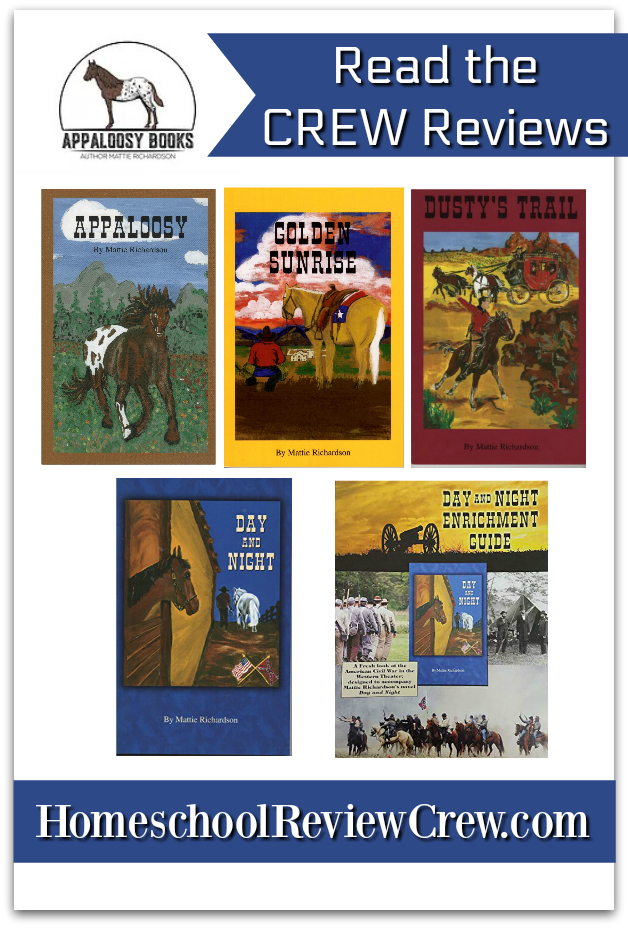
Anyone who knows our family knows that we love to review books. Since the foundation of our schooling is literature, I require my kids to read a substantial amount every day. There is a lot to be learned from fiction, and the kids generally relish in it daily, however, I also insist that they read nonfiction, too. I always appreciate when we find books that blend the two types, ones that teach factual history through a fictional story. That is what we received from Author Mattie Richardson/Appaloosy Books.


Mattie Richardson has been called "North Dakota's Teen Author" as she wrote her first book at 13 years old. She has since written more books while juggling a full-time journalist job and a part-time music career. She also speaks to schools and groups to encourage other young writers. Horses are another passion of hers and evidently the inspiration of Mattie Richardson's Horses in History Series. We received all four books in the series and couldn't wait to learn about the past.

The Horses in History series is just that, horses in history. Mattie's stories each highlight a portion of history and the importance of horses during that time.  We've heard these accounts from men over the years, but Mattie lets us see the stories from the horses point of view. These original narratives add a whimsical touch that helps ages 8-14 get a better understanding of our past.


My 11-year-old read three of the books and helped me with the summaries.

Appaloosy  is set in 1877 during thr Nez Perce War. It is 125 pages.
It's about an Indian's horse named Storm. The Indian breaks him, but didn't wear a saddle. The Indians and the White men battle and Storm is stolen and sold. The man who bought him thought the horse is good for nothing, so he sold him to a girl named Faith. Storm liked the girl, but since she didn't know his name, she renamed him Star. He got to know Faith and her family, and then he was stolen again with the rest of the family's horses. The horses escaped and had the choice to be free horses or return to Faith. He chose to return. 

Dusty's Trail takes place in the early 1860s during the Pony Express era and is nearly 75 pages long.
It's about a horse named Dusty. His owner Levi wanted to get a job with the Pony Express to help care for his widowed mother. She was afraid to lose him, but he ran away and took the job. They spent their days riding from place to place. One day, they show up at a station to find that all the people were dead and the horses stolen. Levi and Dusty rode to the next station to warn the people. Dusty became famous because he was so fast and ran so far as a cow horse. Then, Indians attacked. Levi fell off and was captured while Dusty ran away. Eventually, Dusty decided to save Levi. Another horse named Ace went with him. A man tried to capture the horses, but some flour from the man's wagon fell on Dusty and made him white. The horses escaped and made it to Indian Territory. Dusty found Levi tied up in a teepee. As they were escaping, the Indians woke up. Since Dusty was white from the flour, the Indians thought he was a spirit and let them leave. Dusty became famous again.   

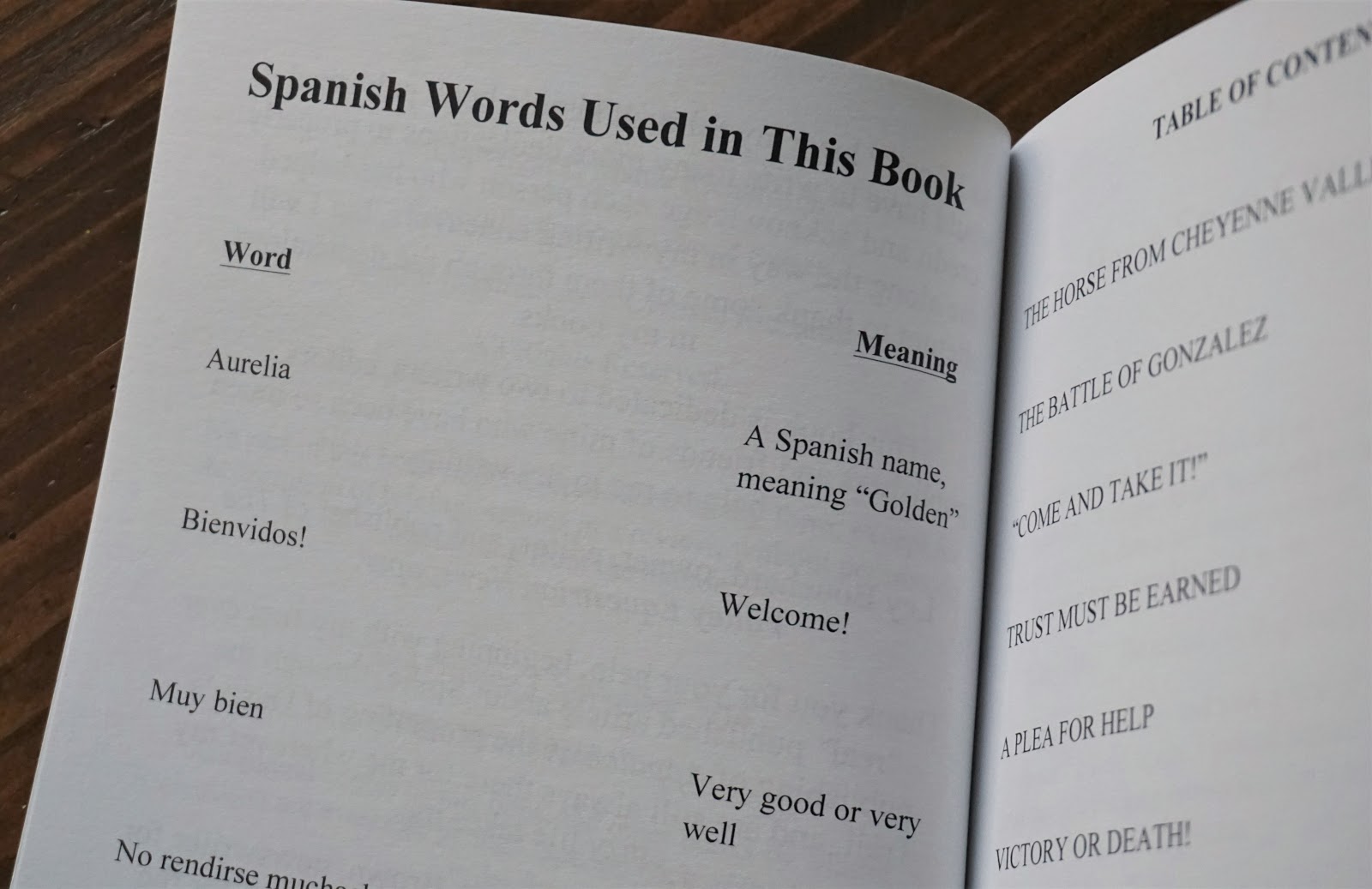
Golden Sunrise centers around the Alamo in 1936 and is just about 100 pages. It is sprinkled with Spanish words to add to the authenticity. 

The story is told by Cheyenne, a Golden Palomino in Northern Texas. Cheyenne's owner, Jared, longs to become a volunteer soldier in Texas's fight for independence. The pair becomes stationed in San Antonio to help defend Fort Alamo. As the battles rage, Cheyenne and Jared hide a cannon, help protect each other, and befriend James Bowie and Davy Crockett.

When Jared died at the hand of the Mexicans, Cheyenne became moody and withdrawn and refused to eat. It took the loving touch of Jared's younger brother Austin and his use of her secret name to restore her will to live. Over time, Austin gained her complete trust and friendship. As Texas became free and independent, the new friends vowed to "Remember the Alamo!" 


Day and Night is set during the Civil War and is around 150 pages in length.
It's about two horses: Shiloh and Tucker. The chapters swap back and forth between the two horses. They are as different as day and night. Tucker is sold to a man who needed a work horse. Eventually the Yankees come and called him a Rebel and stole his horse. Tucker was sold to the army. He ended up with a man named Ben. They went through war until he proved himself. Then he became a colonel's horse. In battle, he saw his brother Shiloh, but he didn't recognize him at first. At the next battle, someone got shot, and Ben offered to help. 
Shiloh was sold as a last resort because his owner needed money. The man who bought him was really mean. Shiloh was stolen by a girl. When her mother wouldn't let her join the army, she ran off with the horse. She then asked the general if she could join, but since she was a girl, he wouldn't let her. She decided to cut her hair off, pretended to be a boy, and changed her name. The men let her join. In battle, Sarah was shot. Ben offered to take her to a doctor, but since she was really a girl, she refused. Ben stitched her up. 
In the end, Ben and Sarah got married and the horse brothers were united again.    

The beginning of each book has a list of words the reader should know. There are both foreign words and period words that are no longer commonplace. Each one is given a short definition to help the story flow.

The end of each book dedicates a few pages to a Blast from the Past, which is the background history from which the story is set. Of course, there is information about the wars, but other interesting facts are noted as well, including how the appaloosa horses got their name, what a quarter horse is, the mystery behind the word palomino, and more.


Along with the four paperback books, we received the PDF version of the Day and Night Enrichment Guide. The guide is divided into eight parts that correspond to the book. The first seven sections follow the same format:
  • Reading Comprehension
  • Vocabulary
  • History
  • A Soldier's Life
  • Living History Activity
  • Geography
  • Horses and History
  • Creating Your Own Stories
  • Biography
  • Further Reading  
The last section finishes up the story with a conclusion and optional field trip activity.

The guide has nearly 100 pages of enrichment ideas: fill-in-the-blank, short answer, coloring, crafts, map work, recipes, word search, and more. There are photographs and much historical information to supplement your study of the Civil War. There is a full accompanying answer key, as well.

This impressive enrichment guide is packed full of information. It could easily be used as a full study on the Civil War.


Day and Night was my daughter's favorite because it followed the story lines of the two horses. She appreciated the historical information woven into the books.

If your child is interested in horses and the past, you should consider Mattie Richardson's Horses in History Series.


You can connect with Mattie Richardson and Appaloosy Books on the following social media sites:
Facebook
Instagram
Twitter


You can read more reviews of these books on the Homeschool Review Crew blog.

Book Set: Appaloosy, Dusty's Trail, Golden Sunrise & Day and Night {Mattie Richardson/Appaloosy Books Reviews}

* Some of the links in the content above are affiliate links. If you click on a link and purchase an item, I may receive
an affiliate commission. Regardless, I recommend products or services that I have used personally and all the text
and opinions are my own. I am disclosing this in accordance with the Federal Trade Commission's 16 CFR, Part 225.

Crew Disclaimer
Pin It

Wednesday, November 6, 2019

Goldtown Beginnings


Our family is always reading, so it's no surprise that we love book reviews! I have a little one just learning to read all the way through a high schooler who is an advanced reader. We have many picture books and even more novels for the older ones, but I've realized it's trickier to find good books for kids who are just venturing into chapters. If your child is ready for more complex sentence structures, a richer vocabulary, and a much heavier emphasis on words over pictures, this new series from Kregel Publications might be perfect for you.

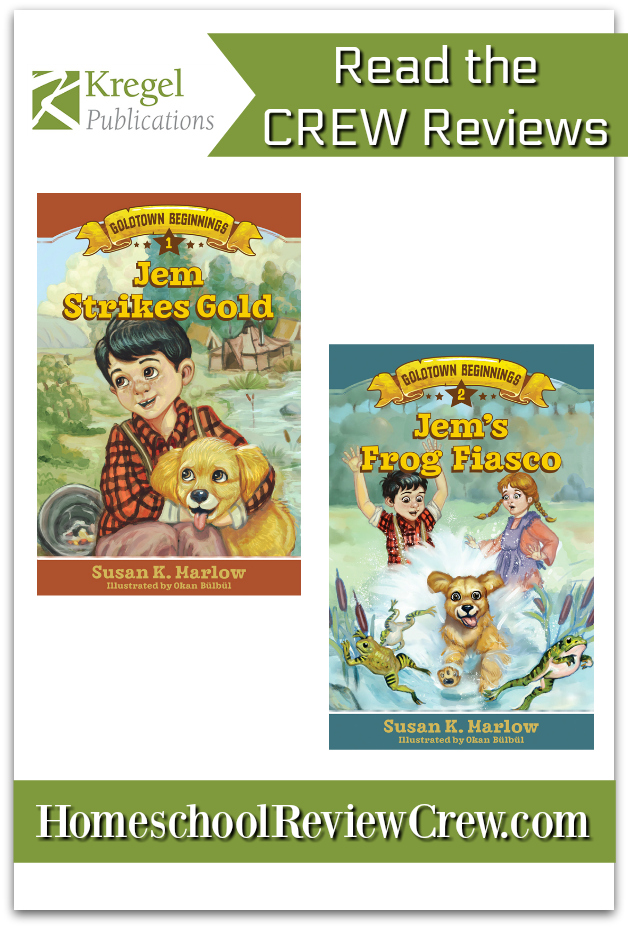
My boys have been enjoying the first couple books in this six-book series: Jem Strikes Gold and Jem's Frog Fiasco.


Kregel Publications was founded in 1949 to provide quality, life-changing, Christian resources to pastors, missionaries, teachers, and leaders. Their mission is "to develop and distribute--with integrity and excellence--trusted, biblically based resources that lead individuals to know and serve Jesus Christ." They now offer over 1,000 titles on Christian education and ministry, contemporary issues, reprints of classic works, and more. Their fiction selections appeal to adults as well as children, as seen in these Goldtown books from author Susan K. Marlow. Along with authoring dozens of books, Susan was a homeschooling mom, taught writing workshops, and cares for a 14-acre homestead. Some of her other books include the Circle C Stepping Stones that we reviewed a couple years ago.

The Goldtown Beginnings series follows the life of Jem Coulter, a nearly 8-year-old boy living in California during the Gold Rush. The stories weave in interesting characters as they teach history in a fun, exciting way. Each book is less than 80 pages long, 10 chapters, and geared toward the lower elementary ages.


My 7- and 9-year-old boys read the stories. I asked the older one to help me with the summaries. Here is what he said about Book one, Jem Strikes Gold:
Jem was panning for gold and found a small gold flake. His fingers were too big to pick it up. His sister Ellie wanted to help, but he wouldn't let her. He eventually gave in since her fingers were smaller. After that, it was time to deliver his mom's pies to the miners. They pulled a wagon with the pies and got gold nuggets as payment. Everyone was living in tents and trying to make enough money to survive. 
Before they finished delivering the pies, a rich boy named Will started picking on them. He tried to steal a pie, so Jem pushed him. Will pushed him back and made Jem fall in the wagon on top of the pies. His pants were covered in mushy blueberry pie. When they got home, Ellie told her mom everything that happened. Their parents comforted him and told him it was ok. They helped cleaned everything up. The Jem and his dad delivered more pies. 
Next, their neighbor had a dog follow him home. Jem and Ellie wanted it, but they knew their parents wouldn't let them have it because they couldn't feed it. The dog kept following them though and would play with them all the time. When they went to deliver pies again, the dog followed and bit Will's pants when he started teasing them. Their mom was happy and let them keep the dog and their dad found some gold. They named the dog Gold Nugget.

 Here is my son's description of Jem's Frog Fiasco:
Jem and Ellie went to deliver pies again. Jem wanted to get another job, so he went to the cafe to ask for one. The cafe owner said he could have a job catching bull frogs to put on the menu. When Jem and Ellie went to catch bull frogs, they saw one. Ellie tried to get it. When she grabbed it, she started screaming. Then it slipped out of her hand. All the other bull frogs hopped away. 
The next time they went to catch them, Jem wanted to do it by himself, but Ellie tried  to help anyway and scared the all the frogs away again. Then he yelled at her and she stomped home. Jem waited a while and caught a lot of bull frogs. After he caught them, he couldn't lift the pail, so he had to drop a few out. When he went home, he realized Ellie wasn't there. Everybody in town went looking for her. Someone told Jem to use Gold Nugget to find Ellie. The dog sniffed Ellie's doll and found Ellie in a coyote hole. He got her out and they went home. Jem realized he wasn't being nice and Ellie forgave him.  

One thing that I appreciate about Susan's books is her passion for teaching. She realizes that books for young kids can be much more than simply entertainment. Each one contains a list of new words that might be more advanced. Vocabulary such as pesterfiascohoarse, and tuckered out are listed and given a brief description so the reader can better understand the text. The end of each book contains a short two-page history of a relating topic from the story, in this case, gold miners and coyote holes.

Not only that, but she offers many other learning resources to enrich the experience. There is an activity guide that offers a daily schedule, a lapbook that includes read-to-be-cut colored pages, and coloring pages that correspond directly to the books. The free activity pages include something for each chapter. There is a wide variety of exercises: short answer, vocabulary matching, maze, math problems, writing prompts, Bible lessons, dot-to-dot, and more. There are also activities that involve drawing, cutting and gluing, graphing, and a recipe. A full answer key is at the end of the guides.


The Goldtown Beginnings books are morally sound and filled with much learning. They are great as both read alouds and silent reading for 1st-3rd grade or so. My guys enjoyed the stories and had fun completing some of the activities.

I can't wait to see which adventure Jem has next as the series continues!


You can connect with Kregel Publications on the following social media sites:
Facebook
Instagram
Twitter


You can read more reviews of these books on the Homeschool Review Crew blog.

Jem Strikes Gold & Jem's Frog Fiasco  {Kregel Publications Reviews}

Crew Disclaimer
Pin It