Showing posts with label YWAM. Show all posts

Wednesday, March 25, 2020

George Washington Carver: From Slave to Scientist

Disclaimer: I received a FREE copy of this product through the HOMESCHOOL REVIEW CREW in exchange for my honest review. I was not required to write a positive review nor was I compensated in any other way.



If you know our family, you know that we love reading and that books are some of our favorite review items. My kids enjoy reading for a while each day on their own as the foundation of our education is literature, but they especially love when my husband or I read aloud to them. We read all sorts of books, but we've all grown to love biographies. We like reading about the lives of people, knowing that that events actually took place. The kids are fascinated to study the actions, vocabulary, foods, dress, and thinking of past periods and seeing the ways in which our lives differ.

The books from YWAM Publishing are our favorites for biographies, and I often recommend them to others. We like them so much, in fact, that we own over 30 of their books from various lines including the Heroes of History, the Christian Heroes: Then & Now, the Heroes for Young Readers, and even a couple of their audiobook biographies. When it came time to choose our next book, the kids all agreed on the title, mostly because of a peanut song that they sing, ha. They were eager to learn more through George Washington Carver: From Slave to Scientist by Janet and Geoff Benge.


George Washington Carver's life started with tragedy. He was sickly and small, born to a young slave woman. His father died before he was born, and shortly after, he and his mother were kidnapped by bushwackers. By God's grace, his masters, the Carvers, were able to reclaim the baby and bring him back from the brink of death. They had loved George's mother and never mistreated her or her children. They raised George and his older brother as their own. George grew up loving the outdoors and everything that went with it. He knew more about plants than anyone in town and often helped people tend their vegetation. He continued to learn on his own by experimenting in nature, and though he impressed those around him with his practical knowledge, he was never satisfied. He dreamed of furthering his education through formal schooling. At 11-years-old, he packed his few belongings and went on a search for knowledge.

The next few years were filled with ups and downs. George learned all he could where he was. Then he would pack up and move to a new place. Each time, he'd find work, offering to do anything and everything he could to make money while he lived with his employers. Even though he was an honorable and hardworking young man who earned the respect of everyone who knew him, he still dealt with racism and malicious people. His teenage years took many twists and turns, but each road lead to furthering his education. It was also a bumpy path through his college years, but he persevered through hard word and ingenuity.


George's passion for nature grew throughout his life. He continued helping anyone he could, but his passion was farmers, specifically black farmers. He wanted them to thrive and have the same opportunities that their white counterparts did. George was offered a job as head of the Agriculture Department at Tuskegee Institute, an all-black college run by Booker T. Washington. There, he truly found his calling and changed the course of the world.

God gave George Washington Carver the knowledge and motivation to find alternatives that impacted lives. Known as the Wizard of Tuskegee, he convinced farmers to change their crops, came up with many uses for both sweet potatoes and peanuts, created the Farmer's Institute to teach local farmers better practices of farm work and also taught practical tips to the wives, taught that if you look around, there are plenty of ways to make what you need yourself and save money, and became an influential scientist. George saw opportunity where others saw hardship. George Washington Carver's influence changed not only the way people lived, but they way they thought, as well.


Along with the book, we received the digital unit Study Guide. The guide helps to further your study including geography, social studies, and history, to name a few. It is designed to benefit all learning styles, group and individual study, and a wide range of ages.

The guide includes the following:

  • Key Quotes - six well-known quotes that can be used for memorization, understanding meaning, and displays
  • Display Corner - a list of objects, books, and photographs from Carver's life and places he lived that could be gathered and displayed to bring life to learning
  • Chapter Questions - four questions for each chapter: vocabulary, factual, comprehension, and open-ended interpretation (answers are at the end of the guide)
  • Student Explorations - essay writing, creative writing, hands-on projects, audio/visual projects, arts/crafts 
  • Community Links - meaningful field trips, guest speakers, service projects
  • Social Studies - reproducible maps, geography, terms/vocabulary, timeline, conceptual questions, 
  • Related Themes to Explore - history, science, literacy, music, military, popular culture
  • Culminating Event - project displays, cultural food, music, activities, oral presentations
  • Books and Resources - books, movies, documentaries, National Geographic articles, websites


The kids and I always enjoy the deeper study that comes from using the unit study guide. There are many different activities that reflect a wide range of learning styles, so there's something that appeals to everyone. Because there are so many options, it would be difficult to use the entire study. One thing that we always do with these studies is discuss the comprehension questions at the end of each chapter. It helps to review the story and understand it more fully. We especially enjoy the vocabulary review. Words like jubilantly, timidity, prestigious, systematically, and substantially are some of the words that are highlighted.

Normally we incorporate many of the hands-on activities to further our study, but things have been a bit different around here lately, and we haven't had a chance. We do have plans though to make a Chutes and Ladders board game to demonstrate the obstacle George Washington Carver experienced in this life, create a crossword puzzle about him, plant an egg carton garden, and make our own peanut butter again. There are many other activities, projects, and ideas to supplement the learning.


George Washington Carver: From Slave to Scientist has motivated us to find uses for things that are no longer "useful," look for purpose in our lives, and to love people--all people--as God loves them.


"Nothing is more beautiful than the loveliness of the woods before sunrise. At no other time have I so sharp an understanding of what God means to do with me as in these hours of dawn. When other folks are still asleep, I hear God best and learn His plan."
~ George Washington Carver ~
You can connect with YWAM Publishing on the following social media sites:


You can read more reviews of this book and other titles from YWAM Publishing on the Homeschool Review Crew blog.

32 Heroes of History {YWAM Publishing Reviews}
Pin It

Wednesday, April 10, 2019

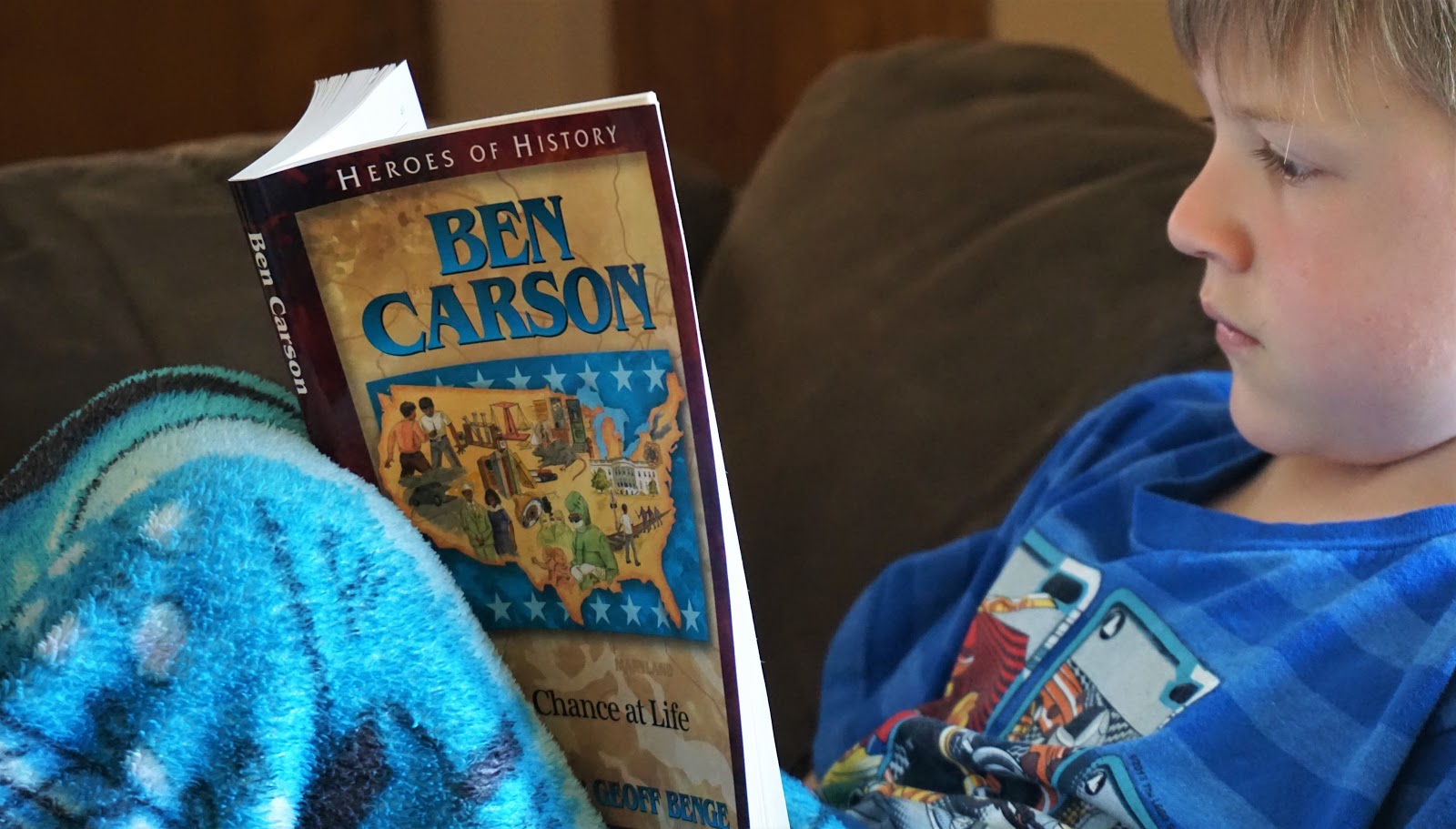
Ben Carson: A Chance at Life


If you know our family, you know that we love reading and that books are some of our favorite review items. My kids enjoy reading for a while each day on their own as the foundation of our education is literature, but they especially love when my husband or I read aloud to them. We read all sorts of books, but we've all grown to love biographies. We like reading about the lives of people, knowing that that events actually took place. The kids are fascinated to study the actions, vocabulary, foods, dress, and thinking of past periods and seeing they ways in which our lives differ.

The books from YWAM Publishing are our favorites for biographies, and I often recommend them to others. We like them so much, in fact, that we own over 30 of their books from various lines including the Heroes of History, the Christian Heroes: Then & Now, the Heroes for Young Readers, and even a couple of their audiobook biographies. One might think that we wouldn't be excited to receive another one of these books, but my kids were thrilled to choose another title. This time, our study of the past didn't take us back hundreds of years. Instead, we learned about an influential person still living in Heroes of History - Ben Carson: A Chance at Life by Janet and Geoff Benge.


 As I listed off names for the kids to choose, I came to Ben Carson. "Who's that?" they asked. I read aloud the description for the book on the website to whet their appetite. By the time I finished, all the kids decided they needed to know more. What made his story even more intriguing to them is the fact that Ben Carson grew up about 30 minutes away from where we live.

The book begins at a pivotal time in Ben Carson's life. His father had just left the family, leaving his mother to raise him and his brother alone. They lived in a poor section of Detroit, but his mother was determined to make a better life for the family. She worked three jobs, moved out of state with family for a time to save money, and was willing to work hard. She taught her boys a strong work ethic, too, and insisted that they turn off the television and spend their time reading instead of filling their days with mindless entertainment. Consistently reading two books a week and writing reports along with being fitted for glasses, made an improvement in Carson's education. His grades began to soar as he rose to the top of every class.

Carson continued to put his all into his studies as he worked through the JROTC (Junior Reserve Officers' Training Corps) program, attended Yale University, and excelled at his temporary summer jobs. He got married, finished med school, and started a family.


During his residency years, Carson became intrigued by brain surgery and was eager to simplify the process. Where others saw challenges, he saw opportunity. He used X-rays to quickly locate the foramen ovale, preformed a lobectomy to save a man's life, and studied brain tumors through New Zealand white rabbits and MRI machines.

Carson preformed many well-known surgeries including separating multiple conjoined twin sets and many brain hemispherectomies. He became greatly revered, not only in his specific medical field, but also for his advocacy of education. He traveled for both passions--to various countries to preform surgeries and all across the United States to speak at schools and rallies. He has influenced many and saved countless lives. His work ethic, dedication to education, and dependence on God has made him a role model for all.


Along with the book, we received the digital unit Study Guide. The guide helps to further your study including geography, social studies, and history, to name a few. It designed to benefit all learning styles, group and individual study, and a wide range of ages.

The guide includes the following:
  • Key Quotes - seven well-known quotes that can be used for memorization, understanding meaning, and displays
  • Display Corner - a list of objects, books, and photographs from Carson's life and places he lived that could be gathered and displayed to bring life to learning
  • Chapter Questions - six questions for each chapter: vocabulary, factual, comprehension, and open-ended interpretation (answers are at the end of the guide)
  • Student Explorations - essay writing, creative writing, hands-on projects, audio/visual projects, arts/crafts 
  • Community Links - meaningful field trips, guest speakers, service projects
  • Social Studies - reproducible maps, geography, terms/vocabulary, timeline, conceptual questions, 
  • Related Themes to Explore - history, science, literacy, music, military, popular culture
  • Culminating Event - project displays, cultural food, music, activities, oral presentations
  • Books and Resources - books, movies, documentaries, National Geographic articles, websites


The kids and I always enjoy the deeper study that comes from using the unit study guide. There are many different activities that reflect a wide range of learning styles, so there's something that appeals to everyone. Because there are so many options, it would be difficult to use the entire study. One thing that we always do with these studies is discuss the comprehension questions at the end of each chapter. It helps to review the story and understand it more fully. We especially enjoy the vocabulary review. Words like immaculately, quell, meticulously, abolished, and intractable are some of the words that are highlighted.
   
To further our study, we experimented with one of our chemistry sets, practiced suturing after a surgery by sewing felt, observed various objects through a microscope, filled in a map of Michigan, researched more about lobectomies and conjoined twins, and had many conversations on the importance of education. Some of the other activities we would like to incorporate include creating a model of the brain with clay, drawing a map of Australia or South Africa, write a Proverb in calligraphy, and read one of the books written by Carson himself. There are many other activities, projects, and ideas to supplement the learning.


To say that we enjoyed this book is an understatement! I have read many of these biographies from YWAM Publishing and this is easily my favorite one. There are many life lessons that are underlying themes throughout the entire book: don't judge a person by their looks, you can change your circumstances through hard work, reliance on God is crucial, reading and education are keys to a successful life, and more. My kids and I had many good conversations while reading this. I especially love how much attention was made to reading. Literature is a huge part of our education. It was encouraging to point out to my kids how important it is to someone as successful as Ben Carson, as well.

There are some intense sections of the book, such as step-by-step details of surgeries. My daughter left the room during one such description of a hemispherectomy as it spoke about drilling into the skull, cutting through skin and tissue, removing pieces of the brain, and dealing with extreme blood loss. The boys, however, were fascinated. In fact, one of them was so enthralled with the story that he asked to reread it himself as soon as I finished reading it to them. 


Heroes of History - Ben Carson: A Chance at Life has motivated us to learn more about the surgeon with "gifted hands." We are inspired to read one of his books to study deeper about his philosophies and put them into practice.

Until then, we'll remember the poem his mom quoted that shaped his life:

If things go bad for you
And make you a bit ashamed,
Often you will find out that
You have yourself to blame.
Swiftly we ran to mischief,
And then the bad luck came.
Why do we fault others?
We have ourselves to blame. 
You can connect with YWAM Publishing on the following social media sites:


You can read more reviews of more great books and study guides offered by YWAM Publishing on the Homeschool Review Crew blog.


Crew Disclaimer
Pin It

Tuesday, May 1, 2018

Liberty and Justice for All


Our family loves to read, so it's no surprise that our favorite reviews often are of books. The kids enjoy reading for a while each day on their own, but they especially love when my husband or I read aloud to them. We read all sorts of books, but the older kids have grown to love biographies. They like reading about the lives of people, knowing that that events actually took place. They're fascinated to study the actions, vocabulary, foods, dress, and thinking of past periods and seeing they ways in which our lives differ.

The books from YWAM Publishing are our favorites for biographies, and I often recommend them to others. We like them so much, in fact, that we've purchased over 30 of them throughout the past few years. I knew my kids would enjoy adding William Penn: Liberty and Justice for All to our collection and incorporating the accompanying Digital Unit Study guide. This book is part of the Heroes of History series written by Janet and Geoff Benge, which contains exciting biographies of men and women who shaped the course of history through their remarkable stories.


The book begins with William Penn as a young boy in London. King Charles had just been killed, Oliver Cromwell claimed leadership, and the country was in a refashioning era. William's father, Sir William Penn, admiral of the navy, was at sea most of the time. William's childhood was a life of luxury and favor. He had the nicest clothes, attended the best schools, and was welcomed in the highest class of society.

Penn loved to discuss politics and religion and was intrigued to learn different viewpoints. It was a friendship with Puritan believers at Oxford University that changed the course of his life. As the country turned against those who did not hold to the beliefs of the Church of England, Penn began to side with the dissenters. He was kicked out of school, spent time in prison, and was disowned by his father.

Over the years, he wrote many publications for the Quaker beliefs; became a leader of religious tolerance; helped to free thousands of people from prison; preached his ideals throughout England, the Netherlands, and Germany; and founded Pennsylvania his "Holy Experiment" as a place of religious and political freedom. He experience much loss, betrayal, multiple unjust trips to prison, and disappointments, but he paved the way for religious liberty, established a place of tolerance, and touched countless lives. William Penn never stopped fighting for the dream he so earnestly believed in.    


Along with the book, we received the digital unit study guide. The guide helps to further your study including geography, social studies, and history, to name a few. It designed to benefit all learning styles, group and individual study, and a wide range of ages.

The guide includes the following:
  • Key Quotes - six well-known quotes that can be used for memorization, understanding meaning, and displays
  • Display Corner - a list of objects and maps from the time period that could be gathered and displayed to bring life to learning
  • Chapter Questions - six questions for each chapter: vocabulary, factual, comprehension, and interpretation
  • Student Explorations - essay writing, creative writing, hands-on projects, audio/visual projects, arts/crafts 
  • Community Links - meaningful field trips, guest speakers, service projects
  • Social Studies - reproducible maps, geography, terms/vocabulary, conceptual questions, critical thinking
  • Related Themes to Explore - politics & law, math, history, science & medicine, geography
  • Culminating Event - project displays, cultural food, music, activities, oral presentations
  • Books and Resources - books, movies, documentaries, magazine articles, websites


The kids and I always enjoy the deeper study that comes from using the Unit Study guide. There are many different activities that reflect a wide range of learning styles, so there's something that appeals to everyone. Because there are so many options, it would be difficult to use the entire study. One thing that we always do with these studies is discuss the comprehension questions at the end of each chapter. It helps to review the story and understand it more fully.

To further our study, we looked at pictures of the Tower of London, drew pictures of William Penn, discussed eulogies and the importance of living a life of character, read about the fire of London, and studied maps of Philadelphia. Some of the other activities that we would also like to do include making a replica of the Liberty Bell, creating Indian beadwork, recording a one-act play of Penn's life, drawing Penn's family tree, and touring a Quaker meetinghouse. The study guide is filled with activities, projects, and ideas to supplement your learning. There are multiple links and suggestions for additional reading material, like other biographies about William Penn, his own writings, articles and websites about the Quakers and Pennsylvania, National Geographic stories, movies, and more. There is also a timeline, maps, and facts sheet.
It is no surprise that our family loved reading William Penn's biography. This, like the others from YWAM Publishing, is a must-have book for anyone who longs to read about influential people. Along with the Heroes of History series, they have Christian Heroes and Heroes for Young Readers, as well. Not only does a purchase give you quality books at a great cost, it also helps support missions around the world.


You can connect with YWAM Publishing on the following social media sites:


You can read more reviews of this title and many of the others offered by YWAM Publishing by visiting the Homeschool Review Crew blog.


Crew Disclaimer
Pin It

Thursday, June 1, 2017

Theodore Roosevelt: An American Original


If you've read our blog at all, you might know that we're a family of readers and love reviewing books. Reading is important in our home school and the foundation of our education. The older kids are required to read to themselves a substantial amount of time each school day (and a shorter amount on weekends). In addition, my husband or I will also read to them. We like all sorts of books for our read-alouds, but everyone's favorite is biographies. We like reading about the lives of people, knowing that that events actually took place. The kids are fascinated to study the actions, vocabulary, foods, dress, and thinking of past periods and seeing they ways in which our lives differ.

The books from YWAM Publishing are our favorites for biographies, and I often recommend them to others. We like them so much, in fact, that we've purchased several of the books ourselves and own over 30 of them. I knew my kiddos and I would enjoy reading Heroes of History- Theodore Roosevelt and incorporating the accompanying Digital Unit Study guide. This book is part of the Heroes of History series by Janet and Geoff Benge, which contains exciting biographies of men and women who shaped the course of history through their remarkable stories.


The book begins with Theodore Roosevelt as young boy during the Civil War. His parents, who were originally from different regions of the country, supported opposite sides. His mother, grandmother, and aunt secretly sent supplies to the Confederate soldiers, while his father spent much time away holding rallies across the country  for Union soldiers urging them to take advantage of the bill to send money home to their families before they foolishly spent it all. After the war ended and tension in the home ceased, his father continued his philanthropic deeds, teaching young Teddy to care for all classes of people. His father's influence help to mold him into a man that cared for others.

Roosevelt worked hard to overcome his severe asthma and weak heart. He loved plants and animals and spent much of his life studying them on his adventures. His integrity and regard for others allowed him to serve in many high-ranking positions, from state representative in the New York State Assembly all the way to the 26th president of the United States. More of his accomplishes include winning the Nobel Peace Prize, protecting national parks, writing books, organized the Rough Riders, and making the construction of the Panama Canal possible. He experienced heartache as well as joy. He was a well-respected man as a leader, soldier, naturalist, explorer, and soldier.


Along with the book, we received the digital unit study guide. The guide helps to further your study including geography, social studies, and history, to name a few. It designed to benefit all learning styles, group and individual study, and a wide range of ages.  


The guide includes the following:
  • Key Quotes - six well-known quotes that can be used for memorization, understanding meaning, and displays
  • Display Corner - a list of objects and maps from the time period that could be gathered and displayed to bring life to learning
  • Chapter Questions - six questions for each chapter: vocabulary, factual, comprehension, and interpretation
  • Student Explorations - essay writing, creative writing, hands-on projects, audio/visual projects, arts/crafts 
  • Community Links - meaningful field trips, guest speakers, service projects
  • Social Studies - reproducible maps, geography, terms/vocabulary, conceptual questions, critical thinking
  • Related Themes to Explore - politics & law, math, history, science & medicine, geography
  • Culminating Event - project displays, cultural food, music, activities, oral presentations
  • Bibliography or Related Resources - books, movies, documentaries, magazine articles, websites


Since the recommended age is 10 and all but one of my kids are younger, some of the study guide was a little advanced for them. There are many different activities that reflect a wide range of learning styles, so there's something for everyone. We discussed the comprehension questions at the end of each chapter. The first question is always a vocab word (succintly, impeding, forlorn, chagrin, etc.). I'd ask the kids what the word meant. If no one knew, I'd use it in a sentence. They'd tell me the meaning after that. I personally loved that part. It's very important to me to read my children rich literature that incorporates vocabulary that is above their level.

I also enjoyed discussing the questions with them. It helped us to review the story and got them understanding it more fully. We also practiced cartography, made a timeline, and observed animals like Teddy did. I fully intend to read this book again with them many years from now so we can partake in the other great activities in the guide. We can recreate the isthmus of Panama out of plaster of Paris and write a newspaper advertisement to recruit men for the Rough Riders. We can act out a play about Roosevelt's life, write essay questions, make a replica of wire pince-nez glasses, design our own cattle brand, create a diorama of the trip down the Little Missouri, and more. The study guide is filled with activities, projects, and ideas to greatly further your study. There is even a bonus section that includes additional word puzzles, crossword puzzles, coloring pages, video interviews, and more extras.  


As always, we enjoyed these materials immensely. Theodore Roosevelt: An American Original was well-enjoyed by our family. The book alone is full of learning, but the study guide is a must for delving deeper. Along with the Heroes of History books they offer, YWAM Publishing has Christian Heroes and Heroes for Young Readers, too. Not only does a purchase give you quality books at a great cost, it helps support missions around the world.

You can connect with YWAM Publishing on the following social media sites:
Facebook
Twitter
Pinterest
Blog


You can read more reviews of many different titles (like C.S. Lewis, Benjamin Franklin, Laura Ingalls Wilder, and many more) on the Homeschool Review Crew blog.

Crew Disclaimer
Pin It

Wednesday, April 27, 2016

George Washington: True Patriot


Our family loves to read, so it's no surprise that our favorite reviews often are of books. The kids enjoy reading for a while each day on their own, but they especially love when my husband or I read aloud to them. We read all sorts of books, but the older kids have grown to love biographies. They like reading about the lives of people, knowing that that events actually took place. They're fascinated to study the actions, vocabulary, foods, dress, and thinking of past periods and seeing they ways in which our lives differ.

The books from YWAM Publishing are our favorites for biographies, and I often recommend them to others. I knew my kiddos and I would enjoy reading Heroes of History- George Washington: True Patriot and incorporating the accompanying Digital Unit Study guide.   


The book starts with Washington as a young boy. In a short amount of time, he experienced much heartache and acquired much responsibility. He was obligated to stay home and care for his mother and many siblings, but his heart craved adventure. Through a series of events, he learned surveying and was able to journey through western frontier. The cold, rain, fleas, ticks, and wilderness did not discourage him. He worked hard and earned money to buy land and many fine things.

After the death of his eldest brother, he was able to gain the position of adjunct of the Virginia colony and the red uniform that went with it. This was his first taste of military life. He was tenacious, was given a special assignment, braved great danger, and earned the respect of many people. 

His story continues as he fought for the British, fought against the British, got married, experienced the death of more loved ones, and gained power and importance. He trusted God and strove for a free, unified country. He was well-loved, but understood that today's heroes could quickly become tomorrow's scapegoats. His path to the first president of the United States of America was not of his choice, but rather duty. His life was spent as a sacrifice for his country, often setting aside his will for the best of the people. He was a remarkable man and one to esteem.


Along with the book, we received the digital unit study guide. The guide helps to further your study including geography, social studies, and history, to name a few. It designed to benefit all learning styles, group and individual study, and a wide range of ages.  

The guide includes the following:
  • Student Explorations - essay writing, creative writing, hands-on projects, audio/visual projects, arts/crafts 
  • Community Links - meaningful field trips, guest speakers, service projects
  • Social Studies - reproducible maps, geography, terms/vocabulary, conceptual questions, critical thinking
  • Related Themes to Explore - politics & law, math, history, science & medicine, geography
  • Culminating Event - project displays, cultural food, music, activities, oral presentations
  • Bibliography or Related Resources - books, movies, documentaries, magazine articles, websites

Since the recommended age is 10 and all but one of my kids are younger, a lot of the study guide was a bit advanced for them. We discussed the comprehension questions at the end of each chapter. The first question was always a vocab word (cantering, aversion, armada, formidable, etc.). I'd ask the kids what the word meant. If no one knew, I'd use it in a sentence. They'd tell me the meaning after that. I personally loved that part. It's very important to me to read my children rich literature that incorporates vocabulary that is above their level. I also enjoyed discussing the questions with them. It helped us to review the story and got them understanding it more fully. We also practiced cartography, made a timeline, and wrote newspaper articles. I fully intend to read this book again with them many years from now so we can partake in the other great activities in the guide. We can create an election campaign or host a levee.  We can act out a play about Washington's life, write essay questions, and recreate objects from the era like wax candles, embroider samplers, line cuttings, and more. The study guide is filled with activities, projects, and ideas to greatly further your study.  


Both the paper and digital copies of the book can be purchased for $7.50 and the digital unity study can be purchased for $5.49. We enjoyed these materials immensely. In fact, we own multiple books from their heroes series. It's not just Heroes of History books they offer, they have Christian Heroes and Heroes for Young Readers, too. All in all, we own 20+ of their books. Yeah, we love them that much. Not only does a purchase give you quality books at a great cost, it helps support missions around the world.


You can connect with YWAM Publishing on the following social media sites:


If you'd like to see more biographies and study guide offered by YWAM Publishing, please read the reviews on the Schoolhouse Review Crew blog.


Crew Disclaimer
Pin It

Thursday, September 24, 2015

David Livingstone: Africa's Trailblazer Review


Our family loves read-alouds. I know, if you've read our blog much, you already knew that. The kids love cuddling up with me on the couch and listening to a story come alive. Some days, we'll sit for hours at a time, immersing ourselves in the pages of a book. We love all sorts of books, but my oldest's favorites? The ones he himself will devour? Biographies. He loves reading about the lives of people, knowing that that events actually took place. I knew he especially would love to review   David Livingstone: Africa's Trailblazer, both the book and the Unit Study Curriculum Guide.

This book by Janet and Geoff Benge is part of the Christian Heroes: Then and Now series from YWAM Publishing. The series relates the stories of ordinary people who accomplished extraordinary things for the glory of God. They are great role models for kids and adults alike, as you read about their faith being tested and how they remained true to God. This book is suggested for ages 10+, but my 9, 7, and 5-year-old enjoyed it just as much as I did. 


The kids learned about David Livingstone at Vacation Bible School at our church this summer. Every night, their teacher would tell a portion of his story. When we had the chance to review a book from YWAM's vast collection, I started listing some names the kids would recognize. I read David Livingstone's name, and the kids immediately all agreed. They wanted to learn more about this amazing pioneer missionary.

Livingstone's life began in a small town in Blantyre, Scotland. Life was difficult. He lived in a one-room apartment with his parents and 4 siblings and had to help pay for it and their food. By the time he was 12 years old, he worked at the cotton mill 14 hours a day, 6 days a week. After his shift was over, he attended classes for 2 hours and often stayed awake studying for another 2 hours into the night. Livingstone didn't mind the rigorous schedule though, because he loved to learn. He was often teased by the other children for his love of reading and desire to gain knowledge. At 9 years old, he could recite all 176 verses of Psalm 119. The only problem, per se, was that he was strongly drawn to science--anything from botany to astronomy. His father insisted that science and religion were not compatible. It wasn't until Livingstone's pastor loaned him a book, written by a Christian scientific designer who showed that the study of science would draw one closer to God, that he was convinced the two were connected. His father, too, was swayed when he learned that the best kind of training for a foreign missionary was medical education.

Livingstone had to save every bit of extra money for many years before he could attend one term of medical school. He worked hard in school, lived in dilapidated places, and struggled to earn the needed finances, yet he never gave up. His determination in getting to a foreign field was the same determination that kept him there when life was difficult again.     


Once in Africa, it didn't take Livingstone long to realize that he was different from the other missionaries. They were content to remain at the mission station and help to improve the lives of the people in the area. Livingstone, however, longed to explore. He wanted to travel inland to where no white man had ever been, to learn the land, to share the Gospel with men who had never heard, to discover "the smoke of a thousand villages."

His road was not as easy one. He often slogged through swamps and deep black mud; lived among slave-traders and cannibals; contracted malaria many times, pneumonia, cholera, and ulcers, watched his children become ill, saw the death of one of his babies, had his medical supplies stolen, and experienced many hardships. His zeal though allowed him to discover Victoria Falls and lakes Nyassa and Bangweolo, draw various maps of inland Africa, and learn much about the continent. He worked to end slave trade, open the land for merchant traders, and bring Christianity to the natives. Despite his many good characteristics, I was sadden to learn that while he was a phenomenal missionary, he all but neglected his family. He didn't see his wife or children but once or twice after he sent them to Scotland. His children were raised without a father and his wife lived without a husband. She did leave her children with their grandparents and spent her remaining couple of months at his side before she died. All in all, I was rather disappointed in his actions toward them. Regardless, his influence caused many people to turn to mission work and the cause of Christ.  


Along with the book, we received the Unit Study Curriculum Guide. The guide helps to further your study including geography, social studies, history, and world missions, to name a few. It is designed to benefit all learning styles, group and individual study, and a wide range of ages.  
The guide includes the following:
  • Student Explorations - essay writing, creative writing, hands-on projects, audio/visual projects, arts/crafts
  • Social Studies - reproducible maps, geography, terms/vocabulary, journey tracking, critical thinking
  • Bible Study - scripture memorization, devotional application, spiritual concepts
  • Community Links - meaningful field trips, guest speakers, service projects
  • Related Themes to Explore - missions, current events, life skills, math, government, science
  • Bibliography or Related Resources - books, movies, documentaries, magazine articles, websites
  • Culminating Event - project displays, cultural food, music, and activities, oral presentations

Since the recommended age is 10 and my kids are younger, a lot of the study guide was a bit advanced for them. We discussed the comprehension questions at the end of each chapter. The first question was always a vocab word (veranda, hinterland, regal, obsolete, etc.). I'd ask the kids what the word meant. If no one knew, I'd use it in a sentence. They'd tell me the meaning after that. I personally loved that part. It's very important to me to read my children rich literature that incorporates vocabulary that is above their level. I also enjoyed discussing the questions with them. It helped us to review the story and got them understanding it more fully. We also practiced cartography, made a timeline, and studied the constellations. I fully intend to read this book again with them many years from now so we can partake in the other great activities in the guide. We can create flags in the Bantu language or host a South Africa fair.  We can video a mock interview with David Livingstone, write essay questions, and prepare regional food like sosaties, cassava, and plantains. The study guide is filled with activities, projects, and ideas to greatly further your study.  
 

Both the paper and digital copies of the book can be purchased for $7.50 and the unit study curriculum guide can be purchased for $7.49. We enjoyed these materials immensely. In fact, we own multiple books from their hero series. It's not just Christian hero books they offer, they have heroes of history and heroes for young readers, too. Not only does a purchase give you quality books at a great cost, it helps support missions around the world.


You can connect with YWAM Publishing on the following social media sites:


If you'd like to read more reviews of other great books and study guides offered by YWAM, please head to the Schoolhouse Review Crew blog.
 
Crew Disclaimer
Pin It

Thursday, October 10, 2013

One Great Purpose


Our family loves read-alouds. I know, if you've read our blog much, you already knew that. The kids love cuddling up with me on the couch and listening to a story come alive. Some days, we'll sit for hours at a time, immersing ourselves in the pages of a book. We love all sorts of books, but my oldest's favorites? The ones he himself will devour? Biographies. He loves reading about the lives of people, knowing that that events actually took place. I knew he especially would love to review Jim Elliot: One Great Purpose.

This book by Janet and Geoff Benge is part of YWAM Publishing's Christian Heroes: Then and Now series. The series relates the stories of ordinary people who accomplished extraordinary things for the glory of God. They are great role models for kids and adults alike as you read about their faith being tested and how they remained true to God. This book is suggested for ages 10+, but my 7, 5, and 3-year-old enjoyed it just as much as I did.     


I'm sure many of you have heard of Jim Elliot and know some of his basic life story. You may even have seen the movie that came out years ago. That was me. I knew a little. I watched the movie. I was touched by their dedication and devotion to God and sharing His salvation message with His people. But there was a deeper reason I really wanted to read this book: my husband knew Steve Saint (Nate's, the pilot, son.) His father worked for him both in Minnesota and later in Florida. They were friends. It wasn't until Leighton was older that he learned the story. Reading a biography that includes a man who was the father of someone my husband grew up knowing (confusing?) made this book all that more real to me.     

Jim Elliot: One Great Purpose is about just that--his one great purpose. He had an overwhelming desire to bring the gospel to the jungles of Ecuador. The book takes you along his journey traveling to South America, learning Spanish and Quichua languages, building mission stations, watching his work being destroyed by the rains, holding Bible conferences, training converts, and eventually contacting the Auca Indians.We learned what they ate, how they lived, what trials they faced. We saw their unwavering faith even when they faced hardships. We cheered for them when the blessings came and wept during the sorrows.

I admit, I get into my books. I'm always sad at the end of a fiction series because I want to know "how it ends." Just tell me more! I want to know the rest of their lives! I know it's silly. There really isn't any more to know. And I cry. There have been times when I've answered Leighton's phone call while sobbing. He's been concerned and wondered what the problem was. "I'm reading," I'd say, tears pouring down my face. Yes, I lose myself in a good book. But I don't think I've ever cried during a non-fiction book. I mean, I already knew the outcome anyway. But like I said, this book was so real to me, as it should be. There were times when it was difficult to read it aloud to the kids. I had to choke back tears because of what these dear people of God were experiencing, long before that dreadful ending. Here in the comfort of our homes, we can lose touch with the rest of the world. Since we graduated from a Bible college, we have many missionary friends on foreign soil right now, experiencing hardships that are very similar. This book has helped me know how better to pray for them.    

For whosoever will save his life shall lose it: but whosoever will lose his life for my sake, the same shall save it. Luke 9:24

Elliot and his friends knew the risks involved with coming into contact with the Aucas. They knew that no one ever met one and lived to tell about it. They knew that they were still living in the Stone Age and wanted no part of living in the present. They knew that they were in a vicious cycle of killing each other off. None of those stopped them from following through with God's plan. In fact, that last reason was probably the number one thing that drove them to want to help these people. They wanted the Aucas to understand that there was a better way to live. Teaching them about God's love would change their hearts. There was one quote from the book that truly demonstrates the love these people had for a group they had never met:

"If it came to a choice between losing their own lives and taking the life of an Auca, the missionaries were ready to lay down their lives."
They were more concerned with the bigger picture--someone reaching the Aucas with the gospel--than their own selves. The men may have lost their lives that day, but they paved the way for others to tell of Jesus.

Along with the digital book, we received the digital curriculum study guide. The guide helps to further your study including geography, social studies, history, and world missions, to name a few. It designed to benefit all learning styles, group and individual study, and a wide range of ages.  

From their site, the guide includes:
  • Student Explorations - essay writing, creative writing, hands-on projects, audio/visual projects, arts/crafts
  • Social Studies - reproducible maps, geography, terms/vocabulary, journey tracking, critical thinking
  • Bible Study - scripture memorization, devotional application, spiritual concepts
  • Community Links - meaningful field trips, guest speakers, service projects
  • Related Themes to Explore - missions, current events, life skills, math, government, science
  • Bibliography or Related Resources - books, movies, documentaries, magazine articles, websites
  • Culminating Event - project displays, cultural food, music, and activities, oral presentations

Since the recommended age is 10 and my kids are much younger, a lot of the study guide was a bit advanced for them. We discussed the comprehension questions at the end of each chapter. The first question was always a vocab word (hospitable, elusive, meticulously, dubious, etc..) I'd ask the kids what the word meant. If no one knew (read: if the older two didn't know), I'd use it in a sentence. They'd tell me the meaning after that. I personally loved that part. It's very important to me to read my children rich literature that incorporates vocabulary that is above their level. We made playdough "clay pots," made a collage of things that reminded them of the story, and looked at my Spanhish/English Bible, amongst other things. I fully intend to read this book again with them many years from now so we can partake in the other great activities in the guide. We can make a papier-mâché map of Ecuador or create a brochure advertising an Amazon Excursion or mark cities on an atlas. We can video a mock interview with Jim Elliot, write essay questions, and host and Ecuadorian party. The study guide is filled with activities, projects, and ideas to greatly further your study. 


Both the paper and digital copies of the book can be purchased for $6.99 and the curriculum study guide (paper only) can be purchased for $7.49. We enjoyed these materials immensely. I've already looked at some of the many other books they offer and started drooling over the ones I want. It's not just Christian hero books they offer, they have heroes of history and heroes for young readers, too. In fact, some of my crew mates reviewed a book about George Washington. Not only does a purchase give you quality books at a great cost, it helps support missions around the world.


You can read reviews of George Washington:True Patroit and more of this book on the Schoolhouse Review Crew blog.


Pin It