Showing posts with label read. Show all posts

Wednesday, March 25, 2020

George Washington Carver: From Slave to Scientist

Disclaimer: I received a FREE copy of this product through the HOMESCHOOL REVIEW CREW in exchange for my honest review. I was not required to write a positive review nor was I compensated in any other way.



If you know our family, you know that we love reading and that books are some of our favorite review items. My kids enjoy reading for a while each day on their own as the foundation of our education is literature, but they especially love when my husband or I read aloud to them. We read all sorts of books, but we've all grown to love biographies. We like reading about the lives of people, knowing that that events actually took place. The kids are fascinated to study the actions, vocabulary, foods, dress, and thinking of past periods and seeing the ways in which our lives differ.

The books from YWAM Publishing are our favorites for biographies, and I often recommend them to others. We like them so much, in fact, that we own over 30 of their books from various lines including the Heroes of History, the Christian Heroes: Then & Now, the Heroes for Young Readers, and even a couple of their audiobook biographies. When it came time to choose our next book, the kids all agreed on the title, mostly because of a peanut song that they sing, ha. They were eager to learn more through George Washington Carver: From Slave to Scientist by Janet and Geoff Benge.


George Washington Carver's life started with tragedy. He was sickly and small, born to a young slave woman. His father died before he was born, and shortly after, he and his mother were kidnapped by bushwackers. By God's grace, his masters, the Carvers, were able to reclaim the baby and bring him back from the brink of death. They had loved George's mother and never mistreated her or her children. They raised George and his older brother as their own. George grew up loving the outdoors and everything that went with it. He knew more about plants than anyone in town and often helped people tend their vegetation. He continued to learn on his own by experimenting in nature, and though he impressed those around him with his practical knowledge, he was never satisfied. He dreamed of furthering his education through formal schooling. At 11-years-old, he packed his few belongings and went on a search for knowledge.

The next few years were filled with ups and downs. George learned all he could where he was. Then he would pack up and move to a new place. Each time, he'd find work, offering to do anything and everything he could to make money while he lived with his employers. Even though he was an honorable and hardworking young man who earned the respect of everyone who knew him, he still dealt with racism and malicious people. His teenage years took many twists and turns, but each road lead to furthering his education. It was also a bumpy path through his college years, but he persevered through hard word and ingenuity.


George's passion for nature grew throughout his life. He continued helping anyone he could, but his passion was farmers, specifically black farmers. He wanted them to thrive and have the same opportunities that their white counterparts did. George was offered a job as head of the Agriculture Department at Tuskegee Institute, an all-black college run by Booker T. Washington. There, he truly found his calling and changed the course of the world.

God gave George Washington Carver the knowledge and motivation to find alternatives that impacted lives. Known as the Wizard of Tuskegee, he convinced farmers to change their crops, came up with many uses for both sweet potatoes and peanuts, created the Farmer's Institute to teach local farmers better practices of farm work and also taught practical tips to the wives, taught that if you look around, there are plenty of ways to make what you need yourself and save money, and became an influential scientist. George saw opportunity where others saw hardship. George Washington Carver's influence changed not only the way people lived, but they way they thought, as well.


Along with the book, we received the digital unit Study Guide. The guide helps to further your study including geography, social studies, and history, to name a few. It is designed to benefit all learning styles, group and individual study, and a wide range of ages.

The guide includes the following:

  • Key Quotes - six well-known quotes that can be used for memorization, understanding meaning, and displays
  • Display Corner - a list of objects, books, and photographs from Carver's life and places he lived that could be gathered and displayed to bring life to learning
  • Chapter Questions - four questions for each chapter: vocabulary, factual, comprehension, and open-ended interpretation (answers are at the end of the guide)
  • Student Explorations - essay writing, creative writing, hands-on projects, audio/visual projects, arts/crafts 
  • Community Links - meaningful field trips, guest speakers, service projects
  • Social Studies - reproducible maps, geography, terms/vocabulary, timeline, conceptual questions, 
  • Related Themes to Explore - history, science, literacy, music, military, popular culture
  • Culminating Event - project displays, cultural food, music, activities, oral presentations
  • Books and Resources - books, movies, documentaries, National Geographic articles, websites


The kids and I always enjoy the deeper study that comes from using the unit study guide. There are many different activities that reflect a wide range of learning styles, so there's something that appeals to everyone. Because there are so many options, it would be difficult to use the entire study. One thing that we always do with these studies is discuss the comprehension questions at the end of each chapter. It helps to review the story and understand it more fully. We especially enjoy the vocabulary review. Words like jubilantly, timidity, prestigious, systematically, and substantially are some of the words that are highlighted.

Normally we incorporate many of the hands-on activities to further our study, but things have been a bit different around here lately, and we haven't had a chance. We do have plans though to make a Chutes and Ladders board game to demonstrate the obstacle George Washington Carver experienced in this life, create a crossword puzzle about him, plant an egg carton garden, and make our own peanut butter again. There are many other activities, projects, and ideas to supplement the learning.


George Washington Carver: From Slave to Scientist has motivated us to find uses for things that are no longer "useful," look for purpose in our lives, and to love people--all people--as God loves them.


"Nothing is more beautiful than the loveliness of the woods before sunrise. At no other time have I so sharp an understanding of what God means to do with me as in these hours of dawn. When other folks are still asleep, I hear God best and learn His plan."
~ George Washington Carver ~
You can connect with YWAM Publishing on the following social media sites:


You can read more reviews of this book and other titles from YWAM Publishing on the Homeschool Review Crew blog.

32 Heroes of History {YWAM Publishing Reviews}
Pin It

Wednesday, March 11, 2020

Traveling Around the World and Through History with Carole P Roman Books

Disclaimer: I received a FREE copy of this product through the HOMESCHOOL REVIEW CREW in exchange for my honest review. I was not required to write a positive review nor was I compensated in any other way.


Anyone that knows our family knows that we love reviewing books. The foundation of our education is reading, so we're always looking for new and exciting literature to supplement our learning. Over the years, we've added many books by Carole P. Roman to our home library.

Over the last few years, Carole has written over 50 books and won countless awards for her works. Not only is she an accomplished author, she's a generous one, as well. We were able to choose any 4 of her titles. She has various series in her collection from books teaching about cultures and civilizations to bedtime stories to early reader chapter books to books about pirates teaching morals and more. Though they are all charming, we are partial to her If You Were Me series and were excited to read more. We received the following books from Carole P. Roman's assorted series:


If You Were Me and Lived in...Ancient China is one of the first books in the Ancient Civilizations Through Time collection. The books in this series are much more in depth and contain much more information than the Culture series books. Each one places you, the reader, in that location during that time period. This 75+ paperback gives a fantastic description of what it could have been like to live in China in A.D. 150. It explains what it may have been like to live during the Han dynasty when poetry and literature were encouraged and paper and porcelain were created. It explains the importance of the Silk Road and how it impacted the people of China. You learn about various occupations and how people were treated differently because of them, how houses were built and functioned, and what kind of foods were eaten. You'll read about how the family dynamic was greatly respected, about wearing tunics as clothing, how colors influenced decisions, a sign that someone had been punished, and the emphasis on numbers. There are pages teaching religion, education, professions, toys, music, and more.

The back of the book contains a glossary of places, things, and philosophies that are pertinent to that time and place. It also has a section of important or famous people and a description for each. These resources can be used as a springboard for further study.


If You Were Me and Lived in...the Ancient Mali Empire is another book that teaches kids about an ancient civilization. This one, taking place in the 1300s teaches all about living in the height of the Mali Empire, also known as the Mandingo Empire. Like the others in the series, it also teaches the main points of the period such as city life, religion, houses, occupations, clothing, food, and more. It explains about the importance of baggy pants, why the people relied on salt, what tradition women couldn't participate in, the meaning of the word Mali, and what gift a man would bring to ask for a wife. With more than 75 pages, there is a lot to learn.

Some of the famous people mentioned in the back include Inari Kunate, Abu Ishaq Ibrahim Al-Sahili, Sassouma Bereté, and Shihāb al-Dīn Abū al-Ábbās Ahmad B. Fadl Allāh al-Úmarī. Just don't ask me to pronounce them.


If You Were Me and Lived in...Brazil is one of 25 books that teach geography. Kids learn what it's like to live in different countries as they read through the Cultures Around the World series. The books follow a distinct pattern. The book begins with a picture of the country along with its capital and then shows where it is on the globe. Next is a brief description of the capital city. The book also gives examples of what you may have been named if you had been born there, what you'd call your parents, and what type of currency you'd use. It talks about popular places to visit (including the vast number of trees in the Amazon), some of the common foods (brigadeiros sound yummy), types of recreation (anyone can play Cinco Marias), and a special holiday (bring on the parades).

There are other facts, too, like the word for school, where the president lives, and more. The last few pages of the book are filled with the pronunciations of the foreign words used along with brief definitions.The pronunciations are also found written throughout the story, but it's convenient to have a list of these words in one place. Around 30 pages in length, the book can easily be read in a single sitting.


If You Were Me and Lived on...Mars is a fun addition to the Cultures collection. Instead of focusing on a country, this book describes to kids what it might be like to live on the distant Red Planet. How would you travel there? How long would it take? Why would you have to wait two years to make the return trip home? It's all explained in this 40+ page book. It talks about physical aspects of the planet, like why its color is red, what it is made of, the consistency of the atmosphere, and where it is in the solar system. It explains how you would have to bring all supplies from Earth to survive the harsh conditions and what you would have to do in order to live there. There's information about moons, temperature, gravity, and dust storms. If you have a space-loving kiddo like my 7-year-old, this is a great book!


My kids and I enjoyed these books greatly. With literature being the focus of our schooling, I depend on living books for the majority of our learning. A book that puts you in the story and teaches without feeling like work is the preferred way to learn history in our home. These books are not full curricula on the topics, by any means, but they are a wonderful introduction. We had many "rabbit trail" discussions that were encouraged by the stories and took the time to look up pictures and more information along the way. The pictures are colorful and fill the pages. 

The kids have been walking around saying Timbuktu just because it's fun, quoting Confucius sayings, making a grocery list for homemade pão de queijo, and dreaming about viewing Earth from outer space. Traveling around the world and through history using books is a great way to learn about the world around us!

If you'd like to learn more about cultures of our world or civilizations of the past, Carole P. Roman has many award-winning options to choose.


You can connect with Carole P. Roman on the following social media sites:


You can learn more abut Carole P Roman's wonderful books by reading more reviews on the Homeschool Review Crew blog.

Carole P. Roman's Histroy, Geography, Bedtime & Captain No Beard series {Carole P. Roman Reviews}
Pin It

Thursday, July 11, 2019

The Heart Changer


If you know our family, you know how important reading is to us. We read many books each week for both personal and educational reasons, so it is a blessing when we receive a new one to review. My daughter, especially, is a voracious reader. She's 11 years old now, and though she still enjoys reading cute picture books to her little brothers, she devours a good chapter book by herself.

It can be tricky to find books that have quality writing and literature for her age level. Often, the stories include themes and topics that are either too mature or too crude. I was excited to hand her a paperback copy of The Heart Changer by Jarm Del Boccio, Author as it meets my requirements for the middle grade level.


Jarm Del Boccio is a world traveler with a background in elementary and high school education and school librarian. Her passion is to make Scripture and history come alive by developing the backstory of key characters. Her debut novel, The Heart Changer, was inspired by II Kings 5 and focuses on the "little maid" that waited on Naaman's wife. Though the Bible doesn't tell us anything else about this girl, we know that she trusted in the healing powers of Jehovah and was instrumental in helping others trust in the true God. Jarm has taken this girl and has given her not only a name, but a story, as well. 

The story begins in the midst of battle as the village of Shunem was ransacked by Syrian warriors. Twelve-year-old Miriam, tried to hide, but was captured by one of the soldiers and taken far away from her family. Mile after mile she walked. Captive. Her muscles screamed in pain and with each step her heart hardened a little more.

Exhausted, sore, and bitter, she arrived in her new home days later. Everything was different--the sites, the smells, the food, the people. She wondered how the Almighty could allow this to happen. But as she watched the other captives chained and put on the auction block as she herself was claimed by the commander of all of the Syrian armies, she felt a flicker of hope in her situation. 

Miriam felt many conflicting emotions as she struggled to settle into this strange place. Torn between needing love and hating those who put her in this situation confused her all the more. Yet through it all, her captors were kind and she knew that the Almighty had a perfect plan. God chipped away at her bitter heart and though she missed her family and worried about their safety, she desired to do her best. When she learned that her master was plagued with leprosy, she played a vital roll in his healing. More than his physical restoration though, Miriam herself experienced a spiritual healing as her own heart began to heal and she fully trusted in the One who made all things.


My girl grabbed the book the day we received it in the mail and headed to her room. A little over an hour later, she handed it back to me. Her only complaint? That she didn't get to use the bookmark that was sent with it. There's no need for a bookmark when you read the entire book in one sitting!

After she described it briefly, here is what she said about it:

"I really liked it! It was a good book. I like that it was based on the Bible."


I also read the book in just over an hour. At less than 120 pages and written for 7-12 year olds, it is a quick, but powerful read. Jarm has done a lovely job filling in the gaps of what could have been that little maid's life. I find it helpful to put myself in a character's place when reading the Bible--imagining how they felt, what experiences would have influenced their decisions, what components would have shaped their perspective. Understanding the details, especially of a culture so very different from our own, truly helps the Bible become more alive and real. The Heart Changer does exactly that.


There is also a PDF teacher's guide (half way down the page, click on the white box with text). The guide is a simple 12-page accompaniment to the book. There are questions to get the reader thinking, including
If you were taken from your home, what would you miss the most?
Do you think it was wrong of Miriam to light the candles to Adara's god?
What character did you relate to the most? Why?
Would Miriam have influenced Naaman for good if she would have shown hate instead of forgiveness?
There are also prompts to research the setting further. What happened to people with leprosy, why Israel was taken into captivity, the distance between Israel and Syria, what the landscape was like are all things that would have played a roll in the story. Learning more details will help the reader understand the situations better. There are additional activities, helpful studies and devotionals, and even a few authentic Syrian recipes. The guide also includes some fun aspects like a brief interview with the author and some "favorites" of the main character.

The Heart Changer is a beautiful story to teach about forgiveness and faith. Even when our path leads us a way that seems painful, we can trust that God is guiding each step.

Jarm Del Boccio, Author has a talent for making a small character with a big roll come to life. I'm excited to see whose story she chooses to write next.


You can connect with Jarm Del Boccio on the following social media sites:
Facebook
Twitter
YouTube
Instagram

Head to the Homeschool Review Crew blog to read more reviews of this book.

The Heart Changer {Jarm Del Boccio, Author Reviews}
Crew Disclaimer
Pin It

Wednesday, September 19, 2018

The Captain Sun Adventures


I've explained many times that we focus on reading for the foundation of our education. Much to my kids' dismay though, I do not allow certain types of books for "school," so you can imagine how surprised they were when I handed them a comic book for approved school reading to review. This isn't just a typical comic book though.

The Captain Sun Adventures, by pastor Bryce Morgan, is a collection of  comic books that combine the excitement and adventure of superheroes with the truths of the Bible. Part comic book, part devotional, these books help kids "think of superheroes, not just in terms of fun, but also in terms of faith." Rescue Me! What Superheroes Can Teach Us About the Power of Faith is the first book in the series and is filled with many lessons from the Bible.


The story is like most comic books. It is fast-paced and filled with both narration and dialogue. Pages are filled with frame after frame of bold artwork and visual cues. Not only does this book introduce the main hero (and his secret identity), it also gives a little backstory, addresses a villain, and involves a team of addition superheroes.   

The evil villain Black-Out came to "snuff out the light" in Capital City with his choking darkness. Captain Sun appeared and saved a bus full of children from plummeting into a raging river, fixed a hole in a plane's wing and prevented it from falling to the ground, saved an enemy from sudden death, all while trying to defeat the villain and trying to break free of his overwhelming darkness. He used his incredible strength and speed along with his super nova power and solar fire. Then, he employed the help of the Hero Defense League. Along with the help of Fogbank, Missile Man, Electro Lad, and Landslide, he was able to distract Black-Out long enough to get the help of the city. He convinced the people to join together become a light so bright that they chased away the darkness together.


After each chapter of the story is a newspaper page that acts as the devotional part of the book. These sections take a theme from the story and relate it to a lesson from the Bible. Some examples are as follows:
  • Our "origin story" and how God transforms us to our new identity in Christ
  • Bad guys, sin, and God's grace
  • Superpowers and the power we receive through faith in Christ
  • Secret identity and living for God
  • Heroes and working together for the cause of Christ

The devotionals also include a fun question like If you could have just one super power, what would it be?, What is something heroic that you could do today?, and How many super villains can you name?. These questions encourage thinking and add a fun aspect to the lesson. There is also Bible verse to compliment the theme.


The end of the book contains a list of questions to think about. The questions are broken into chapters and either relate to the story itself or address themes from the book that can be applied to our Christian lives. There are also fun printable coloring pages on the website that accompany the story.


Here is what my kiddos thought of the book:

I really liked it! The team up was really cool.

I think this is one of my favorite books. I really like it!

I like how it has the newspapers and the Bible verses in them.


Rescue Me! What Superheroes Can Teach Us About the Power of Faith is a cute little book with big lessons. I have 4 boys and 1 girl, and let me tell you, superheroes are a big thing around here. The kids are always pretending that they possess amazing powers. I like how this book merges that excitement with the power of Christ and teach kids to be superheroes for Him. The newspaper devotionals are perfect for little heroes. Kids are drawn to the comic book style and superhero theme, but they'll learn a lot about Christ and our responsibility to live for Him.


You can connect with The Captain Sun Adventures on the following social media sites:


You can read more reviews of this book on the Homeschool Review Crew blog.  


Crew Disclaimer
Pin It

Wednesday, March 28, 2018

An Introduction to Civilizations and Cultures


* This post may contain affiliate links. 


If you know our family at all, you know that we love reviewing books, and the Carole P. Roman books and collections are no exception. In only 6 years, Carole P. Roman has written over 50 books for children and received countless awards for her works. Not only is she an accomplished author, she's a generous one, as well. We were able to choose any 3 of her titles. She has various series in her collection from books teaching about cultures and civilizations to bedtime stories to early reader chapter books to books about pirates teaching morals and more. Though they are all charming, we are partial to her If You Were Me series and were excited to read more. We received the following books:

   
If You Were Me and Lived in...Israel is the 19th book in the Cultures Around the World series. This series follows a distinct pattern. The book begins with a picture of the country along with its capital and then shows where it is on the globe. Next is a brief description of the capital city. The book also gives examples of what you may have been named if you were born there, what you'd call your parents, and what type of currency you'd use (and why its ancient roots). It talks about popular places to visit (why the Dead Sea got its name), some of the common foods (mmm, glida), types of recreation (Krav Maga, for example), and a special holiday.

There are other facts, too, like the word for school, why they read and write from the right side of the page to the left, and more. The last few pages of the book are filled with the pronunciations of the foreign words used along with brief definitions. The pronunciations are also found written throughout the story, but it's nice to have a list of these words in one place. 


If You Were Me and Lived in...Australia is volume 8 of the same series and is also told in the  second-person style and follows a matching format. This book talks about the Old Parliament House and why its location was chosen as the capital city, what animals you'd find in the Great Barrier Reef, and when you might eat Vegemite (my kids are leery to try this). We learned when you'd use wickets, about Australia Day and why it is celebrated in January, and about a bareboat.

Like the other, this one  also concludes with a pronunciation guide with descriptions. This one is a tad shorter than the other at just shy of 25 pages.


If You Were Me and Lived in...the American West is the 10th book of the Introduction to Civilizations Throughout Time series. The books in this series are so much more in depth and contains much more information than the Culture series books.  Each one places you, the reader, in that location during that time period. This 50+ page paperback gives a fantastic description of what it could have been like to live in the American West in the 19th century. It explains why you may have left your homestead in the "Great Migration of 1843." It describes the hardships you would have experienced during travel in your conestoga, like the thick mud, clouds of dust, illnesses, and accidents. You learn about the simple clothing, the daily chores (like collecting buffalo chips to build a fire to cook dinner), why you would hang a pail of milk on the side of the wagon, and what you'd eat. You'll read about how you'd have to build a home in the new land, how you'd spend your days, when you'd be fortunate enough to attend school, and why you might long to be a cowboy. 

The back of the book contains a glossary of people, places, and things that are pertinent to that time and place. It also has a section about important or famous people and a description for each. These resources can be used as a spring board for further study.


My kids and I enjoyed these books greatly. With literature being the foundation of our schooling, I depend on living books for the majority of our learning. A book that puts you in the story and teaches without feeling like work is the preferred way to learn history in our home. These books are not full curricula on the topics, by any means, but they are a wonderful introduction. We had many "rabbit trail" discussions that were encouraged by the stories and took the time to look up pictures and more information along the way. The boys and I have been calling their sister Minerva for days, laughing about the buffalo "chips," making a grocery list for homemade humus and falafel, and dreaming about visiting the beautiful sights of Australia and swimming in the Great Barrier Reef. 

If you'd like to learn more about cultures of our world or civilizations of the past, Carole P. Roman has many award-winning options to choose.


You can connect with Carole P. Roman on the following social media sites:


You can read more reviews of the Carole P. Roman books and collections on the Homeschool Review Crew blog.

Crew Disclaimer

* Some of the links in the content above are affiliate links. If you click on a link and purchase an item, I may receive an affiliate commission. Regardless, I recommend products or services that I have used personally and all the text and opinions are my own. I am disclosing this in accordance with the Federal Trade Commission's 16 CFR, Part 225.
Pin It

Wednesday, July 26, 2017

R.E.A.D. Curriculum Review


There are many benefits and various reasons that our family loves homeschooling. One of my personal favorites is teaching my little ones to read. Reading is a skill that will help them the rest of their lives. Whether for education needs or recreational desires, reading will mostly likely aid the process. And being the one to help them learn their letters and sounds, form early words, and read their first books is exciting to me.

Everyone has a different style, and while I didn't use a curriculum to teach my first three kids to read (but instead relied on skills I learned while teaching first graders in the classroom years ago), some might prefer something that is planned out for them. I admit, I've slacked lately in helping my soon-to-be-kindergartner with his reading skills, so it was nice to have the Learn to R.E.A.D. Curriculum Notebook and R.E.A.D. Review Pack to help. Since The Crafty Classroom did all the work of putting together the materials, all I had to do was print and get busy helping my little one.

The Crafty Classroom offers all sorts of downloadable curricula to help your students, including categories of the alphabet, Bible, geography, math, reading, science, and writing. There is super sequences, color science, ASL alphabet, U.S.A. mazes, writing prompts, The 10 Commandments, and so much more. Just browsing through the options makes me want to buy all the curriculum. It all looks so fun! As a homeschooling family with their own four kids, the Crafty Classroom has designed their materials to make teaching a bit easier.


The Learn to R.E.A.D. Curriculum Notebook (798 pages) is a 36-week curriculum for those who are Ready, Eager, Able, and Determined to READ. It's designed for a 4-day school week and contains everything you need to teach your child to read. The materials cover phonics, digraphs, blends, sight words, grammar, and writing. One word family and two-three sight words are taught each week. Set-up is simple; you print the pages and place in a binder. The only other supplies that you will need are basic classroom items (like crayons, glue, pencil, ect), a composition notebook, two page protectors, dry erase marker, and something to store flashcards.

The format is the same each week with the same activities/pages on their corresponding days. For example, the schedule every Monday looks like this:

  • Calendar & Warm Up
  • I Can Rhyme Chart (reading)
  • Letter Sound Chart (language)
  • Handwriting
  • Playdough Mat (activity/game)
  • Word Cards (sight word)
Other types of worksheets include find & color pages, word mazes, making words with letter tiles, finding the nonsense words, story reader, and more. Each day begins with the calendar and warm up exercises before completing the other pages. These warm ups teach key life skills like first and last name, time, weather, temperature, money, days, months, numbers, and more. The pages can be kept in page protectors so they can be easily erased and completed each day.  


The R.E.A.D. Review Pack is a group of 28 early readers. The books can be used as a stand-alone product, but they were created to correspond to the R.E.A.D. Notebook and promote reading fluency. The two products compliment each other well and help the student put to practice what he's learning. The mini books are very easy to assemble. Each one prints on three sheets of paper, then you cut, stack, and staple.  There is also an instructional video link included in the book. The download is 92 pages.

Each book is based on 4-6 word families and 8-10 sight words, as well as previously learned words. The first page of each one lists the word family review and the sight word review that is covered. There are simple pictures and text on each page.


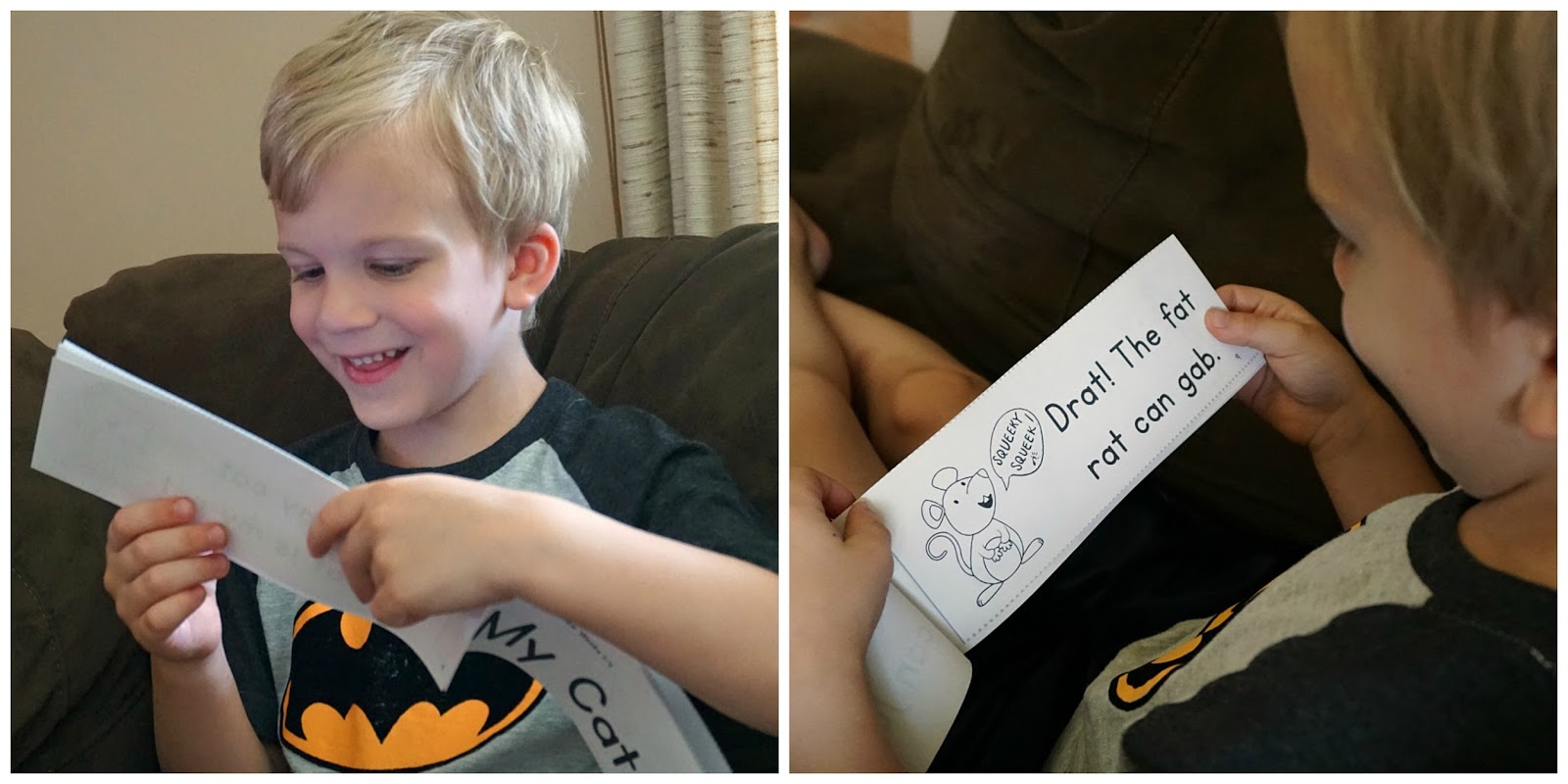
My little kindergartner is loving using these materials. He's pleased whenever I tell him it's time to do his schoolwork. He really likes the hands-on pages where's there's something to cut and glue, the mazes, and dot-to-dots. He always laughs when we talk about real words and make nonsense words and likes using various liquids to complete the dot painting pages. However, he is not crazy about all the writing pages. He'll usually write the smaller portions with no complaints, but grumbles when there is a page that has line upon line of tracing or independent writing. Since he's still young and building up those hand muscles, I allow him to write each word once or twice and move on.

The curriculum is working well and helping him to read better, which is evident by the fluency he's reading the review pack. One thing that concerns me though is the number of pages. Don't get me wrong, more for your money is a good thing, but more in every area is not necessarily good. I don't think he needs to be doing 5 worksheets along with the calendar warm up every day. To me, that's a lot of seat work for a little one. Which ones I choose to do each day depends on the amount of effort required and his interest in them.

Another issue with the number of pages is that the book is nearly 800 pages long. Even if I were to be able to print front and back, that's a lot of paper and ink, but because several of the pages have portions that are to be cut, it would be impossible to print on both sides. I could go through and determine which ones I could print double-sided, but that would take up precious time. I've used other curricula where there was a separate workbook with all pages filled and activity book with just the fronts to be cut. Maybe something like this would work here, too.

Making something work for your family is a great aspect of homeschooling. Choosing our pages instead of doing absolutely everything that's offered means that the Learn to R.E.A.D. Curriculum Notebook and R.E.A.D. Review Pack are great options for our home. My little guy enjoys his work and loves having his own books. Most importantly, he's learning to read.


You can connect with the Crafty Classroom on the following social media sites:


You can read more reviews of these products or of some of the others offered by the Crafty Classroom on the Homeschool Review Crew blog. 

Crew Disclaimer
Pin It

Friday, March 17, 2017

Things That Make Me Smile 3/3/17

Jake (11), Alyssa (8½), Zac (7), Tyler (4½), Nicholas (2)


Happy Friday! This week was filled with lots of Lego-building, book-reading, food-making, memory-creating fun. What made you Smile this week?


1. The kids had set up all our pillows to make a fort. Nicholas broke it down and Jake shouted: "The wall's been breached! Save the women and children!"

2. Alyssa, at my parents' house: "Did you know that I love to read? That's why I brought a ton of books!"

3.

4. Alyssa, after church on the way to the nursery: "I can't wait to see Nicky! I missed him so much!"

5. Jake, while I was reading: "Hey, that reminds me of a song I made up 3 minutes ago!"

6. Alyssa, holding a new book that she had been reluctant to read: "You know the saying 'don't judge a book by its cover'? You really should listen to it!"

7. Alyssa: "I'm going to eat breakfast now. {looks at the clock} Whoa! I need to catch up! It's already Elenvenses."

8.


What made you Smile this week?

Pin It

Friday, July 3, 2015

Things That Make Me Smile 7/3/15

Jake (9½), Alyssa (7), Zac (5½), Tyler (3), Nicholas (6 months)


Happy Friday! And Happy Independence Day! We have much to be thankful for and many reasons to Smile.


1. Zac, licking an envelope: "Mmm, this part tastes good. But the blue part? It doesn't taste any good. It just tastes like paper." 

2 Jake: "I want to have 365 kids, one born each day of the year, and name them all Someone. Then I can say, 'Today is Someone's birthday,' because every day is someone's birthday."

3. Zac: "How does Santa not turn into a giant iceberg?"
Me: "Why would he do that?"
Zac: "Because he lives in the North Pool." 

4. I went to get Nicholas up from his nap and found him standing in bed. 

 
5. Tyler: "Mommy, is the sun a boy or a girl?"
Me: "Neither. It's not a boy or a girl."
Tyler: "It's a boy."
Me: "It is? And why's that?"
Tyler: "Because the moon's a girl.
"

6. Alyssa: "The best part of when Daddy leaves is that he always come home at some point."

7. Tyler: "Mommy, I'm going to Heaven!"
Me: "You are?"
Tyler: "Yeah, because Jesus died! Do you want to go with me?"

8. Zac: "I bet Dad is fast enough to catch a frog. How fast can he run? Probably 1 mile an hour!"

9. Tyler, putting together a puzzle: "This fits correctly."

10. Jake started reading The Fellowship of the Ring 3 1/2 weeks ago and finished it today.


11. Zac: "What's that?"
Me: "That's the antenna."
Zac: "What's it for?"
Me: "It brings the radio into the van."
Zac: "What's a radio?"

12. Zac, driving a car down my leg and stopping at my foot: "Are your toenails dry?"
Me: "Yes. Thank you for asking. It was nice of you to not want to ruin my polish."
Zac: "Yeah, I didn't want to get paint in my wheels."


What made you Smile this week?

Pin It

Wednesday, November 5, 2014

If He Had Not Come


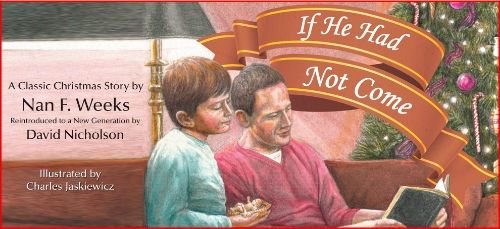
It is hard to believe that the Christmas season will soon be here. This is such a special time of year and definitely one of my favorites. The kids and I sat down and talked about all the things we love about it: the decorations, the music, the food, spending time with family, and, of course, the presents. But the most important thing--the reason we even celebrate the holiday--and the first point that the kiddos mentioned that they love is celebrating the birth of Jesus. God sent his Son, Jesus, to die for our sins. It is because of His birth that we enjoy all those other special things. While reviewing the book If He Had Not Come we also learned about what other things we enjoy because of His birth, or rather, how life would be different if He had not come.

The book was originally published in 1938 by Nan F. Weeks. Not much else is known about her except that she was a teacher and children's author. David Nicholson, also a teacher, first hard the story in church. The message impacted him so much that he mad it a tradition to read it to his own family each and every Christmas. Now, he's reintroducing this beloved story to a new generation with hopes of encouraging others to take its thought-provoking message to heart.
 

Christmas Book Review

If He Had Not Come begins on Christmas Eve and contains all the magic of it. Before heading to bed in anticipation of the coming day, Bobby and his father sat down for their daily Bible reading. Bobby eventually fell asleep, thinking about some of the words they read spoken by Jesus, "If I had not come."

If He had not come. What sad, life-changing words.

How would life be if He, Jesus, had not come? Throughout the story, Bobby discovers the answer to that. Instead of waking to the joy of presents under the tree, he found an undecorated house. Instead of the town being quiet and at home celebrating God's Gift with their families, he found the stores and businesses full of rude, gruff people. Instead of the church, hospital, and children's home he found empty lots. Over and over again, he saw the words "If I had not come." If Jesus had not come, Bobby learned that the world would be a coldhearted, dark place.

He was thrilled when he awoke from his dream and thanked God that He did come.


The story has a powerful message and is a great starting place for a discussion with your kids about the true meaning of Christmas. Not only does this large hardback book have classic illustrations throughout the entire book, it's also got pages of extras in the back for further study. After I read the story to the kids, we read through the questions and discussed them together. What do you think . . . Why did . . . Put yourself . . . Imagine . . . The questions are not simple ones with definite answers, but rather open-ended ones where you really have to think. I love questions like these because they give me a glimpse of what's going on in those precious minds of my little ones. 

There are also many questions with definitive answers that can be found by looking up the appropriate Bible references. The entire salvation message is written in the book, as well. My kids enjoyed the activity. As they drew Christmas trees, I explained why it's symbolic. They learned why we use a tree, what the star represents, what the lights remind us of, and why we give presents.  


My kids and I enjoyed If He Had Not Come ($18.95) and will add it to our Christmas reading every year. Not only is it a great reminder of why we celebrate the day, but the suggested activities (best for ages 6+) at the end really make it a learning experience.


If you'd like to see what other families thought of this book, you can read more reviews on the Schoolhouse Review Crew blog.


Crew Disclaimer
Pin It