Showing posts with label game. Show all posts

Wednesday, March 18, 2020

Continent Race Game

Disclaimer: I received a FREE copy of this product through the HOMESCHOOL REVIEW CREW in exchange for my honest review. I was not required to write a positive review nor was I compensated in any other way.



Our family always loves when we get to review materials that make learning fun. Our education style is a foundation of literature with a heavy emphasis on hands-on learning. Since we are not big text-book-learners, I am pleased when we find a game that is a combination of fun and learning to incorporate into our days. In fact, once a month, we have game schooling, where we set aside all regular school work in lieu of playing games all day. There is so much you can learning through games! We've been doing this for years now with great success.

Naturally, I was excited to receive Continent Race from Byron's Games to add to our game collection.


The story behind Continent Race is really quite amazing. Six-year-old Byron had a month-long hospital stay after his appendix ruptured. During that time, he kept track of each country's medal count during the Summer Olympics and was challenged by one of the staff to create a game using flags. That simple objective sparked Byron to create something great. He immediately knew that he wanted a game for children in the hospital to play so they could have fun and learn while they recovered, and, in turn, was encouraged and healed himself. And Byron's Games was born.

Byron stayed true to his mission and has since donated 150 of his games to hospitals and another 25 copies to individual children who are currently undergoing cancer treatments. A portion of all sales benefits select children's charities. The family has also added other products to the company, like the Connection's Stationary Kit (reviewed by my crewmates), a travel pillow, beach blanket, and more in the works. Byron transformed a scary situation into an exciting opportunity.


Continent Race is dedicated to teaching geography. It comes with the following materials:

  • World Map Game Board -- heavy cardboard, each continent is a different color with each country within a varying shade of the color, bright and crisp picture
  • 5 Continent Cards -- 8 1/2" x 11" heavy cardboard, one side lists each country in alphabetical order, one side shows a zoomed in version of the continent from the world map
  • Playing Cards -- 205 cards each showing a country and its capital along with the flag, 3 Antarctica wild cards

The object of the game is to be the first player to collect the required number of country cards from each continent. The countries are grouped by the continent color that matches the game board. The 5 groups were made to represent the Olympic rings: Europe (blue), Asia (purple), Africa (yellow), the Americas (red), and Australia/Oceania (green). The advanced level of the game includes orange mystery cards which require the player to determine the continent it belongs to.


The rules are simple. The players draw and discard cards to collect countries from the continents. Once someone has the cards for 3 continents, he wins. There are other aspects such as announcing the names of the countries you play and discard along with the winner finding his played countries on the game board.

My kids (ranging from 5-14 years old) and I played the game the last two months during our game schooling day and they played again with their dad. The materials are beautiful! Very well-made on sturdy cardboard and bright and colorful pictures. Even my younger ones could easily match continents by looking at the color-coded cards.


As simple as the game may be though, it seems to be lacking something. There isn't strategy or much gameplay. The game board is lovely, but is practically nonessential. Having markers for each player to place on the countries they play would add another level as they'd have to find the countries on the map and add an additional aspect to the game. Each time we played the regular version, someone won in 3 turns. When we tried the advanced level, my son won in 5 turns. Unfortunately, this is not a game that my kids want to play. One of them even told me, "It needs something," and another one said, "It's too basic."

I truly love the concept of the game and the story behind it. The components make wonderful reference materials! The cards are great for memorizing countries and their flags and the continent cards would be perfect to hang on the wall in your school room.

There are other features on the site, too. There is a phonetic pronunciation for each country (though an audio clip would be appreciated) and coloring pages for the flags of each country (we did find that the Iceland flag actually brought up the Ireland flag though) and more.


I think this game has true potential! The materials are already high-quality and the owners have a heart for others. A couple little tweaks would bump Continent Race up the board game list.

I think Byron and his parents are going to accomplish great things.


You can connect with Byron's Games on the following social media sites:


You can see how other homeschool families used this game and even check out the Connection's Stationary Kit also from Byron's Games by reading the reviews on the Homeschool Review Crew blog.

Continent Race & Connections Stationery Kit {Byron's Games}
Pin It

Tuesday, October 15, 2019

Fun Family Chess

*This post may contain affiliate links.


Today's review is a fun one! My oldest child has been playing chess since he was around 6-year-old. My dad is very skilled at the game and plays whenever he can. I have many memories growing up watching my dad and uncles focused on a match. I was pleased not only when my father started teaching my son, but even more so when my boy grasped the concepts quickly. He fell in love with the strategy and soon started playing with anyone who would agree to it.

Seven years have passed, and though he has helped his younger siblings learn the art of chess, none of them can match his skill. Every now and then he can convince one to play with him, but most of the time the others get discouraged because of their lack of expertise. They need something to level the playing field. That's why I knew that Fun Family Chess from Brain Blox would be the perfect tool to help them gain confidence in playing their big brother.


The chess set comes with all of the following:
  • 15-inch wooden chess board
  • 32 solid wood chess pieces
  • 1 wooden chess cube
  • 2 reference cards
  • full-color instruction book


The chess board folds in half for easy storage and latches on the outside to keep it closed. The inside is lined with soft velvet and has enough space to hold all of the other materials. Since this set was specifically designed to teach kids how to play the game, the board has icons on the edges to show where each piece starts.

The chess pieces come in white and brown. The pieces are well-made, lightweight, and the perfect size for little hands. They each have a thin felt bottom to protect the board. Two velvet bags are included to hold and protect the pieces inside the board box. They are not the fanciest chess pieces I have ever seen--and they could be a bit heavier as they fall over easily--but they are nice, especially considering the price of the set.


Of course, you can use the set for traditional chess, but Fun Family Chess is a great way to teach kids (or anyone, really) how to play the game. Trying to remember how the pieces move and attempt strategy at the same time can be overwhelming. Not to mention, chess is a mind game that requires you to think ahead. The wooden cube eliminates all those issues for the new learner. The lightweight, nearly 1-inch cube has a symbol for each piece (other than the king) on a side with the sixth side showing a star. A player rolls the die and moves a matching piece on the board. If he cannot move that piece, he can roll again. The star means that the player can choose any piece to move. This is a gentle introduction to the game as it teaches the movements and basic concept but makes it fun. A person might be an amazing chess player, but if he doesn't roll what he needs, it won't matter. There is a little decision making involved, but for the most part, the game levels the playing field for all participants.

The heavy duty reference cards are colorful 8.5" x 5.75" cards on cardboard. Each card lists the rules of Fun Family Chess along with descriptions and visuals of each piece's movement. It's color-coded to match the colors of the wooden cube (though the colors are slightly off) to make it easy to find the coordinating movements. There is one card for each player. 


The full-color instruction book is just over 10 glossy pages. Along with many graphics and images, it contains information on setting up the game, how to play Fun Family Chess, an introduction to standard chess, and tips and strategies. It includes moves such as pawn promotion, en passant, and castling. Those are all things I learned from my son because my dad had taught him years ago, but otherwise I would have had no idea until now. This little booklet is filled with helpful information.

My kids were thrilled to receive their first wooden chess set! They love everything about it from the folding board to the variation of game-play to the bags for the pieces. My oldest (13 yr) hasn't been too interested in playing Fun Family Chess as he rather enjoys the strategy of the traditional game, but he has used the set to play multiple games against his siblings and friends.


The younger kids (11, 9, 7, 4 yr), however, have spent hours playing this new version--together and even by themselves! I have enjoyed watching them play and laugh. The littlest one is learning how each piece moves and loves playing with the others. It's pretty special not only to watch how patient they are with him, but also how quickly he's picking up the concepts because of this teaching method. I'm sure it won't be long until he's beating me at the game!

Brain Blox has done a fantastic job creating a way to teach little ones the basic concepts and giving them a love of the game. Fun Family Chess truly is "chess made fun for everyone."


Make sure to read our review of Brain Blox Wooden Building Planks! These simple planks are so much more than a toy. Engineering, critical thinking, problem-solving, and spatial awareness are just a few of the skills your kids will learn with these. They're a favorite in our home!


You can connect with Brain Blox on the following social media sites:m
Facebook
Instagram
YouTube

You can read more reviews of this chess set on the Homeschool Review Crew blog.


Fun Family Chess {Brain Blox Reviews}
* Some of the links in the content above are affiliate links. If you click on a link and purchase an item, I may receive an
affiliate commission. Regardless, I recommend products or services that I have used personally and all the text and opinions are my own. I am disclosing this in accordance with the Federal Trade Commission's 16 CFR, Part 225.

Crew Disclaimer
Pin It

Saturday, July 13, 2019

Play Update #1

* This post may contain affiliate links.


We did 30 Days of Playing in June! I had been planning to post a few updates along the way, not just for accountability, but for inspiration, as well, because it's always fun learning new ways to connect with our kids.

But here we are, weeks passed June, and I'm just posting the first list. I guess we've just been having too much fun playing to stop and sit at a computer!

Here is what we played the beginning of the month. Maybe you can find a new toy or game to play with your family. Feel free to share what you've played last month, too!


1. Frisbee -- This ring frisbee is a fun variation of the classic and much easier for little ones to catch.

2. Rummikub -- This is our current favorite game! It's a rummy-style game played with tiles for 2-4 players. Alyssa (11 yr) loves this one because you manipulate the tiles to do what you want. It's a great strategy game for the older ones, but also a good game to reinforce numbers and matches for our 4-year-old. 


3. Football -- This is my favorite football! It's small enough that it fits perfectly in my hand and is a much better fit for the younger kids. It's softer than a regular football, too. Easy to catch, easy to throw. Perfect. The kids and I spent many hours tossing it around. 

4. Water Balloons -- Who doesn't love water balloons on a hot, summer day?! We grabbed a pack of 100 from the dollar store and filled them all. Many were thrown in a typical water balloon fight, others were reserved for tossing back and forth, and some were used for slow-motion videos. We had a lot of fun throwing the balloons on the ground or hitting them with a baseball bat and watching the replays in slo-mo.  

5. Melissa & Doug Castle Puzzle -- A few months ago we started putting together regular puzzles as a family. After many years of babies and toddlers in the house, we're at a point where we don't have to worry about a little one pulling pieces off a table or putting them in their mouth. We've mostly done 1,000-piece puzzles, but I had gotten this 200-piece castle one a couple years ago and never opened it. It's since been discontinued, but it was a fun and super quick build. I have my eye on this colorful doors puzzle next!

6. Football -- We spent another full day tossing, throwing, playing, and tackling.

7. White Mountain Candy Wrappers Puzzle -- Another puzzle! I had just purchased this one because the price had dropped and even though I hadn't been planning to assemble it right away, the kids asked. We finished it up that evening when Leighton came home from work. The White Mountain puzzles are our favorites. They are well-made and have fun designs. This candy one was a fun puzzle for everybody!


8. Painting and Shopping -- No, those things aren't really playing. I know. Leighton had pulled up the carpet in our living room and had just refinished the hardwood floor. Since the room was empty, I thought it was the perfect time to paint--the living room, the entryway, and the hallway. It took the whole day to get it done. Even though there was no time to stop and play, I let the older kids paint for a bit (they thought it was like playing!) and then took them with me grocery shopping after the first coat of paint. We laughed and joked a lot and still spent quality time together even though we didn't play a game.

9. Yes and No -- We've been playing this game for so many years that I don't remember how it started.  It's like Twenty Questions, except the number of questions doesn't matter. Everything has to be a yes or no question and it has to be something everyone knows. Even toddlers like this one, even if they don't fully understand. We play mostly during dinner, but car rides are fun, too. Whoever guesses correctly gets to pick the next round.

10. Pirate Maze Book -- This is such a fun puzzle book from Usborne! It has over 60 pages of pirate-themed mazes. It is filled with cute details and tons of sailor, undersea, and treasure references--perfect for pirates and landlubbers alike. My younger boys love this book and have spent hours poring through the pages. There is so much going on in the book that we always find something new to enjoy when we do it.


That's only some of the fun we had during our 30 Days of Playing challenge! The fun hasn't ended just because the month did though, so feel free to list some of your family's favorite games and toys! 

And be watching for more ways that we played in the month of June.


* Some of the links in the content above are affiliate links. If you click on a link and purchase an item, I may receive an affiliate commission. Regardless,
I recommend products or services that I have used personally and all the text and opinions are my own. I am disclosing this in accordance with the
Federal Trade Commission's 16 CFR, Part 225.
Pin It

Wednesday, March 21, 2018

Home School in the Woods


Our family gets excited every time we get to review for Home School in the Woods. Their products are detailed, hands-on, and so fun, making them well-loved history materials in our home. We've used their Project Passport titles for full curricula of both Egypt and the Middle Ages and studied the presidential election process with a Lap-Pak. This time though, we were introduced to one of their newest options--the Ã€ La Carte projects.

Home School in the Woods is a family business that was started as a way to make history real, understandable, and applicable. Using timelines and realistic illustrations as a foundation, they've created many resources to make learning history an enjoyable process.

While the full curricula options are fantastic, sometimes you just need a filler for another study or more information for a personal interest. Those are the times when the Ã€ La Carte activities are perfect. These resources are individual activities that are pulled directly from the larger curricula downloads of History Through the Ages. The projects include timelines, authentic crafts, lap booking, games creative writing, and much more. The hardest part is choosing which activities to get!


My house is filled with little boys, so pirates are a big deal around here. I knew my kiddos would enjoy the Pirate Panoply Game. This simple game teaches all about a pirate's clothing and accessories during the age of exploration. To play, you roll a die and dress your pirate with the assigned numbered article. Roll a 1, your pirate gets his hat. Roll a 5, and he gets his breeches. The first player to get fully dressed wins. This activity is for an unlimited number of players and was first found in Time Travelers: New World Explorers

This was an easy game for everyone and was enjoyed by the little ones all the way through the adults. It's a fast-paced game, too, so it is great for times when you have only a few minutes. The kids enjoyed coloring the various pieces and then mixing-and-matching them while dressing their pirates. Each time is a different combination.


Also part of that study is the Merchant Marauder File Folder Game. Though the two games originated from the same study which is geared toward 3rd-8th graders, this one is more for the older crowd. Players practice their math skills as they shop for items to set sail across the seas. They learn how to find the value of Spanish cobs as they pay with doubloons, pieces of eight, escudos, and reales. The first player to purchase five of his needed items wins.

This game is more complicated than the other. Trying to keep track of all the tiny pieces of cob was confusing and converting the types into what they needed could be frustrating. I would say this game is more appropriate for the 6th-8th grade crowd. The kids and I decided to change it up. Instead of making a player pay for an item, he automatically got it when he landed on it. This took the mathematical learning out of it, but made it more enjoyable for my kids. It was still just as exciting when they landed on an item they needed.


As soon as I saw The Art of Quilling (3D), I knew I needed to get it. My daughter loves crafts--and that's putting it mildly. She enjoys various arts from knitting to origami to drawing to sewing, but she had never tried paper quilling. This download, which was originally for the Time Travelers: Colonial Life, gives a history of the paper rolling art, when it was created, who mastered it, and which types of materials were used. It briefly explains how to do the art and what you can use if you don't have an actual quilling tool. There are instructions and pictures for forming 8 different shapes and tips for embellishment. There is also a quilling pattern included.

I purchased a quilling tool and then handed it and the instructions to my daughter. She was thrilled! She read the page and got right to work. The instructions are clear and easy enough for my new 10-year-old (today is her birthday!) to understand. She has had so much fun rolling the paper strips and creating designs. I do think the activity should include two more patterns though for the price.


All of the Ã€ La Carte projects include detailed instructions and tips for both printing and assembly. My only concern with the Home School in the Woods products in the past was the printing hassles. I was so excited to see that they now include the option for duplex printing! It didn't affect these materials specifically, but will make a huge difference for the bigger studies. Now I can say that I love everything about this company.

Home School in the Woods is a fantastic option for history learning. The Ã€ La Carte options are inexpensive enough to fit any budget. I'm already trying to decide which to use next. The Passover Seder Game to enhance our Easter study or The Penny Rug 3D Project to please my crafty girl or a Colonies Timeline to complement our current read aloud biography. No matter what, I know that the activity will be high quality and thoroughly enjoyed.


You can connect with Home School in the Woods on the following social media sites:


 You can read more reviews of the Ã€ La Carte products on the Homeschool Review Crew blog.

Crew Disclaimer
Pin It

Tuesday, February 27, 2018

Starfall Review


As a mom of many, it can be challenging to keep my little ones busy learning during the school day.  I am a big supporter of learning through play in the younger years, but sometimes that play needs a bit of direction. I appreciate when I find online programs that teach through games and fun, especially during those times when I'm focused on the older kids. The Starfall Home Membership from Starfall Education Foundation  is one of those resources, as their goal is "Children Have Fun Learning to Read."

The organization was founded by Stephen Schutz in 2002. Having struggled to learn to read as a child, he was determined to create a way to help children thrive. His program focuses on exploration and positive reinforcement to give students the tools they need to become "confident, intrinsically motivated, and successful." Starfall is now a comprehensive program for pre-k and kindergarten and offers supplemental language arts and math for first and second grade. 

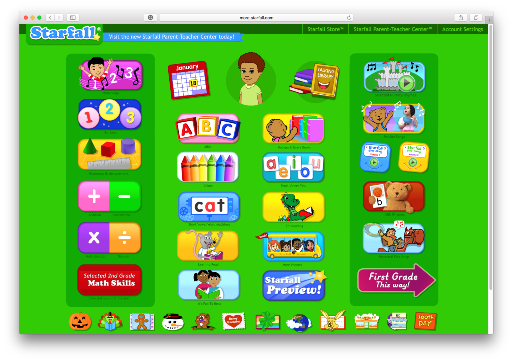
Starfall is user-friendly, so when I tell my 5-year-old it's his turn for the computer, he goes right to the site and gets to work, er, play. He can navigate the site through the pictures. When there is text that he cannot yet read, he can click on the picture of an ear to hear it read to him. There are many options for learning and exploring. The activities include songs, games, books, calendar work, rhymes, and more. 

While we are choosing to use this program as child-lead learning, there are detailed lesson plans in the new Starfall Parent-Teacher Center. My little guy is in kindergarten, so if we were to follow the guide, we would cover the following topics:

  • letter recognition
  • color recognition
  • pre-decodable text
  • short vowel recognition
  • letter/sound substitution
  • beginner reading
  • emergent reading skills
  • rhyme and rhythym
  • familiarity with literature genres
  • calendar concepts
  • holiday activities
  • reading along
  • phonics


The curriculum guide highlights activities from the website and the mobile apps and incorporates supporting materials that can be printed. There are also additional resources that can be purchased from their online store, such as games, instructional cards, posters, incentives, books, and more.

Starfall also offers many additional supplemental resources. There are worksheet generators, custom printables, projectables, books, posters, and more. These valuable tools are free and create a flexible and engaging learning experience.

Here is what my 5-year-old said about the program:

"My favorite game is the alien planet with the equals and the ups and the downs 
(greater than/less than) and the future and the past, because I'm learning about it. 
My second favorite is Halloween fractions. I like the pumpkins and the background. 
And I like the pluses, like 1/8 + 2/8 equals what? 3/8. I'm learning a lot."


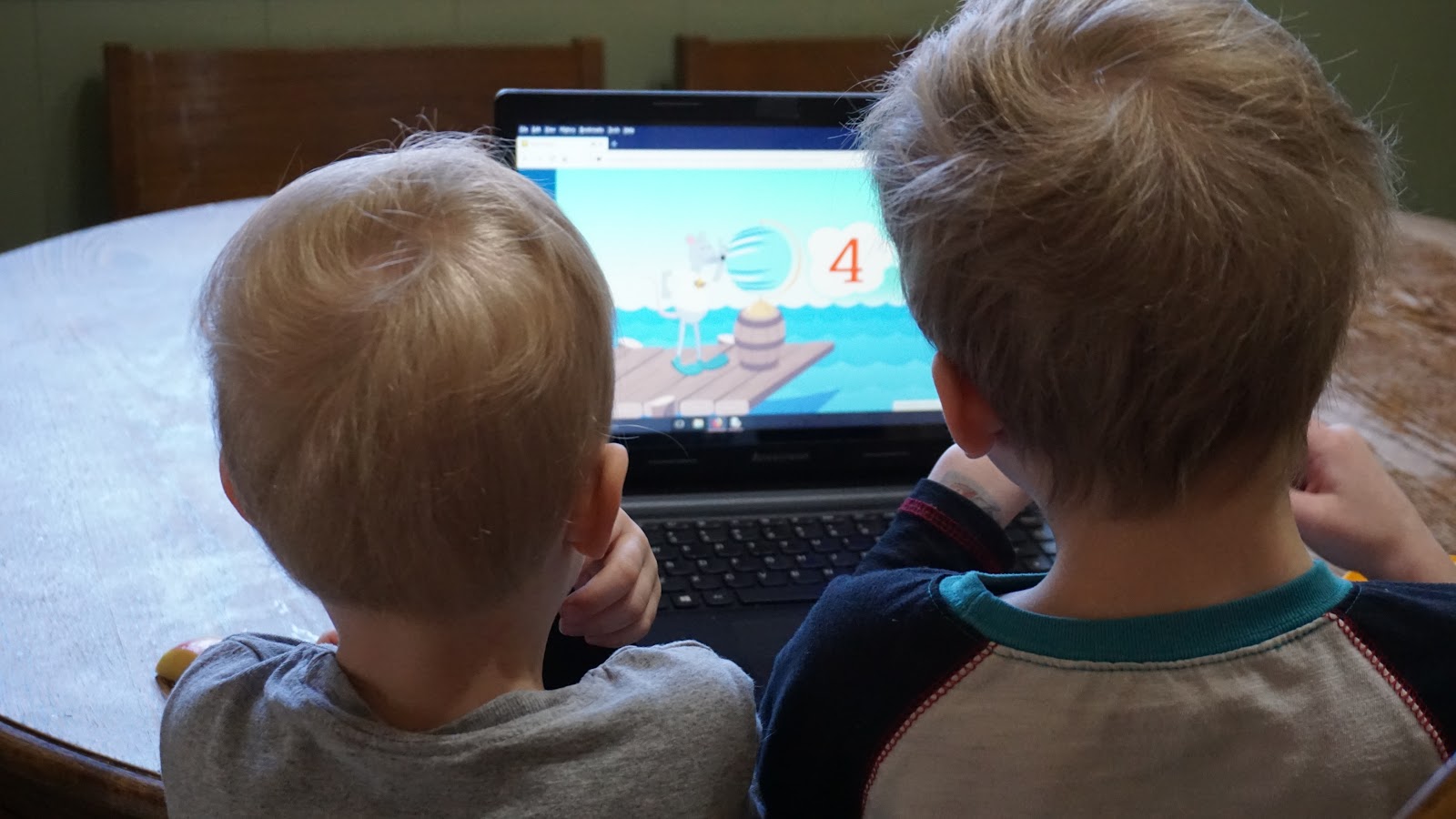
My boy gladly heads to the computer each day for more learning. I often find his little bother sharing his chair, engaged in the screen. I know that the information is sticking, not only because he tells me about what he's learning, but because one (or all, ha) of the kids is walking around singing one of the learning songs.

If you're needing an online program for your young learner, Starfall Education Foundation might be just what you need.


You can connect with Starfall Education Foundation on the following social media sites:


You can read more reviews of this program on the Homeschool Review Crew blog. 


Crew Disclaimer
Pin It

Friday, August 19, 2016

FlipStir Puzzle


Today's review from Enlivenze LLC is another fun one!

My oldest (10 yr) loves mind games and puzzles. He's really good at finding solutions and figuring things out. I always say that his engineer's mind is very much like his father's. He learned to solve the Rubik's Cube a year ago and has a record of 41 seconds. He has since learned to solve other cube-type puzzles, as well. The boy loves a challenge. So, when I had the opportunity to choose a FlipStir Puzzle, I picked the Solar System, specifically because it's a level 2 difficulty.


What is a FlipStir Puzzle? It is a self-contained 3D puzzle. The only instructions are Shake, Stir, Solve! Each puzzle has 10 pieces in a tube along with a maneuvering wand. The object is to jumble all the pieces and assemble the puzzle. Easy, right?

Not so much.

All the kids were thrilled once the puzzle arrived. Within seconds, the younger kids declared it "too hard." That was ok; I chose it for the oldest. But when the oldest fiddle with it for a few minutes and lost interest, I was shocked. There it sat, on the counter, all alone.

My husband came home from work and completed the puzzle after just a few minutes (show off, ha). I teased him the next day when I noticed that the entire solar system was upside down though. Therefore, he didn't truly solve it. Obviously. So, of course, he came home, shook the tube all up, and reassembled the puzzle--right side up this time.

  
The FlipStir puzzle has sat on our kitchen counter for the last month or so. Sometimes, someone would pick it up and jiggle the pieces around, and then set it back down looking like the same jumbled mess. Every now and then I'd ask my son if he was going to try it again. And every time he'd show no interest.

One day last week, I left the room for 5 minutes or so while I went to swap the laundry. I walked back up the stairs and into the kitchen. There my son stood with hand outstretched, holding the completed puzzle.

"What? How did . . . Did you . . . You did it?"

The boy who wouldn't touch the puzzle for weeks, assembled the whole thing in less than 5 minutes.

  
Shortly after he did it, his 8-year-old sister completed the puzzle, too.

At this point, 4 of us can finish the puzzle. None of the little boys (all younger than the puzzle's suggested age of 7) have done it or have really even tried much for that matter. And I can see why. This game can be frustrating! You use the wand to move a piece, get it almost in place . . . and it falls. Or it won't flip. Or everything else is just in your way. My daughter said, "I wish you could open it up so you can get to the pieces." You know what needs to be done, but getting it to do it isn't as easy. It can be frustrating. In a good way.

Of course, my 2 smarty pants have no trouble at all with it. My son has assembled it many times since last week. We timed him only once, while we videoed. It took about 3 1/2 minutes. My husband can do it faster than that. It takes me . . . much longer, ha.

 Here he is assembling it in super speed, even with a little brother jumping all around. 


The tube itself is sturdy. It's strong enough that I've felt comfortable letting even the toddler play with it. The pieces and wand moving around can be a bit noisy and can also leave marks on the clear plastic tube. But if you're not worried about waking a sleeping baby or getting clear pictures for a review, those things probably don't matter anyway, ha. 

Since the Solar System is a level 2 puzzle, the pieces have wavy edges. There are also the options of the Statue of Liberty and the Periodic Table. The level 1 puzzles have straight edges and include Rainbow Colored Pencil and a Tyrannosaurus Rex puzzles.

We've enjoyed our FlipStir puzzle. Not only is it challenging, but it's self-contained, meaning no lost pieces around the house! It's small enough that you could take it in the car for trips or while waiting for an appointment. It would make a great present for Christmas, birthday, or just because. The puzzles encourage focusing, patience, and hand-eye coordination. My kids have already been asking for a level 1 puzzle. With all the benefits of a FlipStir puzzle, I see our family enjoying many of these over the years.


You can connect with the company through the following social media links:

FlipStir Puzzle on Facebook and Twitter
Enlivenze LLC on Facebook and Twitter


You can see the other fun FlipStir Puzzles by reading the reviews on the Schoolhouse Review Crew blog.

Crew Disclaimer
Pin It

Thursday, May 26, 2016

Sunya Publishing Review


Schooling tends to be a bit relaxed around here. I'm a firm believer that little ones learn best through play. That doesn't mean that we don't do any book work, but that we incorporate fun and hands-on learning often in our days. Games are an easy way to combine learning with fun. So when we had the opportunity to try out a brand new game from Sunya Publishing, I knew my little ones would be happy to play.

Sunya - The Magic and Wonder of Math and Science Adding & Subtracting (they also sell a multiplication & division version) is a card game for ages 7 and older. Players take turns making math facts. There are two different games that are played similarly, one for addition and one for subtraction.  


The game includes the following:
  • Parent/Teacher Guide Book
  • 60 Adding & Subtracting Playing Cards
  • 30 Math & Science Fact and Riddle Cards
  • Adding & Subtracting Number Line
This is such a new product that it's still in development. The Schoolhouse Review Crew was given the special privilege of testing it out. Because of this, there might be some kinks that need to be worked out.

The game itself is simple to play, but the directions are rather wordy. Some parts took me a few reads before I figured out the rules. I'm hoping they simplify the wording before going to print, because the game really is a good one. 


A number sentence (either addition or subtraction) is placed in the middle of the table. Each player begins with 5 cards (after being dealt 4 and drawing 1). He then makes a new number sentence using just the cards in his hand or a combination of those and the cards on the table.

For instance, if the sentence on the table reads 4 + 3 = 7, a player can place cards (2, 5) directly on those to create a new fact such as 2 + 5 = 7 or he could change it altogether, such as 6 + 3 = 9.

If a player does not have a play in hand, he draws one card at a time until he can play. There are also rule about reverse plays, wild cards, exchanging cards, the 0 and 1 rule, and an optional rule for blocking. If anyone needs help solving an equation, he can use the included number line card.   

The game proceeds until someone plays all of his cards in the number sentence. Sunya is a word from Sanskit, meaning empty or void of any quantity. In the game, the first person to play his last card declares, "Sunya!" and wins.

The winner then gets to draw a math & science fact and riddle card from the pile to read to the other players. The cards are filled with things like "How is the moon like a dollar?" and "What is a googolplex?"


The three older kids (10, 8, 6) and I have been playing Sunya. Since the main objective of the game is to strengthen your math skills, helping each other make sentences is encouraged. The kids like this part because it means that it doesn't matter if the other players see your cards. In other words, they don't have to try to juggle all their cards in their little hands without anyone else seeing what numbers they have. The riddle and fact cards have been a big hit too, as our whole family loves solving things like that. There have been lots of laughs as we play the game and many "please, can we play one more time?" In fact, we've been having so much fun that one of them said, "Wait, that was school?" I'm always happy when they're enjoying learning.

The guide book lists a couple other variations of the game, but we haven't tried them just yet. They both start with the basic game, but then get more difficult as more rules are added. The book also gives some suggestions for math activities using the number cards to be used with younger children. 


Our family has enjoyed this game. If you're looking for a simple game to encourage math abilities, you'll want to keep up with the news from the new company, Sunya Publishing.


If you'd like to read more reviews of this product or of the Multiplication & Division Game, please head to the Schoolhouse Review Crew blog.

Crew Disclaimer
Pin It

Wednesday, September 30, 2015

USAopoly Review


Homeschooling isn't all about books and learning. Our family loves to incorporate fun into our days, especially since we still have a house full of little ones. I'm a big believer of learning through play during the younger years. Games are a great way to have fun while increasing some skills without the kids even realizing it. We were happy to receive two games from USAopoly: Wonky: The Crazy Cubes Card Game and Tapple: Fast Word Fun for Everyone.

USAopoly is a company that is all about fun and games. They have been a leading developer and manufacturer of puzzles and board games "with a twist" since 1994. Their products are designed to bring friends and families together by creating memorable moments and emotional connections. When the company's values are "bring a smile, play fair, do it right, honor your word, and give it your best," you know the products are going to portray it.

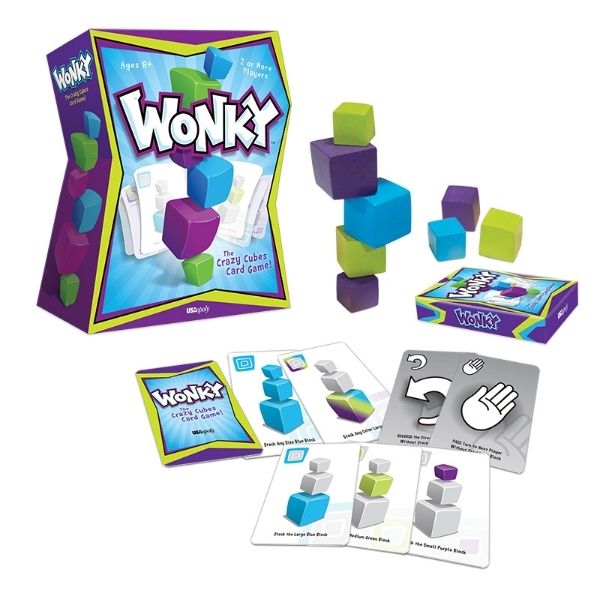
Wonky is the crazy cubes card game. Players build towers using oddly-shaped blocks that come in 3 different sizes and 3 different colors. The game comes with 9 custom blocks, 54 strategy cards, storage bag, and rules, all packaged in a wonky, misshapen box. Players take turns choosing cards that show which type of block to add or an action to complete. The first person to play all his cards or who successfully plays the 9th block on the tower wins.

Some examples of the cards are
  • Stack the large blue block
  • Stack the small purple block
  • Stack any size, any color block / The next player draws a card
  • Pass turn to next player without stacking a block
  • Stack any color medium block
  • Stack any color, any size block
  • Reverse the direction of lay without stacking a block


What a fun, silly game this is! Like I said, we have a house full of littles, and little ones haven't quite honed the skills needed to stack crooked blocks, ha. We've played a few times with the cards, but mostly the kids just like to take turns choosing blocks to add to the wobbly tower. I'll even find them each playing by themselves sometimes, concentrating on stacking all the blocks. I love that they have to use strategy and building sense to make it work. My husband, with his engineer's mind, is definitely the best at the game. It'll be even more fun, I'm sure, as the kiddos get older and can understand the tactics of playing certain cards to sabotage their opponents.   

The blocks and the pack of cards fit comfortably in the canvas drawstring bag, so it's convenient and space-saving to store the game in just that, rather than the cute, bulky box. 


Tapple is fast word fun for the whole family. It contains the portable Tapple wheel (requires 2 AA batteries), 144 categories on 36 cards, and rules. The cards fit conveniently in a compartment on the back of the wheel, making the game easy to store. Players choose a category and start the timer. Then they take turns naming a word that fits the category, tap the corresponding letter for the beginning of the word, and press the button to reset the timer. The next person has 10 seconds to pick a word starting with a letter that has not been used and reset the timer again.


Categories include the following:
  • Countries
  • Something Red
  • Boy Names
  • Books
  • Candy
  • Fictional Characters
  • Furniture
  • In the Ocen
  • and so many more


I love word games! This one is fast-paced and lots of fun. The younger kids like to play, but quickly get frustrated because of their inexperienced spelling abilities. The older kids though really enjoy playing. There are so many great category topics (like Bible Characters and Family Members), but we like to make up our own too, to make it a little easier for the little ones. We'll also play without starting the timer and just press the letters. The lack of pressure from the ticking causes less stress and makes it more enjoyable when the younger ones get frustrated. The letters pop back with a simple twist at the top of the wheel. This game, especially, would be perfect for parties, game night, get-togethers, and holidays.


We've been having lots of fun as a family playing these games, and I'm sure we'll enjoy them for many years to come as the kids get older. Even though both games are best for ages 8+ and we have only one child that fits that age range, we've been able to adapt them to be enjoyed now. These games are great for any family to own.


You can connect with USAopoly on the following social media sites:


If you'd like to see how other homeschool families used these games, please read the reviews on the Schoolhouse Review Crew blog.
    
Crew Disclaimer
Pin It