Showing posts with label hands-on. Show all posts

Wednesday, July 15, 2020

Pitsco STEM Pack

Disclaimer: I received a FREE copy of this product through the HOMESCHOOL REVIEW CREW in exchange for my honest review. I was not required to write a positive review nor was I compensated in any other way.


Hands-on learning is a priority in our home! I believe in the importance of learning by doing, so I love when we review resources that are focused on actively engaging. This Middle School STEM Creator Pack from Pitsco Education perfectly meets our needs.

Pitsco Education has been dedicated to hands-on exploration and problem solving for over 40 years. Their materials and curricula are STEM-based, meaning they incorporate science, technology, engineering, and math skills while making real-world applications. Their philosophy of education, "What will you bring to the world?" is manifested through experiences that engage both hands and minds. It is their desire to put a piece of the world in students' hands and help them understand how it applies to their lives.


The STEM Creator Pack is geared toward the 6th-8th grade crowd. It includes all the materials, instructions, and curriculum to build 5 projects with 15 activities.

  • Catapults
  • Balloon Cars
  • Da Vinci Bridges
  • Personal Inventions
  • Friction Climbers

All the projects come individually bagged with everything you need. I have been doing hands-on activities with my kids for more than a decade; I am not afraid to gather random household supplies to complete an assignment, but this kit is so convenient! It cuts back on excuses for not doing projects with your kids such as not having enough time or not being able to find materials or not wanting to look for ideas. All you have to do is grab a bag. Truly, it could not be simpler!


Even though the kit was designed for middle schoolers, I chose to use the Creator Pack with my science-loving, engineer-minded, always-building, busy boys ages 5, 8, and 10.

Each project comes with a Creator's Guide booklet which includes step-by-step building instructions with pictures, interesting facts, and engaging questions. I found that since the instructions are written in an easy-to-understand way and have visual clues for each step, my boys did not even need my help with building some of the projects. Even my second grader had no trouble with things such as folding the car template, taping it, and assembling the wheels. Though I did help with cutting it out and teaching him how to score for easy folding, he was able to follow their instructions just fine.


Most of the projects also include additional activities to extend the learning. For instance, after the boys each took a couple turns playing with the catapult, there were 4 suggested ways to use it: testing the distance, hitting a target, designing a multi-player game, and playing the game. Each activity lists needed supplies (some of which are not included in the kit, but are common), instructions, charts for recording data, and additional relative facts and discussion questions.

Some of their favorite times were testing their theories and trying new ways to use their projects. They learned the best placement of the straw to get their balloon-powered car to go the fastest, that the friction climber is a fun way to get a Lego minifigure to higher heights, how to accurately shoot the catapult so someone can catch the projectile, what happens when you change the angle of a ramp, and various other real-world things.


We did not have the best of luck with the Da Vinci bridge project, unfortunately. That was one set of instructions that I found confusing. Even my engineer husband who easily understands things like this had a difficult time getting the popsicle sticks to stay together long enough to form a long bridge. That is one that we will definitely have to try again as a family.

We still have one final project to complete. They saved their favorite for last--creating their own inventions, which opens up all possibilities for creativity. The kit comes with tons of provided materials like chipboard, string, clay, spools, rubber bands, and straws, but encourages the use of any supplies. There are a few suggested inventions, but  the main purpose is getting kids to come up with ideas--whether it's improving something or creating an entirely new concept--and then creating them. I know that my boys will spend days being engineers and testing their contraptions.

 
My boys absolutely love this kit! It's fun, engaging, and gets them doing what they love best--building and creating.

I absolutely love this kit! It's organized, thorough, easy-to-follow, and gets my kids doing what I love best--learning by doing. 


Pitsco Education is generously sharing their learning kits with their followers! You can enter to win your own STEM Creator Pack by filling out a brief form for the giveaway. Good luck!  Then you, too, can create this fun catapult like my boys did.


Middle School STEM Creator Pack is a must-have for anyone who values hands-on education, incorporates STEM activities, or just likes to have fun. It's the perfect summer activity kit as you can grab a bag once a week and learn without feeling like work. They offer products focusing on robotics, aerospace, coding, sustainable energy, drafting, structures, and more, so there is something to pique your child's interest.

I can't wait to surprise my little engineers with more hands-on fun from Pitsco Education!


You can connect with Pitsco Education on the following social media sites:


Pitsco Education offers many fun and engaging learning products. My Crewmates were able to review things such as elementary and high school kits, coding cubes, Smart Buddies, and Arduino kits. You can read more reviews of these products on the Homeschool Review Crew blog.


STEM At Your Fingertips - Elementary, Middle & High School STEM Kits {Pitsco Education Reviews}
Pin It

Friday, July 19, 2019

Pattern Block Activities


My kids love when we get fun reviews, especially in the summer! I want my kids to make learning a daily habit to prepare for a lifetime of knowledge. That's why we don't truly stop "school" in the summer months, but rather alter our schedule to focus on crafts, skills, and hands-on activities.  

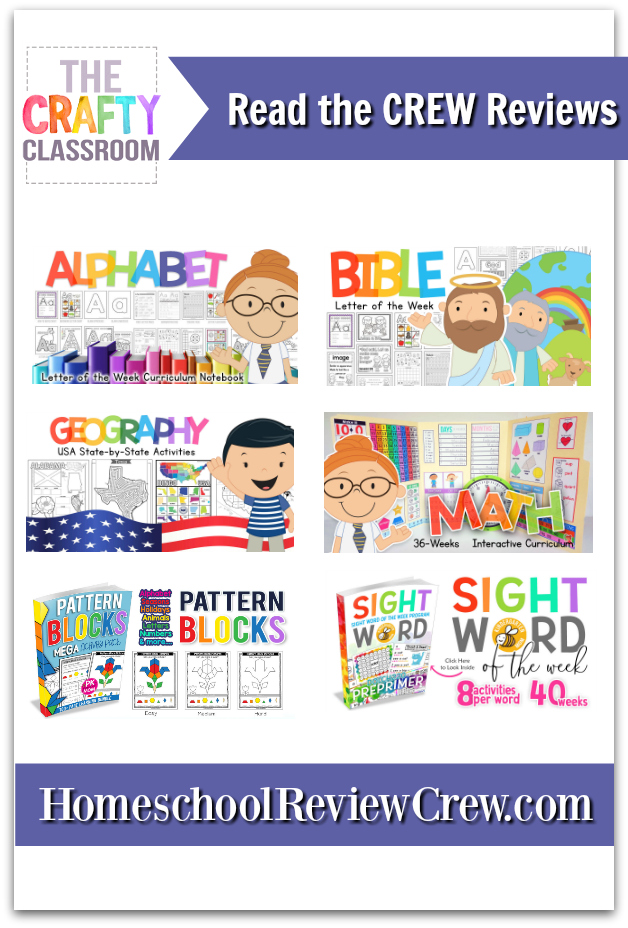
The Pattern Block Activity Bundle from the Crafty Classroom is our perfect summertime learning. It's simple, hands-on, educational, and fun! 


The Crafty Classroom offers all sorts of downloadable curricula to help your students, including ways to learn the alphabet, Bible, geography, math, reading, science, and writing. There is super sequences, color science, ASL alphabet, U.S.A. mazes, writing prompts, The 10 Commandments, and so much more. Just browsing through the options makes me want to buy all the curriculum. It all looks so fun! As a homeschooling family with their own four kids, the Crafty Classroom has designed their materials to make teaching easier by making them "fun, interactive, and low-prep."

The downloadable Pattern Block Activity Bundle meets all those qualifications. The hardest part of using it is deciding which pages to print! The bundle comes with over 230 unique designs which cover the following topics:

  • Uppercase Alphabet
  • Lowercase Alphabet
  • Numbers
  • Animals (farm, forest, ocean, zoo)
  • Holidays (New Year's, Valentine's, St. Patrick's, Earth Day, Easter, July 4th, Thanksgiving, Christmas)
  • Seasons
  • Transportation

Each of the designs is offered for 3 levels of difficulty. The easiest one shows the blocks with color; the next level shows the blocks with no color; the hardest one shows just the outline of the design.


The are an additional 8 pages of follow-up activities to extend the learning by encouraging logic, reading, writing, and math skills. These bonus pages can accompany any of the design pages or can be used for independent building.

There are activities to draw the build, write about it, compare blocks, graph blocks, games, and more.


Pattern blocks can be used at any age (hey, even I like to build when the kids do!), but it's generally more appealing to the younger crowd. While my daughter (11 yrs) has recreated the designs a few times, my boys (ages 9, 7, 4) have spent hours building and rebuilding.

There are different ways you can print and store the pages. I chose to print them full page and keep them in page protectors in a 3-ringed binder. Instead of printing the entire bundle with 731 pages, I chose various designs from each level. We keep them divided by level in the binder so it's easy for the kids to find what they want.

Also, I tried printing on both sides of the page, but I found the ink showed through too much, at least on our regular printer paper. A heavier paper might be fine for double-sided printing.


I find my kids building with the blocks multiple times a day. Their favorite way to use them is to recreate the design next to the page instead of directly on top. I love that added level of difficulty!

Another thing they have started to do is build on to the original designs, like putting the owl in a tree, creating flowers for the bees, and making the elephant spray water. Not only are they showing creativity, but honing pattern and spatial skills, as well.


I have found that the boys will use all levels of difficulty, but the medium is their favorite. It has just a hint of complication without having to think too much. I guess it is summer, after all, ha.

I have seen many pattern block pages over the years and own a few different sets. This one from the Crafty Classroom though has a greater variety of pages--porcupine, lobster, hot chocolate, beetle, sandcastle, mushroom, pot of gold, recycle sign, Statue of Liberty, parachute--and hundreds more. This one bundle can easily cover all your design idea needs.     


The Pattern Block Activity Bundle is a fantastic set. It has a large selection of designs, 3 levels of difficulty for each one, and comes with additional learning pages. It truly is "fun, interactive, and low-prep." I know that we will use this set for many years.


You can connect with the Crafty Classroom on the following social media sites:

The Crafty Classroom offers many fun and excellent products to help learning, like the Learn to R.E.A.D. Curriculum that we reviewed a couple years ago, a Bible Letter of the Week, a literary unit for Fables and Fairy Tales, a 3-book bundle fill with activities about the U.S.A, and much more.

Make sure to head over to the Homeschool Review Crew blog to read more reviews of these products and more that other homeschool families have been using this summer. 


Hands-on, Low-prep and Ready to Go Learning - Tots to 3rd Grade {Crafty Classroom Reviews}
Crew Disclaimer
Pin It

Thursday, August 2, 2018

Wonders of the World


I have wanted to study the Wonders of the World with my kids for a long time, so when we had the opportunity to review a product from one of our very favorite vendors that offered a study on them, I jumped at the chance. Home School in the Woods is known for their detailed, hands-on history curricula. We have used various resources from their many product lines over the years and have loved each one. From their Project Passports to their Activity Studies to their Hands-on History Lap-Paks to each À La Carte item, the choices are full of information, high quality, and so very fun. 

Home School in the Woods is a family business that was started as a way to make history real, understandable, and applicable. Using timelines and realistic illustrations as a foundation, they've created many resources to make learning history an enjoyable process.

The Wonders of the World study is part of the Hands-on History Lap-Paks series. Each Lap-Pak is a complete study of a specific topic with multiple projects and accompanying text.


The download (also available as a CD) comes as a zip file. Once you open it, and see the multiple folders, click on the "start" file. At that point, the entire program will open in your browser, making it very easy to use. Instead of clicking through multiple folders, trying to bounce back and forth among the resources, everything is laid out as you need it. 

There are full step-by-step directions for everything you need. The text is given in 2 ways: printed and audio. The printed form can be chosen for a booklet format or a full-size binder format. The audio is the word-for-word version of the printed text and is divided into 2 sections with each topic listing the time index, making it simple to advance to the needed place. 


The study includes Wonders from four categories:

  • Ancient 
    • Great Pyramid of Giza
    • The Hanging Gardens of Babylon
    • The Statue of Zeus at Olympia
    • The Temple of Artemis at Ephesus
    • The Mausoleum at Halicarnassus
    • The Colossus of Rhodes
    • The Lighthouse of Alexandria
  • Medieval
    • Stonehenge
    • The Leaning Tower of Pisa
    • The Colosseum
    • The Hagia Sophia
    • The Great Wall of China
    • The Catacombs of Kom el Shoqafa
    • The Lost Porcelain Pagoda
  • Modern
    • The Channel Tunnel
    • The CN Tower
    • The Empire State Building
    • The Golden Gate Bridge
    • Itaipu Dam
    • The Panama Canal
    • The Netherlands North Sea Protection Works
  • Natural
    • Mount Everest
    • The Grand Canyon
    • The Northern Lights
    • The Harbor of Rio de Janeeiro
    • The Great Barrier Reef
    • Paricutín: The Volcano in a Cornfield
    • Victoria Falls 

The suggested ages for the study is grades 3-8. My kids are in 8th, 5th, 3rd, and 1st grades. I'd say it is definitely perfect for my three older ones, but my little one had no issues following along. I chose to read the text to my kids, instead of listening to the provided audio. I find that they can focus better on me than a recording. Plus, I like stopping and adding my own thoughts or rabbit trails, looking up pictures, and discussing various aspects as a family. These Lap-Paks are both fantastic stand-alone studies and also great starting points to be enhanced with further resources. 


Each Wonder of the World has a description about it, including where it was/is, when it was built, how it was built or created, why it came to be, and in some cases how it was destroyed (just ask my kids what they think about earthquakes, ha). They talk about people, materials, measurements, purposes, and all sorts of other fascinating details. 

Along with the description is a hands-on project for the Lap-Pak or lapbook. The activities can be as simple as a picture of the Wonder with a description glued to the back to more complicated parts like moving gladiators, swinging gates, or 3D stones. Most of the necessary materials are things like white and colored paper and cardstock, colored pencils, glue, and tape, but a few of the projects add some extra attention to detail by incorporating cardboard, salt, cotton ball, brads, and watercolors.
When the study is complete, all the projects are glued into the Lap-Pak. My kids love looking at these lapbooks from past studies we've done. They have fun opening flaps, spinning wheels, lifting folds, and moving parts. But even more than having fun, the kids remember more details about what they've learned. Seeing all those pieces in the Pak reminds them of the information they studied and helps them to recall so much more than if they simply sat and listened to me read. This Lap-Pak is an extremely important part of the study. 


If you've never used the materials from Home School in the Woods, it can be overwhelming at first. Expect a lot of printing. And cutting. And coloring and assembling and organizing. It is work, yes, but many important and well-done things are. When your child raves about a study--even during the summer months--talks for days about the informatio
n they've learned, or even picks up a project they had studied years before and can still recount many of the details, you will know that it was worth it.

This is why this company is one of our favorites. Their history materials are packed full of information. Their projects are creative and fun. The combination of the two makes the Hands-on History Lap-Paks a perfection addition to our learning. We can't wait to finish learning about the last few Wonders in the study.  


This study on the Wonders of the World was shorter and very specific. If you're looking for a longer and more detailed study about a time period and place, you would love the entire Project Passport collection.

We've taken "trips" to Ancient Egypt and the Middle Ages ourselves, so I was excited to hear that they recently completed the final installment to the series. Project Passport Ancient Rome will take your family to early Rome and teach you all about the Republic, everyday life, philosophy, education, architecture, religion, science, and so much more. Pack your bags, this will be a trip you don't want to miss!           


You can connect with Home School in the Woods on the following social media sites:

You can read more reviews of the many hands-on history products offered by Home School in the Woods on the Homeschool Review Crew blog.


Crew Disclaimer
Pin It

Wednesday, March 21, 2018

Home School in the Woods


Our family gets excited every time we get to review for Home School in the Woods. Their products are detailed, hands-on, and so fun, making them well-loved history materials in our home. We've used their Project Passport titles for full curricula of both Egypt and the Middle Ages and studied the presidential election process with a Lap-Pak. This time though, we were introduced to one of their newest options--the À La Carte projects.

Home School in the Woods is a family business that was started as a way to make history real, understandable, and applicable. Using timelines and realistic illustrations as a foundation, they've created many resources to make learning history an enjoyable process.

While the full curricula options are fantastic, sometimes you just need a filler for another study or more information for a personal interest. Those are the times when the À La Carte activities are perfect. These resources are individual activities that are pulled directly from the larger curricula downloads of History Through the Ages. The projects include timelines, authentic crafts, lap booking, games creative writing, and much more. The hardest part is choosing which activities to get!


My house is filled with little boys, so pirates are a big deal around here. I knew my kiddos would enjoy the Pirate Panoply Game. This simple game teaches all about a pirate's clothing and accessories during the age of exploration. To play, you roll a die and dress your pirate with the assigned numbered article. Roll a 1, your pirate gets his hat. Roll a 5, and he gets his breeches. The first player to get fully dressed wins. This activity is for an unlimited number of players and was first found in Time Travelers: New World Explorers

This was an easy game for everyone and was enjoyed by the little ones all the way through the adults. It's a fast-paced game, too, so it is great for times when you have only a few minutes. The kids enjoyed coloring the various pieces and then mixing-and-matching them while dressing their pirates. Each time is a different combination.


Also part of that study is the Merchant Marauder File Folder Game. Though the two games originated from the same study which is geared toward 3rd-8th graders, this one is more for the older crowd. Players practice their math skills as they shop for items to set sail across the seas. They learn how to find the value of Spanish cobs as they pay with doubloons, pieces of eight, escudos, and reales. The first player to purchase five of his needed items wins.

This game is more complicated than the other. Trying to keep track of all the tiny pieces of cob was confusing and converting the types into what they needed could be frustrating. I would say this game is more appropriate for the 6th-8th grade crowd. The kids and I decided to change it up. Instead of making a player pay for an item, he automatically got it when he landed on it. This took the mathematical learning out of it, but made it more enjoyable for my kids. It was still just as exciting when they landed on an item they needed.


As soon as I saw The Art of Quilling (3D), I knew I needed to get it. My daughter loves crafts--and that's putting it mildly. She enjoys various arts from knitting to origami to drawing to sewing, but she had never tried paper quilling. This download, which was originally for the Time Travelers: Colonial Life, gives a history of the paper rolling art, when it was created, who mastered it, and which types of materials were used. It briefly explains how to do the art and what you can use if you don't have an actual quilling tool. There are instructions and pictures for forming 8 different shapes and tips for embellishment. There is also a quilling pattern included.

I purchased a quilling tool and then handed it and the instructions to my daughter. She was thrilled! She read the page and got right to work. The instructions are clear and easy enough for my new 10-year-old (today is her birthday!) to understand. She has had so much fun rolling the paper strips and creating designs. I do think the activity should include two more patterns though for the price.


All of the À La Carte projects include detailed instructions and tips for both printing and assembly. My only concern with the Home School in the Woods products in the past was the printing hassles. I was so excited to see that they now include the option for duplex printing! It didn't affect these materials specifically, but will make a huge difference for the bigger studies. Now I can say that I love everything about this company.

Home School in the Woods is a fantastic option for history learning. The À La Carte options are inexpensive enough to fit any budget. I'm already trying to decide which to use next. The Passover Seder Game to enhance our Easter study or The Penny Rug 3D Project to please my crafty girl or a Colonies Timeline to complement our current read aloud biography. No matter what, I know that the activity will be high quality and thoroughly enjoyed.


You can connect with Home School in the Woods on the following social media sites:


 You can read more reviews of the À La Carte products on the Homeschool Review Crew blog.
Crew Disclaimer
Pin It

Wednesday, July 12, 2017

Make-A-State Activity


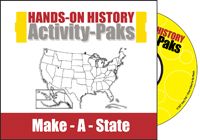
We are thrilled every time get to review a product from Home School in the Woods. This time was even more exciting though, because we were able to use their newest product! The Make-A-State Activity, which is part of their Activity-Paks line, is filled with hands-on projects that teach all about the 50 states.   


Home School in the Woods is a family business that was started as a way to make history real, understandable, and applicable. Using timelines and realistic illustrations as a foundation, they've created many resources to make learning history an enjoyable process. I, like Amy the driving force of the company, did not enjoy the boring textbooks in high school. It wasn't until we started our own homeschooling journey that I started to realize that learning history wasn't boring, but, in fact, could be quite interesting. I was excited to download this study and learn more about the individual states that make up America.

The download (also available as a CD) comes as a zip file. Once you open it, and see the multiple folders, click on the "start" file. At that point, the entire program will open in your browser, making it very easy to use. Instead of clicking through multiple folders, trying to bounce back and forth among the resources, everything is laid out as you need it.


The Make-A-State Activity-Pak contains templates to create an individual lap book for each of the 50 states and also includes a bonus book for Washington D.C.. The projects incorporate illustrations, coloring, creative writing, map skills, research, and more. Each lap book covers the same 20 activities. Some of the templates are the same for each state, while others are individualized. There are 20 activities for each lap book:
  • Key State Facts
  • Origin of State Name
  • State Motto
  • State Symbols
  • State Song
  • State Industry/Agriculture/Climate
  • State Wildlife
  • Regions
  • State Geography
  • State Government
  • State Seal & Flag
  • State History
  • Famous People From . . .
  • Native Tribes
  • State Landmarks
  • Sports Teams
  • State Quarter
  • Recipes
  • State Vocabulary
  • State Timeline 

While there is a bonus page of learning about each state that is filled with facts and other brief information, the activity-pak is designed to compliment your own curriculum, text, or research. This product is different, in that sense, from the other materials we've used from Home School in the Woods (U.S. Elections Lap-Pak, Project Passport: The Middle Ages, and Project Passport: Ancient Egypt) that included the complete lesson texts. The company is known for their detailed, hands-on curricula, and this study does not disappoint. The activity-paks encourage independent study, by guiding the student through a series of topics and offering activities and projects. Hands-on assignments add another level of learning that helps the student to better retain information. There are detailed instructions for each project.

This study is recommended for grades 3-8, but, personally, I've found that it works well even for my younger kids (ages 5 and 7), too. We like to incorporate as much family study as we can, and the Make-A-Sate Activity-Pak is wonderful. Everyone can be involved, whether it's helping to research the information on the internet or helping to cut and tape or helping to draw and color.

We chose to start with the study of Michigan since that's where we live. The kids already knew things like the robin is our state bird and Lansing is our capital, but they've learned so much more than that the last month or so. They've enjoyed seeing our state symbol and flag, learning our motto, and listening to our song. We've studied about wolverines, assembly lines, the Great Lakes, the Soo Locks, meat pasties, and more.

 
The only negative opinion I have about this study is the breakdown of the PDFs. Because everything has very specific printing instructions (regular paper, colored paper, white cardstock, colored cardstock) each individual page is its own file. I understand the need for the "special" pages, but because of the individual files, you have to open each file individually and print. On pages that are double-sides, you have to open the file, print one page, turn it around, open another file, and print the back. The other studies we've used from this company incorporated more cardstock, whereas this one used mostly regular paper. It would be so much simpler, if the entire resource were one file, or could at least also be given as a single PDF, along with the current format. That way, I could choose the double-sided printing option and my printer can do the work for me when needed and have the option of printing all the regular pages at once. Printers have so many options now that make printing easy, and I really feel that this format hinders it. It's the same complaint I have of each of the products from Home School in the Woods. I had really hoped to see this changed since it's their brand new study.

Aside from the printing frustrations, we absolutely love this study; so much, in fact, that we will continue with our study of the states, even with the extra work to get it all printed. The lap book activities are well done and offer such variety. Because of the slower pace of our summer schedule, we're at the point where the Michigan lap book is about to be assembled. The older kids (ages 9 and 11), especially like the resources from Home School in the Woods, and since they're away at church camp for the week, we'll wait until they're home to put it all together. I'm excited to see the final project with all its moving parts and opening flaps and pages.


Home School in the Woods really is a fantastic place if you're looking for hands-on history curricula. If you'd like another activty-pak, like this one, they also have options for The New Testament, Artists, and a couple others. If you'd like a product that includes more lesson text, their Time Travelers or  Project Passport lines might be more appealing. The also offer timelines, map sets, lap books, and more. A new feature that is being offered is the A La Carte Projects, if you're looking for just a few projects for topical studies. Currently, you can even use code "alacarte" at checkout to get the Erie Canal project for free! Try it out and fall in love with their resources, just like we have. You can find entire lists of products on their website. 


The Make-A-State Activity is a great resource for encouraging independent study of the 50 states. My kids and I are enjoying using this product and look forward all that we'll learn as we continue our study.


You can connect with Home School in the Woods on the following social media sites:


You can read more reviews of products offered by Home School in the Woods on the Homeschool Review Crew blog.


Crew Disclaimer
Pin It

Wednesday, February 22, 2017

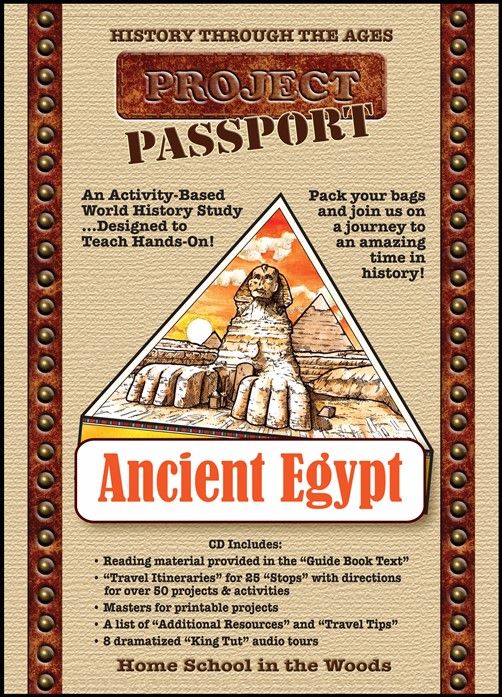
Project Passport: Ancient Egypt


A new year has started with the Homeschool Review Crew! And what better way is there to start than with  a review from one of our favorite vendors? Home School in the Woods is known for their detailed, hands-on history curricula. Their Project Passport series offers many studies that take you in a trip to various lands and time periods. The studies are created in a fashion that makes you feel as if you are truly traveling by taking you on a thrilling, educational journey.

We are currently "visiting" Ancient Egypt with the digital version of HISTORY Through the Ages Project Passport World History Study: Ancient Egypt. My kids have always been fascinated by the pyramids, mummies, hieroglyphics, pharaohs, and all things Ancient Egypt. They were excited to take another Project Passport trip back in time.  


Home School in the Woods is a family business that was started as a way to make history real, understandable, and applicable. Using timelines and realistic illustrations as a foundation, they've created many resources to make learning history an enjoyable process. I, like Amy the driving force of the company, did not enjoy the boring textbooks in high school. It wasn't until we started our own homeschooling journey that I started to realize that learning history wasn't boring, but, in fact, could be quite interesting. I was excited to download this study and travel to the Middle Ages.

The download (also available as a CD) comes as a zip file. Once you open it, and see the multiple folders, click on the "start" file. At that point, the entire program will open in your browser, making it very easy to use. Instead of clicking through multiple folders, trying to bounce back and forth among the resources, everything is laid out as you need it.   


Using Project Passport is like taking an actual trip to a specific time period. The program is divided into 25 stops or destinations:
  • Stops 1-2 Laying the Foundation
  • Stops 3-5 Everyday Life
  • Stop 6 Agriculture, Trade, and Transportation
  • Stop 7 Education
  • Stop 8 Literature and Writing
  • Stop 9 The Sciences
  • Stop 10 Medicine and Disease
  • Stop 11 Ancient Egyptian Arts
  • Stop 12 The Great Builders
  • Stop 13 Religion and the "gods"
  • Stop 14 Governing the Land
  • Stop 15 The First Dynasties
  • Stop 16 From Chaos to Order and Back Again to Chaos
  • Stop 17 A Land Divided
  • Stop 18 The New Kingdom Begins
  • Stop 19 Egypt's Most Famous Women
  • Stop 20 The Conquering Pharaoh
  • Stop 21 Akhenaton and Tutankhamen
  • Stop 22 Egypt Fades Away
  • Stop 23 Ancient Egypt and the Bible
  • Stop 24 Bringing Back the Past
  • Stop 25 Packing Up  

The first few stops require a bit of work. What makes this study so well-done, also makes it so much work. Laying the Foundation is where you create many of the things you'll need for the trip: a realistic passport, a luggage folder complete with tag, a scrapbook of sights, a postcard rack, a newspaper, timeline, and more. Since this is our second Project Passport trip, we were able to use the same luggage and passport from before. Everything else is specific to each individual study.

 
This study is recommended for grades 3-8, but, as with many things, we adapted it to be used as a family project. That means that I was completing each step for a 6th grader, 3rd grader, 1st grader, and a preschooler (a few stops along the way, the preschooler lost interest in many of the activities. I stopped printing the materials for him, but he does listen to and participate in the lessons).  It required much paper and cardstock and even more preparation. Since we are doing the trip together, I printed certain things (newspaper, Egyptian cookbook, games, etc.) only once and keep it in a separate 3-ring binder to be used by all. Other things (timelines, maps, souvenir cards, postcards, etc.) I printed a set for each child to be kept in their own binders. Since the kiddos are a bit older now, they can do much of their own cutting, gluing, and whatnot this time around.

For each stop, there is a guide book text, which contains all the reading material for learning, and a travel itinerary, which gives thorough step-by-step instructions for the activities. A sample stop might be like this: reading text, adding snapshot moments to the timeline, writing a newspaper article or a postcard, and one or more other activities like playing a game or creating a souvenir craft. Another impressive feature at some of the stops is the audio tours, where the "tour guide" and background noises make you feel like you're really in Egypt.


This is my third study from Home School in the Woods, and I am just as impressed as I was the first time. We average about one stop a week, as there is so much involved with the lessons. Since we have a busy get-into-everything toddler in our home, we wait until his nap time to head back to Egypt. One day we'll read the guidebook text (which usually spirals into deeper discussions of the topics and results in our looking at various pictures). Another day, we'll work on some of the simpler projects. Day three, we reserve for some of the more complicated, hands-on learning.   

One thing that really increased our learning that my parents visited Egypt a few years ago. The kids and I were able to look through their pictures and see the places and things that we are learning about. I was also able to show them my own cartouche that my parents brought back for me. All these things made the learning more personal for us.   


Here's what my kids said about this product:
    

"I like the Pyramids! And I like the projects.

"I like that it has a lot of coloring."

"I like when you read about it to us. I don't like the coloring, but I like the projects."


The only negative opinion I have about this study is the breakdown of the PDFs. Because everything has very specific printing instructions (regular paper, colored paper, white cardstock, colored cardstock) each individual page is its own file. I understand the need for the "special" pages. The problem comes in when you have to print lengthy things like the timeline or newspaper. Because of the individual files, you have to open the file, print one page, turn it around, open another file, and print the back. To make things simpler, I would like to see those entire resources as one file so I can choose the double-sided printing option and my printer can do the work for me. My techie husband was able to grab those files, combine them in a PDF converter app, and then print all at once. It was faster than printing it according to the directions, but it seems like an unnecessary step when it could come as one file in the download. 

Aside from the printing suggestion, I absolutely love this study. The amount of information and the varying activities are astounding. It is a lot of work to prepare, but that's part of why it's so well-loved in our home. I can guarantee we'll take another Project Passport trip one day as there are so many places we can visit, like their newest title, Ancient Greece and Ancient Rome (coming 2018). 

I think the biggest compliment I can share about this product is when my daughter announced in the middle of our study one day, "This is my favorite school thing ever."


You can connect with Home School in the Woods on the following social media sites:

If you'd like to see some of the other fun studies from this company, please read the reviews on the Homeschool Review Crew blog. 


Crew Disclaimer
Pin It

Friday, August 26, 2016

Can Do Cubes


This review goes hand-in-hand with the jollyliteracy.com and just2ducks LLC Jolly Phonics and Grammar review that I posted earlier this week. Like I said before, I loved teaching my first grade students in the classroom to read many years ago, and I love even more teaching my own kids at home now. To me, it's one of the most rewarding privileges of homeschooling the early years. Words are everywhere--books, signs, stores, mail, directions, recipes, letters. Whether it's for entertainment purposes or to increase knowledge, reading is an every-day skill. Literature is the foundation of our schooling, so reading well is vital in our family.

I taught my first 3 kids to read without the use of any curricula. My philosophy for little ones is that they learn best through play. I teach letters through manipulatives, puzzles, games, and typical conversations (saying things like, "Do you see that M on that sign?" and "Look! There's a T just like your name.") Once letters and sounds have been learned, we move to blending into words, using the same methods, adding in writing the words on paper or dry erase board. Any time you can get a little one involved in sensory learning, the lesson is fun, inviting, and productive. These Can Do Cubes are perfect for our style of learning.  


The Can Do Cubes set is used to teach synthetic phonics. The approach, as I described above, begins by teaching simple phonemes (sounds), blending them to make words, teaching complex phonemes, and blending those. The set contains many components to complement any synthetic phonics program.

  • Stage 1 Cubes -- 27 1-inch cubes showing one spelling for each of the 44+ sounds that make up the simple alphabetic code.
  • Stage 2 Cubes -- 30 individual 1-inch cubes along with 2 cubes connected with a string (to represent split digraph sounds) showing the spellings for the 175+ sounds of the complex alphabetic code.
  • Handbook for Stage 1 -- Small spiral-bound book filled with information about reading, such as pre-reading activities, explanation of the alphabetic code, encoding, pronunciation chart, notes, and much more.
  • Handbook for Stage 2 -- An identical book to the other, but filled with helpful instruction of the complex alphabetic code cubes, capital letters and punctuation, reading and spelling activities, phonemes charts, and more.
  • Teaching Learning and "Sounding Out" DVD -- An interactive demonstration of pronunciation and sounding out of words presented by Debbie Hepplewhite, synthetics phonics consultant and creator of the Can Do Cubes set.
  • Phonics Chart -- A large chart that explains phonemes, graphemes, and teaching points for each.
  • Word Charts -- Two large charts that list by cube number the words that can be made.   
  • Teacher's Guide and Template Book CD -- Includes online templates and worksheets in PDF for easy printing.


The cubes themselves are made of hardwood and laser-engraved. The Stage 1 cubes each have a small number at the bottom, indicating its placement of learning.  There are 8 different cubes: 6 of number 1 and 3 of numbers 2-8.  Each number cube is the same and contains all of the sounds for the number. For example, all 6 number 1 cubes have the letters s, a, t, i, p, n.

The Stage 2 cubes show the spelling variations for the 44 sounds. For example, one cube shows the different long a sounds: ai, ay, a, ey, eigh, ea. There are also cube for capital letters, punctuation, double letters, and split vowel digraphs. Each cube type is arranged in a way to make it easy to find.


The Can Do Cubes are listed in the order of the Jolly Phonics curriculum, so it made it easy for us to use the two resources together. My 4-year-old is at the beginning stages of reading and is just learning to blend sounds to make words. While he does enjoy sitting at the table and reading simple CVC (consonant-vowel-consonant) words, he much prefers to "play" with his blocks. The multi-sensory approach works very well for him.

There are many ways in which we use these cubes:
  • I make a sound and he finds the matching letter.
  • I say a word and he finds the letters to make it.
  • I make a word and he reads it.
  • I make a word and he finds the letters to copy it.
  • I put 2 letters and leave a space for another. I say a word and he finds the missing letter.
  • I make a word and he finds all the possible rhyming words.
The possibilities of learning with these cubes are really endless. You can say a word, have the student make it with the cubes, and then write it on paper. Or for even younger kids, you can have them find all the matching letters on the cubes. You could use them in a hangman type game or the child makes a word for you to read. If it involves letters, sounds, or reading, you can use these cubes to do it.


The materials are well-made and fit in the main box, making it easy to keep track of it all. The trays have pull tabs on the sides so you can easily get them out. Even my older kids have enjoyed the cubes, both by themselves and helping their learning-to-reading little brother. I love that the trays list which cubes belong where, especially for those times when the toddler like to dump everything out at once, ha.

If you have a student who is learning to read, struggling with spelling, or just needs a multi-sensory approach, we recommend the Can Do Cubes. 


You can connect with jollyliteracy.com on the following social media sites:

Facebook
Twitter
Pinterest


You can see how other homeschool families used these cubes by reading the reviews on the Schoolhouse Review Crew blog.

Crew Disclaimer
Pin It