Showing posts with label science experiment. Show all posts

Wednesday, May 22, 2019

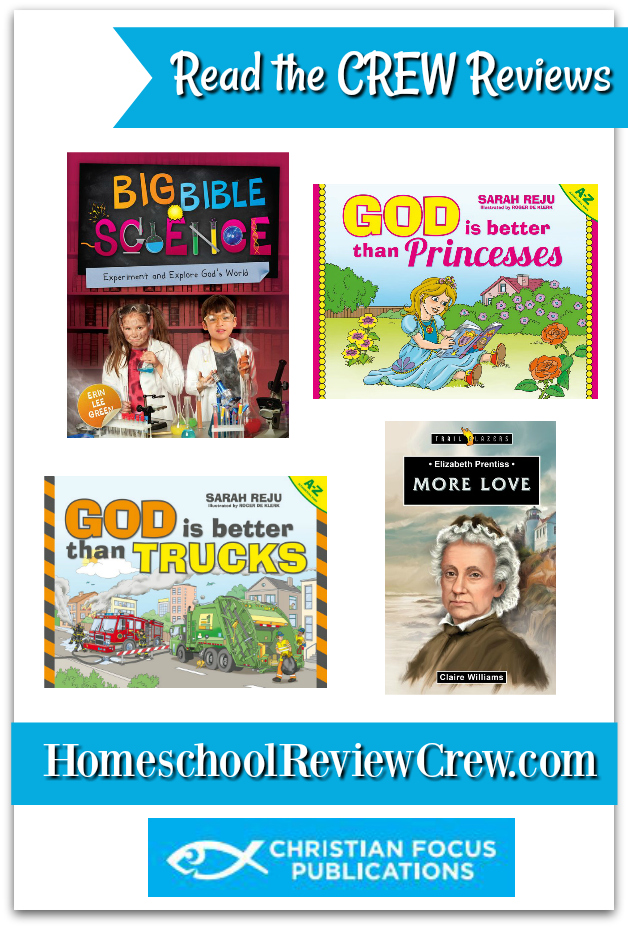
Big Bible Science


My kids will happily spend their days experimenting with supplies, observing reactions, and investigating scientific data. It is no surprise that they are excited to review science-related materials and explore how the world around them works. Christian Focus recently sent us a book that perfectly speaks to our hands-on approach to learning called Big Bible Science.

Christian Focus has been producing books since the early 1970s. Their mission, "staying faithful" to God and His Word and "reaching out" to the world with the gospel of Christ, is made manifest through the resources they publish. From their Bible studies to their biographies to their children's books, and everything in between, the books point readers to God and the Bible. Their materials are written by authors all over the world and have been translated into over 70 languages.


Since we are big science-loving, hands-on learners, we have used many science and experiment books over the years. Big Bible Science, written by Erin Lee Green, is unique from everything else I have seen.  Rather than simply teaching scientific concepts and observing laws and theories through experimentation, this book demonstrates how God designed the world and all of its scientific aspects. It highlights various Bible stories that coincide with science facts and incorporates many other Scripture references. The book uses a version different from our own, so we keep a Bible with us during our lessons to read.

This paperback book contains just shy of 100 pages of fun. The pages are thick, glossy, and filled with bold colors and images. There are photographs, clip-art, and sketches that complement the written text. The book begins with an introduction explaining the importance of introducing kids to new concepts and all about a biblical worldview of creation. There are also pages with teaching tips, safety protocols, a list of activities and the adult-assistance needed, and other miscellaneous information. There is a page dedicated to the explanation of notebooking and the importance of keeping a scientific journal along with detailed directions to do so.


Big Bible Science covers 21 topics:

  • Gravity
  • Newton's First Law of Motion
  • Newton's Second Law of Motion
  • Newton's Third Law of Motion
  • Coefficient of Friction
  • Static Electricity
  • Acids and Bases
  • Combustion Reactions
  • Plant Requirements
  • Lunar Craters
  • Water Cycle
  • Angle of the Sun's Ray
  • Basic Animal Classification
  • Animal Classification: Zoo Trip
  • Nervous System
  • Muscles
  • Bones
  • Respiratory System
  • Circulatory System
  • Digestive System
  • Urinary System


The science topic are divided into chapters/experiments. Each chapter follows the same format:
  • Objective -- a brief explanation of the learning goal for the chapter
  • Materials -- a list of needed supplies
  • The Big Idea -- the scientific explanation; ties in a biblical perspective and memory verse
  • Activities -- scientific demonstrations, games, and experiments
  • Apply It -- ideas to find examples of the lesson in the real world; reinforces key aspects of scientific and biblical principles
  • Go Beyond -- challenges and experiments for deeper study    


I have been using this course as a group activity with 4 of my children (ages 11, 9, 7, 4). I love reading through the Big Idea sections with them. My favorite part of homeschooling is the time we learn together--expounding on a topic, gaining a glimpse into their minds, and learning and growing together. Not only do these sections teach my little ones scientific concepts, but also incorporate biblical stories and truths into the lessons. We've discussed how Zacchaeus accepted Jesus and related it to Newton's First Law of Motion, the goodness of God's creation and Psalm 34:8 through acids and bases, how adding good habits and character traits to our lives is similar to Newton's Third Law, and more.

My kids' favorite part, by far, are the activities! Some of the chapters list a single experiment for the topic, while others offer many ideas to fully understand that concept. From driving toys cars through a masking-tape finish line to creating moon craters with balls and flour to classifying animals on a trip to the zoo to acting out the components of the blood, there is something to appeal to all little learners. Some of our favorite activities were sending balloons through the house attached to a straw on a string while learning about Newton's Third Law of Motion and tasting various foods found in our kitchen while learning about acids and bases. The activities are simple enough to be enjoyed by my 4-year-old but exciting enough to interest my 11-year-old, as well.


Another aspect of the book that I really appreciate is the mini biography section in the back. I require my kids to read a certain amount of their literature every week in a biography book. There is much you can learn while reading about people's lives. These brief accounts highlight various men who changed the world through their scientific advancements. Some of the 11 influential men that are included are Svante Arrhenius, Benjamin Franklin, Carolus Linnaeus, Leonardo da Vinci, and Lynn Townsend White, JR. 

Big Bible Science is a fantastic resource for learning detailed science concepts through the light of God's Word. Scientific facts, biblical truths, hands-on activities, short biographies--this book has it all.


You can connect with Christian Focus on the following social media sites:

Some of my crewmates received other books from Christian Focus including a full biography about a Christian hymn writer and a couple cute ABC picture books that teach about God.

You can read those reviews on the Homeschool Review Crew blog.


Big Bible Science, Elizabeth Prentiss, God is Better than Princesses,  God is Better than Trucks. {Christian Focus Reviews}
Crew Disclaimer
Pin It

Tuesday, August 4, 2015

Funtastic Unit Studies Review


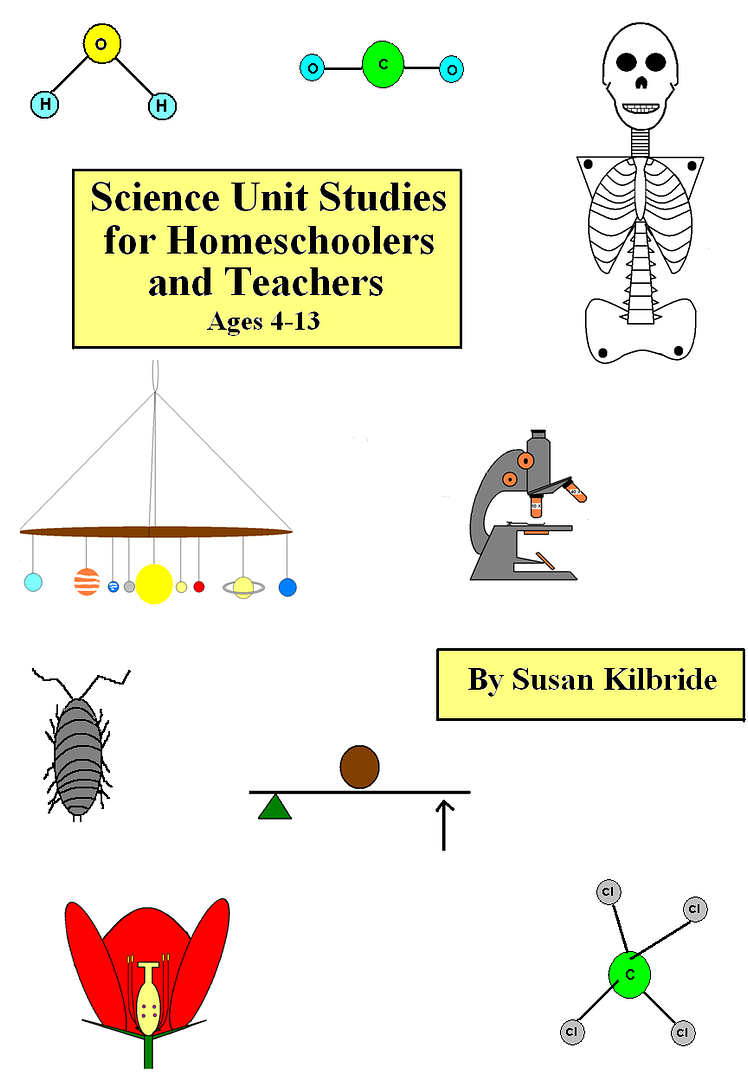
My kiddos love science. They thrive on experiments and hands-on projects. They long to understand how and why things work. They enjoy examining and discovering just about everything. My little ones, like their daddy, are naturally drawn to all things science. I knew they'd be excited to use the Science Unit Studies for Homeschoolers and Teachers this summer. 

This book, written by Susan Kilbride, is part of  Funtastic Unit Studies. Susan, a homeschooling mother with a degree in biology, started the company to help other parents feel comfortable teaching science. She used the methods that she applied when teaching her own son and the unit studies book was born.      


Science Unit Studies for Homeschoolers and Teachers is broken into 2 sections: studies for ages 4-7 and studies for ages 8-13.

Ages 4-7
  • Our Senses
  • The Human Body
  • Dinosaurs and Prehistoric Life
  • Animals
  • Insects and Their Kin
  • Fun with Magnets
  • Stars and Planets
  • Health
  • Beginning Plants
  • Animal Ecology
Ages 8-13
  • Insects
  • Microscopes and Invisible Creatures
  • Atoms and Molecules
  •  Matter
  • Chemistry Fun
  • Weather
  • Force and Motion
  • Simple Machines
  • Light and Color
  • Plants II


Each chapter starts with a list of materials needed for that topic. Then, it's broken into parts or subtopics for the unit. Each part lists activities for learning. For instance, we started with Chapter 1: Our Senses. The unit is as follows:
  • Part 1: Introduction
  • Part 2: Taste
  • Part 3: Touch
  • Part 4: Sight
  •  Part 5: Sound
  • Part 6: Smell
  • Part 7: Review of Senses 


This book is very simple to use and makes teaching science fun. Since we do science together as a family, I like to find activities that include all the children (9, 7, 5, 3). The chapters for the younger group work perfectly for us.  I've done a study on the 5 senses with the kids before, but this one was even more exciting for them. We did activities like read "Goldilocks and the Three Bears" and pointed out every time one of the senses was used; tasted some yummy treats and discussed whether they were sweet, salty, bitter, sour, or savory; took turns hiding objects from around the house in a paper bag and tried to guess what they were by feeling them; listened to different pitches of sound on glasses of water and even played "Mary Had A Little Lamb;" took turns picking things from the kitchen and tried to guess what they were just by the scent; played Mad Libs in which an orange turned into a popcorn machine; and experimented with many other activities to learn about our senses.

 
The activities for the older group are more in depth, of course. They include using a microscope; writing a research paper; decoding physical and chemical properties; classifying objects; and using materials like a pulley, cellophane, a carnivorous plant, iodine, colored marshmallows, and more. There are also accompanying tests and worksheets along with the answer sheets.

This book is packed full of activities and experiments that could easily keep your kids busy all year. Most of the materials are things that you probably already have around the house.The activities are easy to prepare and take just minutes to set up. In fact, I know that I could hand the book to my 9-year-old and allow him to preform the majority of the activities on his own. This book truly is written to make learning science as simple as possible.


Science Unit Studies for Homeschoolers and Teachers is thorough, affordable, and fun, and one that you'll want to utilize in your homeschool. If you can't wait for your own copy to arrive, you can start with the 2 free PDF units from the book that are offered or use one of the other freebies on the site. 

My kids ask every day if it's time to do science. We're all enjoying this book and will continue using this wonderful resource.


If you'd like to see how other homeschool families used this book, please read the reviews on the Schoolhouse Review Crew blog.


Crew Disclaimer
Pin It

Thursday, June 26, 2014

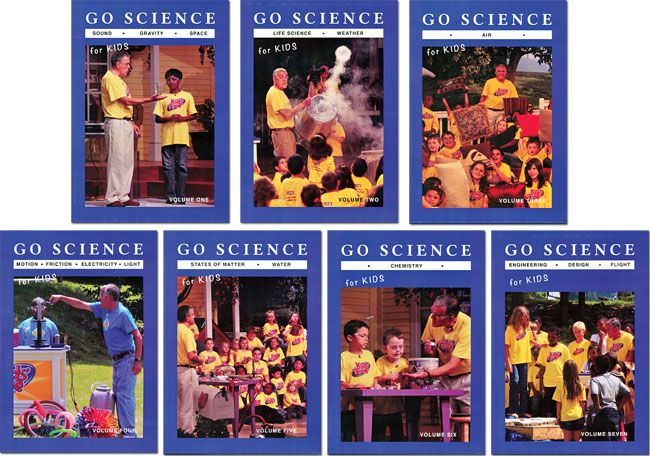
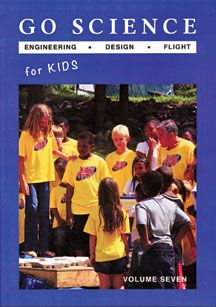
Go Science Series 2


I've said many times that my kids love science. Love as in they'd preform experiments all day if they could. Not only do they enjoy watching the experiments themselves, but they want to know the hows and whys behind them, too. (They totally get that inquisitive mind from their daddy. I don't really care why something works, I'm just glad that it does, ha.) They were thrilled to receive 2 Go Science DVDs series 2 to review from Library and Educational Services.

Library and Educational Services is a small, family-owned company right here in Michigan. They've been in business as a whole-sale distributor for 35 years, selling to libraries, schools, resellers, specialty stores, missionaries, daycare centers, and ministry leaders. They carefully select their merchandise to ensure they represent Christian morals and values. I personally have ordered from them and have been very pleased with the products.

The Go Science DVDs are filled with the high-energy demonstrations of Ben Roy, teacher at the University of Tennessee at Chattanooga and former director of a science program on television. Ben captivates, motivates, and inspires students to get excited about science and points people to God.  


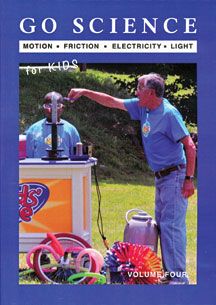
Our first selection was volume 4: Motion, Friction, Electricity, Light. Each of the experiments were filmed with a group of children for a Christian TV broadcast. The demonstrations last anywhere from 3-10 minutes a piece. Mr. Roy is very personable and involves the children. He asks them questions about their likes and such before calling them forward to help with the experiments.

There are many demonstrations on this volume:
  • Tablecloth Trick
  • High Bounce Balls
  • Marble Gravitron
  • Yo-Yo Big Spool
  • Bowling Ball
  • Friction
  • Floating Rice
  • Simple Motor
  • Nail Magnet
  • Jumping Rings
  • Food Coloring and Bubbles

My kids (8, 6, 4) love watching these. They laughed as they tried their own marble gravitron, were amazed at the jumping rings, and couldn't wait to try floating rice. My daughter explained, in depth, how we could make our own simple motor. My son keeps asking me questions about science to see if I know what he's recently learned. They also think it's really neat that the whole series, every demonstration, shows how God made science and everything that happens is because of Him. I love how Mr. Roy not only grabs the kids' attention, but uses that influence to point them to the Creator. In the food coloring and bubbles section, he uses the experiment to show that our sin is red like crimson, but Jesus blood can make us white as snow. 


Our second choice was volume 7: Engineering, Design, Flight. This video is full of demonstrations, as well:
  • How Much Will it Hold
  • Leaning Tower of Lyra
  • Nail Balance
  • Trebuchet
  • Centrifuge
  • Walking on Eggs
  • Bed of Nails-Small
  • Rocket Balloons
  • Vinegar Rocket
  • Toilet Paper on Paint Roller
  • Film Canister Rocket

Any time you talk about a trebuchet or rocket, you're going to gain the attention of my little ones. It's exciting to watch objects fly through the air, using things you can find around the house. And it doesn't matter how many times they've seen it, they want to see it again. They were eager to try walking on eggs themselves, trying out a bed of nails, and sending rockets flying into space (or at least across the yard). Mr. Roy carries that same enthusiasm throughout each demonstration. You can see that he truly loves science and God, and it's contagious. At the end of each episode, he states,"When we learn more about science, we learn more about our Creator, God." And that truly is what these videos are all about.“
science, we learn more about our Creator, God.” - See more at: http://schoolhousereviewcrew.com/library-and-educational-services-review/#sthash.K2aud3rB.dpuf
“When we learn more about
science, we learn more about our Creator, God.” - See more at: http://schoolhousereviewcrew.com/library-and-educational-services-review/#sthash.K2aud3rB.dpuf
“When we learn more about
science, we learn more about our Creator, God.” - See more at: http://schoolhousereviewcrew.com/library-and-educational-services-review/#sthash.K2aud3rB.dpuf


Each individual volume of the Go Science series 2 can be purchased from Library and Educational Services for $8.97 (retails for $14.95) or the entire 7-volme set can be purchased for $59.82 (retails for ($99.70). The videos are geared towards kids 4-12 and are perfect as a starting place for experiments, as supplemental work, or as a motivation for kids who are not excited about science.

My little ones thorough enjoy watching these, and they can't wait to preform more of the experiments at home themselves. I love that they're learning science and how it correlates to God. We'll get plenty of enjoyment from these DVDs for many years. 

If you'd like to see more of what Library and Educational Services has to offer, you can request a catalog. There is also a demo video from the series.


Don't forget to head to the Crew blog to read more reviews of the other volumes in the Go Science series.   


Crew Disclaimer
Pin It

Thursday, February 27, 2014

Science4Us.com Review


My kids love science. They love it so much that I think they could spend all day exploring and experimenting. I knew they'd be excited to review a 6-month Science4Us.com online subscription.

Science4Us.com is an online, interactive, standards-based curriculum made by the creators of VocabularySpellingCity.com. Although it's geared toward kids in grades K-2, students in grades 3-5 can utilize the lessons for review. Their mission is to provide a solid foundation of scientific concepts to early elementary students and to equip the teachers with the support and resources necessary to ensure that it happens. 


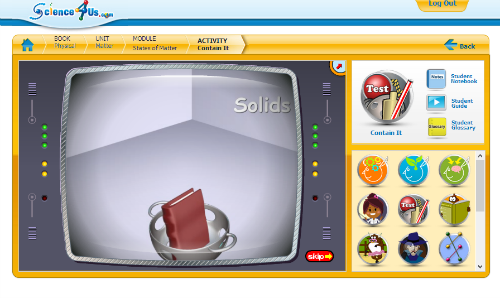
There are over 350 lessons that are divided into books of science: physical, inquiry, life, and earth/space.


Physical
This book teaches kids how the world around them works. It focuses on matter (materials and mixtures, observing matter, states of matter, changes of matter), energy (sources, light, heat, sound, electrical, transformations), and force and motion (location and perspective, motion, force, magnets, simple machines). It teaches the student the name and reasons behind concepts that he already understands (gravity, energy, friction, perspective). It makes learning these new terms fun by teaching with hands-on activities, games, and interactive lessons.
 
Inquiry
This book consists of two units: science tools and think like a scientist. These lessons use a student's natural desire to play and experiment, begins to show how observations can be analyzed, and builds skills toward the scientific method. It uses tools such as quantitative and qualitative observations, the 5 senses, rulers, balances, scales, and hands-on activities. It helps students understand that there are different ways to solve problems, compare and contrast, and evaluate data. The student will study graphs, table and charts and even language skills. This book allows the student to learn valuable science skills at his own level.

Life
This book is divided into two units: living things (living/nonliving, plants, animals) and balance in nature (food webs, habitats, eco awareness). In this branch, the student will practice classifying, categorizing, observation, and record keeping. He'll learn to distinguish mammals, birds, fish, reptiles, amphibians, and invertebrates. He'll also study how living things interact with the world around them. Using animated characters, engaging activities, and fun games to master vocabulary terms such as omnivore, herbivore, carnivore, predator, prey, extinction, and endangered and invasion species.    

Earth/Space
These complex topics are also divided into two units: earth (history, materials, features, weather) and space (exploring the universe, earth in space). This study involves both tactile exploration and abstract concepts. It starts with building a timeline of the student's life and works through imagination using concrete activities to teach about abstract concepts. It studies, rocks, water, landforms, thermometers, gauges, patterns, cycles, and seasons. Using example a young child can understand now, will build the foundation for further study of our planet, solar system, and universe. 


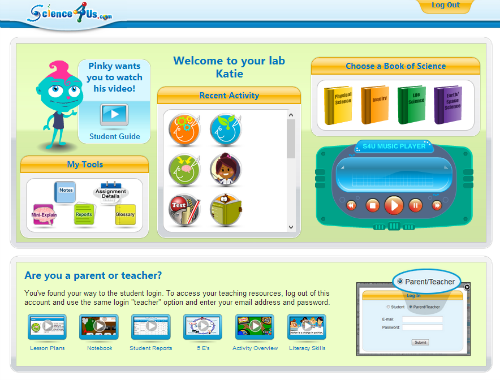
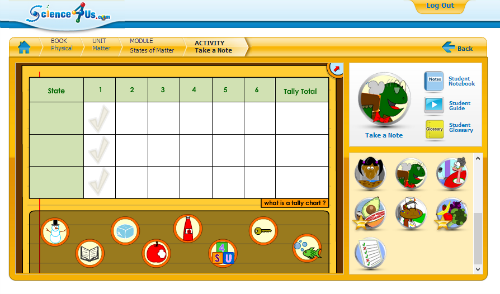
Considering the elaborateness of the program, you'd think it would be difficult to navigate. It's not. Not at all. There is a section for the parent/teacher. There, you can choose specific modules for the individual student's lesson plans, review the students' reports, learn teaching strategies, watch explanatory videos, and download corresponding worksheets. Once the student is logged in, he knows exactly what is on the lesson plan for the day. 

Though the option of specifically setting the activities for the day can be very beneficial, we chose not to follow that route. My kids Jake (8), Alyssa (5), and Zac (4) can log-in to the program and completely navigate it by themselves. They choose which books and study of science they want to learn. Because we have two computers and three children old enough to use the program, I often have two children sitting and "playing" science and one child running back and forth between the two. Eventually, I'll hear, "Is it my turn? Can I play now?" None of them ever get off without my telling them to--that's how much they love this! They would sit and play for hours, if I'd let them. They have so much fun watching the videos, playing the games, singing the songs, and learning valuable science skills. They ask to play even on days that aren't typical school days. To my kids, this isn't just school. It's fun!  They have the option to save the tasks in their notebooks. Because they enjoy this so much, Alyssa has started to write things down in a real notebook. She draws pictures and makes notes of the things she's learning.

To say that we're enjoying Science4Us.com would be an understatement. I love its complexity of information, yet simplicity of use. The kiddos reference the program many times a day in their vocabulary and observations. It's not simply a fun way to bide their time, it's truly teaching them scientific facts.


A Science4Us.com membership costs $7.95 per child per month. If you'd like to see if this program would work for your family, read their scope and sequence or check out the demonstration lessons. Even before we received our subscription, my kids played the demos many times. 

You can connect with Science4Us.com through Facebook, Twitter, Google+, and Pinterest.


To see how other families used this program, click to read more reviews from the Schoolhouse Review Crew.


Crew Disclaimer
Pin It

Sunday, November 10, 2013

Apologia Exploring Creation with Chemistry and Physics Review


My kids love science. They thrive on experiments and hands-on projects. They long to understand how and why things work. They enjoy examining and discovering just about everything. My kids naturally are drawn to all things science. While I am pleased that they are science-minded like their daddy, I instinctively lean towards language arts and math. I am always looking to balance my passions with their interests. I was ecstatic to be chosen to review Exploring Creation with Chemistry and Physics from Apologia.

Apologia Educational Ministries is well-known in the homeschool realm for their science curricula and other biblical worldview products. This Christian company believes "that every educational subject in your home school can and should be taught from a biblical worldview built on the solid foundation of God’s Word and centered on Jesus Christ." It's always best to use products that reinforce your beliefs. We have loved everything we've gotten from Apologia in the past, so I was looking forward to this curriculum, as well. 


Exploring Creation with Chemistry and Physics ($39) is part of their Young Explorers series for K5-6th grade. This study uses the Charlotte Mason method to give students an introduction to chemistry and physics and teach how God made everything in the universe. Topics such as atoms, molecules, simple chemicals, laws and motion, electrical magnetism, and simple machines are covered. This hard cover glossy book is filled with colorful, eye-catching pictures, most of which are kids in the middle of conducting a fun experiment. Each lesson is broken into small sections that can easily be completed alone or in conjunction with another part of the lesson. The book is written directly to the student, so it's very easy for the parent to read and the child to understand. 

While my little ones (7, 5, 4) thoroughly enjoyed the how and why teaching parts of the text, their absolute favorite was all the experiments. There are dominant blue boxes marked try this! that are sprinkled throughout the book and list all the supplies and directions for completing the experiments. Directly under the box is the explanation. Most of the experiments use things that can be found around the house and can be set up and completed easily.


Along with the textbook, they offer notebooking journals ($24) to further the study and reinforce the information. These spiral-bound, consumable books are filled with fun, supplemental materials. The regular notebooking journal is for upper elementary grades and those efficient at writing. It provides a place for the student to record experiments, display artwork, and take notes. There are mini-books, crossword puzzles, and more fun activities. The junior notebooking journal is for lower elementary grades and those with limited writing skills. It has much fewer writing activities and offers big lines for the student to complete the work. This journal also includes mini-books and more experiments, but swaps the writing puzzles for coloring pages. 


This science curriculum is perfect for our family. There is so much great information given with age-appropriate language. It makes it easy for the little ones to understand and gives them a greater knowledge of God as our Master Designer. There is a sample schedule given in the front of the notebooking journal to do two lessons a week, but I found it works better for us to do shorter lessons more often. My kids rush through the rest of their studies so we can get to our science book. Jake (7) has been working with the regular journal and Alyssa (5) and Zac (4) have been using the junior edition. Each level fits perfectly where they are. Jake has always been my why? child. He truly wants to understand the hows and whys, of everything. So often, I'm not able to give him an answer without looking it up. Exploring Creation with Chemistry and Physics combines his love of experimenting with his longing for understanding. This will be a book that we enjoy for many years.     


If you'd like to research some more, please click to read more reviews from the Schoolhouse Review Crew.


Pin It

Sunday, April 14, 2013

Supercharged Science


I have a confession to make. Maybe you've already noticed; maybe not. But here goes . . . that Theory Thursday tab at the top of the screen? It's been kinda lonely lately. The last science experiment we posted was all the way back in August! My poor science-loving kids. It's not that we haven't done any experiments at all. We've done a few that I just haven't taken the time to blog about and we've done a few repeats (like this favorite), but I have definitely not made weekly experiments a priority.

And even though we've been greatly blessed with a subscription to review Supercharged Science, we still haven't done weekly experiments . . . It's more like daily experiments! Ha!


The kids and I were very excited to reacquaint ourselves with the e-Science program. Do you remember the simple hovercraft we made a couple years ago? We found the directions from Supercharged Science. Over the last 2 years, we've joined in on a few of their online teleclasses and preformed many experiments. Aurora, owner and founder, is extremely personable. Whether she's speaking in front of the camera in a video of an experiment, conducting a live class, or writing an email, it's like she's talking directly to you. She's one of those people that you want to be your friend. She has a wealth of information, yet has a way of explaining things to make it easy enough for a child to understand. But it's not just her magnetic personality that draws you to e-Science; it's the program itself.


One thing that makes this perfect for my hands-on kids is that they recommend "teaching science from the inside out," in other words, starting with experiments to pique their interest and then moving on to explain the reasoning. But it's so much more than a list of experiments! They offer resources for each type of learner: teleclasses & videos for auditory, text downloads & reading for digital, videos & projects for kinesthetic and visual. 

Since it's a full curriculum, it's very thorough. I'm talking 20 study units, over 1,000 videos, more than 900 science activities, experiments and projects thorough. Lesson plans, data lab sheets, quizzes, exercises, reading material - everything you need to teach kids kindergarten all the way through 12th grade is included on this one site. The program contains so much, but they make it easy for you, the parent, to give your child the best science education possible. The getting started page takes you step-by-step through the program and explains just how easy it is to follow. 


My kids are young (7, 5, 3), so we pretty much kept to the experiment portions. We did read through some of the explanations and further study materials, but I tried to keep to that "inside out" teaching. Of course, Jake, the oldest, is my question child. Why does this do this? Why did that happen? How does this work? He is the one who wants to understand it all. I usually respond with I don't know or my favorite Ask your father (since he gets that science-y brain from him anyway.) But I don't have to say those things anymore. Now it's Well, let's find out. E-Science has made it so easy to find the answers to his questions. 


We did things like bounce magnets, made kazoos, baked bread, classified objects, play thumb war, bounced balls, made a pendulum, made a pulley, rolled balls down an inclined plane, and more. But our very favorite activity? We made a robotic hand! The kids were ready to make a full-body robot, but I told them they'd need their daddy's help for that one.

I really can't say enough good about this program. It's thorough, easy to use, fun, organized, and the kids enjoy it. Even Zac (3 yr) will sit and watch video after video and continue to ask for more. It's quality content that truly appeals to the kids.  The program costs $37 a month for the K-8th plan and $57 a month for the K-12th plan. You'll receive access to the first 7 units and some additional sections filled with useful content and projects. You gain access to 2 new units each month after that. If you'd like to use e-Science as a supplement to your current science curriculum, they have a list of conversion charts for many companies that make it easy to find the topics you're studying and match up additional study.

Whether you use it as a stand-alone curriculum or a supplemental program, e-Science will not disappoint. There's even a 30-day money-back guarantee, so there's really no reason not to give it a try! They also offer a free science guide filled with 30 fun activities to get you started! Head over to Supercharged Science today to see all they have to offer.

  
Watch the video below to see how Alyssa shows off our really cool robotic hand . . . while her brothers act like typical brothers.


As always, you can read more reviews of e-Science from the Schoolhouse Review Crew.


Pin It

Monday, November 5, 2012

Activity Bags


One of the biggest questions I had when I started homeschooling my oldest child 2 years ago was "How am I going to keep the other kids busy?" My kids are by my side almost constantly all day long. To think that my littles were going to play quietly by themselves the entire time would be silly. Alyssa (4 yrs) has always enjoyed doing school. She will sit and fill out worksheets and coloring pages for an hour. Zac (2 yrs) though? He might color 1 page and be done in 2.79 seconds. I started to search the internet for activities that would be fun, education, and keep him busy. I even started compiling a bunch of busy bag activities before we went on vacation this past summer. 

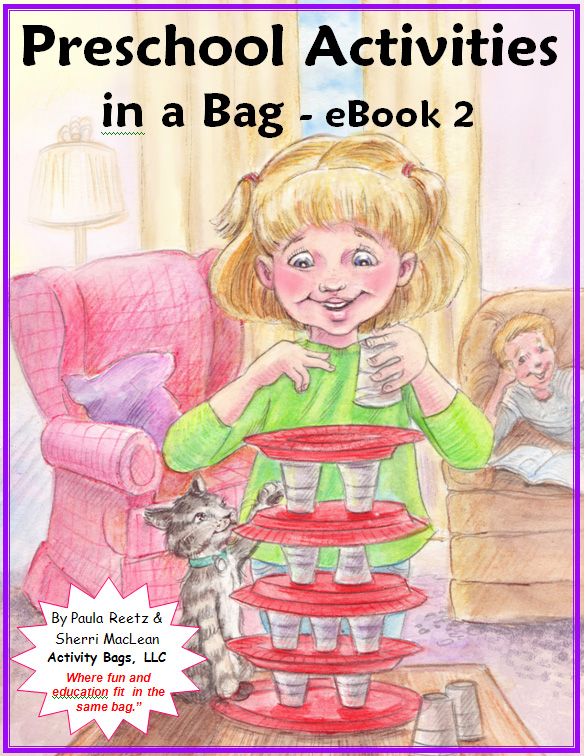
When I was given the opportunity to review Activity Bags, I was thrilled! This was exactly what I needed. Each e-book comes filled with self-guided activities that can be kept in a gallon-size zipper bag.  All the books were created by 2 homeschooling moms. The books include all the instructions, supply lists, and printable pages you need for each activity. They are designed to be used in a swap and contain all the necessary info to help you in that process. I personally have been wanting to participate in an activity bag swap for a long time. The concept is very simple - get X number of people with kids, each person makes X number of bags of the same activity, and everyone swaps bags. So, if you have a group of twenty people, in the end, you'll have 20 different activities. It's an easy and inexpensive way to quickly increase your number of independent activities for your little one.

There are currently 8 books with more in the works. We received the Preschool Bundle which consists of 2 books. Each book has 33-34 activities that prepare children ages 3-6 for kindergarten. They work on skills for counting, letters, colors, fine-motor, and more. The cost is very economical at only about $1 a bag and many of the supplies can be found around the house. Each e-book costs $15 individually or the set can be purchased for $27.

I first tried doing these activities with Alyssa and Zac while Jake (6 yrs) was doing other work. The only problem was that they were having so much fun that he wanted to play, too! From then on, we all did the activities together. Most of them worked just fine for all three ages. Some were a little too simple for Jake, and others were a bit too difficult for Zac. Every one was perfect for Alyssa though. During one activity from Book 1, I was explaining that a collage could be pictures placed all in one big pile instead of straight and organized. I told them that it's a different way to organize. Jake replied, "It doesn't sound organized to me. It sounds like messy." That's my boy!


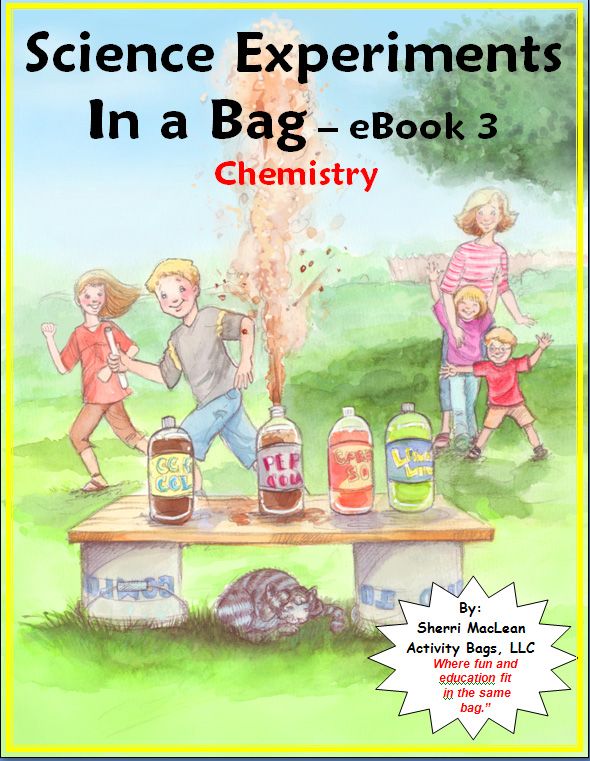
We were also blessed to receive the Science Bundle containing 3 books. Again, each book cost $15 individually, $27 for two, or $39 for all three. Each one comes with 25 different simple science experiments that your child can see, touch, manipulate, modify, investigate, and solve. Each book focuses on different branches of science. Book 1 includes experiments in biology, general science, and nature. Book 2 has experiments dealing with chemistry, the human body, and general science. Book 3 is filled with all chemistry experiments.They are all geared towards kids in K-8th grades. Again, they can be used in a swap or simply at home by yourself.

As you may know, my kids love science and conducting experiments. I plan experiments for every Thursday, but the kids are always performing their own throughout the week. These books have made it so easy for me to have an experiment ready to go on Thursdays or just any time they're in a scientific mood. The lists are simple to gather, the instructions are easy to understand, and the activities are fun and engaging. Some of them include Secret Messages, Green Copper, and Floating Egg. The books also include log sheets, notes, and observation questions. With a total of 75 experiments, I won't have to do any research to find experiments for a while.


We have loved using these books! There are also books for Reading Games in a Bag, Math Games in a Bag, and Travel Activities in a Binder. They are even currently creating 3 Craft Kits in a Bag. I personally am very excited to buy more books. They are very thorough and offer many activities that are great for the kids. I definitely plan to host a swap in the future. If you're local and would like to participate, let me know.

If you'd like to get a feel for the activities and all they offer, you can fill out a brief survey and get some samples for FREE!  Trust me, your kids will thank you.

If you're interested in some of the other books offered or if you'd like to see more reviews of the preschool and science books, head over to the Schoolhouse Review Crew blog


* Disclaimer - I was given these e-books in exchange for my honest review. All opinions are my own.
Pin It

Friday, May 25, 2012

Theory Thursday: Oobleck

This is one of our favorite experiments. Anything that is goopy, gooey, messy, gluey, slimy, grimy, hands-on fun is always a favored activity in our house. Even my 2 year old has started to ask daily, "We do science?"

So what concoction has taken the number one spot?

Oobleck!

It gets it's name from Seuss' Bartholomew and the Oobleck, but isn't nearly as invasive. It's actually a non-newtonian fluid whose flow properties differ from other liquids. In other words, it can be both a liquid and a solid. 

Not only is it really fun to play with, but it's also super simple to make. And I bet you already have the ingredients in your kitchen.

You'll need 1 cup cornstarch, 1/2 cup water, food coloring (optional), a bowl, and a spoon.


Dump the ingredients into the bowl and stir.

Or try to stir. 

The mixture instantly takes on the solid form and makes it difficult to combine thoroughly. Jake told Alyssa, "Here, let me do it. I have muscles." Even he struggled though, and I took over. 


 Then came the fun! They all tried touching it and were surprised how firm it was.


 But once they had a handful of it, it slurped out of their fingers as it changed back to a liquid.


 They rolled it into balls and said it was like play dough.


 Once they released the pressure, it change back into a slimy glob.


They loved this stuff! Jake even sang an oobleck song as they experimented. It's gotta be pretty special stuff to deserve its own song. They played forever with it, scooping it up and watching it drip back down. They've already asked when they can play again.

That is, if I let them play again. I just might keep this stuff to myself! 

Yeah, it's that fun.

Pin It