Showing posts with label Middle Ages. Show all posts

Wednesday, June 13, 2018

Art of the Middle Ages


My daughter was thrilled to review another book from ARTistic Pursuits, Inc.. She has enjoyed making crafts since she was little, but as she's gotten older, that every-now-and-then pastime has evolved into an infatuation. Now, she crafts daily. Whether she's sewing or knitting, drawing or paper quilling, folding origami or weaving on her loom, you can often find her sparking her creativity in one art form or another. 

I knew my girl would be excited to study the Art of the Middle Ages with the ARTistic Pursuits Art Instruction Book with DVD and Blu-Ray Not only does she (and the rest of the family) enjoy studying that time period, but she also thrives on learning new skills. The projects in this book combine old favorites with some new techniques.


ARTistic Pursuits was developed by Daniel and Brenda Ellis in 1999. What began as a single drawing book for high schoolers has evolved into full curricula from preschool all the way through high school. Their goal is to "develop experiences in the visual arts that allow children to create original works of art." Their program is designed to help students understand art concepts and enjoy the process of putting their own ideas and visual images on paper.

The Art of the Middle Ages book is the third volume in the kindergarten to third grade art program. This curriculum currently contains six volumes with another two projected for this summer. It is a four-year elementary course with one book for each semester and one lesson per week. Once your child finishes the first book, Art for Children, he can either work through the others chronologically or choose to study the various time periods of art in any order.


This specific book includes 18 projects. They are broken into 12 Master Works text lessons and 6 art material instruction video lessons.

One thing that I love is that each text lesson begins with a history of the particular project. These sections are bursting with information, not only the art aspects such as materials, types, purposes, and importance, but also facts about wars, church, people, animals, transportation, life, and more. The student is encouraged to examine the art works from the masters of the period and strengthen his observation skills as he answers a few questions designed to get him to see more within the picture.

After this brief history lesson, the student will recreate his own version of the project by practicing the art form. Detailed step-by-step direction are given, clearly numbered with accompanying pictures. Each lesson also includes a supply list and prep notes when needed.


The video lessons are given in both DVD and Blu-Ray versions. There is a single page in the book for each of these lessons. It shows the name, a picture of the project, a list of supplies, and a simple description.

The videos themselves begin with a brief introduction before moving on to the instructional portion. Then, the student can watch Brenda as she creates the projects in real time. The steps are easy-to-follow with audible directions. The video is zoomed in to show the hands close up, so the student can see exactly how each step is preformed.

The end of each video is a re-cap of the project. A portion of each step is shown with text instructions on the screen. 

  
My daughter is the craft queen in our home, but a couple of the boys enjoy creating projects, as well. As she's been working through the book, the boys join in on the crafts they find interesting. I've been letting the kids choose which projects to complete as they wish. They have stitched art into burlap, woven creations on a straw loom, made raised pictures with glue, assembled paper stained glass windows, and bound books with yarn. They worked with some supplies for the first time, such as gesso, watercolor crayons, and burlap. They watch the videos on the computer so they can create their projects while they watch and pause the instruction, as needed.

Not only are my kids learning new skills and bits of history, but they're having fun while doing it! The curriculum is easy to use. In fact, the older kids can make the projects completely on their own by following the instructions in both the text and the videos. Even my kindergartner is enjoying recreating the art.


It's difficult to find my kitchen table during the day as I often find it covered in tissue paper, glue, scissors, string, watercolors, and bits of odds and ends. Projects are covering my walls and windows. My kids hands are busy and their faces smiling. It's a beautiful thing.

Studying the Art of the Middle Ages with ARTistic Pursuits Art Instruction Book with DVD and Blu-Ray has been greatly enjoyed in our home.


You can connect with ARTistic Pursuits, Inc. on the following social media sites:


You can read more reviews of several of the curriculum books from ARTistic Pursuits on the Homeschool Review Crew blog.


Crew Disclaimer
Pin It

Thursday, October 6, 2016

If You Were Me Books


This review is brought to you by Carole P. Roman and Awaywegomedia.com.

Reading is a huge part of our lives. With literature being the foundation of our schooling, I depend on living books for the majority of our learning. Textbooks have their place, I suppose, but a book that puts you in the story and teaches without feeling like work is much preferred in our home. My kids enjoy history especially in this manner. We were able to study 4 different time periods and locations with the following books:

As soon as the books came, the kids were excited. They enjoy the other If You Were Me books by Carole P. Roman that we own, and they expected these to be the same. They are similar in that the books are written in second person format. Each book places you, the reader, in that location during that time period. What we didn't expect was that these book, which are part of the Introduction to Civilizations set, are so much more in depth. The books are substantially longer and contain much more information.

If You Were Me and Lived in...Ancient Greece takes you back to 350 B.C.. It teaches where the country is located and its capital and other cities. It describes that Greece is "the Cradle of Western Civilization" because it created the foundation for many countries for their government systems, literature, and philosophy. It talks about the Ancient Greeks' clothing, like a chiton, peplos, and toga. Almost every page spread talks about a Greek god, describing their names, appearance, and traits.

 
If You Were Me and Lived in...Renaissance Italy focuses around the year 1483 in Tuscany. Popular names were Lorenzo and Cosimo for boys and Dolce and Lisabetta for girls. This was an important period of rebirth and inspired many famous artists, like Da Vinci, Michelangelo, Raphael, and Donatello. Because Florence was the birthplace of the new movement and became known as "The Athens of the Middle Ages." The book gives a good understanding of how the people lived with a detailed drawing of a typical house and explanation. Common seasonings during that time were cinnamon, cloves, nutmeg, saffron and pepper, along with oranges and lemons. It was a time of sporting events, festivals, and dances.  

If You Were Me and Lived in...Elizabethan England describes life in 1578 during the reign of Elizabeth I. This was the golden age for art and literature and saw an increase in exploration. The narrow, cobblestone streets were filthy as people threw dirt, garbage, and waste out the windows. Houses were half-timbered and made of wattle and daub and the floors were covered in straw. Middle class people ate mutton, sausage, cheese, stew, and bread. No one drank water, but chose ciders and ales instead. The clothing consisted of many layers, and laws stated what color each class of people could wear. The religion was determined by whomever was on the throne.

  
If You Were Me and Lived in...the Middle Ages focuses on 1072 in a small town in London, England. This book, at nearly 100 pages, is double the length of each of the other books. so there's a ton of information. It talks about names, like Geoffrey, Roul, Melisende, and Aalis, and explains how they determined surnames. It's written as if the reader is the daughter of a knight. It describes life in a castle with wealth, servants, a large family. It mentions the Crusades, the importance of the church, the classes of society and their occupations and how they lived.

I used these books as read-alouds with the kids. We spent days cuddling together on the couch, traveling back in time reading these stories. We talked about the pictures and compared to how differently people lived back then. The books contain a brief overview of each period and leave it open for further study. We spent much time discussing the information. The author, Carole P. Roman, offers many free printables and worksheets to accompany the books and lists other resources, as well. We haven't started the Middle Ages book yet, as I know that one we can easily spend weeks working through with all the details included.   

The back of each book contains a glossary of people, places, and things that are pertinent to that time and place. Each one also has a section about important or famous people and a description for each. These resources can be used as a spring board for further study.


Here's what my kids had to say about the books:

"I liked learning how people used to live."

"I liked learning what foods they ate and what they did. I liked learning their names."

"It was cool seeing how they dressed."


We learned some interesting bits of information like where the phrase "it's raining cats and dogs" originated, who once considered  tomatoes poisonous, that chicken cost a penny at one point, and what was called "white gold." If you're looking for a way to teach your children about time periods in a fun, easy manner, these books will meet that need.


You can connect with Carole P. Roman on the following social media sites:


If you'd like to read more reviews of these books or of some of the other titles offered, please visit the Homeschool Review Crew blog.

Crew Disclaimer
Pin It

Thursday, June 16, 2016

The Minstrel in the Tower


I know, I say it a lot, but our family loves reading. With the foundation of our schooling being literature, it's no surprise that our favorite reviews often deal with books and reading. Add in Progeny Press, a company that we love, and you know that the study is going to be very much enjoyed. This time, we were able to use the Minstrel in the Tower E-Guide. 

Progeny Press is a Christian company owned by Michael and Rebecca Gilleland. It is their mission to "teach our children to think clearly, to understand literature, and to rely on the scripture for truth and values, and enjoy themselves while they do it!" They offer more than 100 study guides for classic, popular, and award-winning books. The guides are designed to help students better understand and enjoy literature by getting them to think through the themes and ideas written in the stories. The study guides are available in three formats: a physical book, a CD with a PDF ebook, and a downloadable PDF file. 

Since we like to incorporate as much as possible as family studies and my children are 10, 8, 6, and 4 years old, I knew I wanted to look at the lower elementary (K-3rd grade) list. Because the kiddos love anything pertaining to the Middle Ages, I was immediately drawn to The Minstrel in the Tower guide that accompanies the book with the same name. The Minstrel in the Tower is a short chapter book (60+ pages) written by Gloria Skurzynski. It tells the story of a young brother and sister that travel the countryside alone to find their estranged uncle because their mother is sick. The children are caught, held for ransom, and eventually escape from their tower prison. Set during the time of the Crusades, knights, minstrels, lutes, lords and ladies, the tale is one of magic and excitement.


The guide is broken down into sections:

  • Before-you-read Activities
  • Chapter 1
  • Chapter 2
  • Chapter 3
  • Chapter 4
  • Chapter 5
  • Chapter 6
  • Chapter 7
  • Chapter 8
  • Word Search
  • After-you-read Activities
The 45-page guide also includes additional resources, answer key, and a brief bio of the author.


This study guide is filled with different types of activities. There are questions like Why do you think Roger wanted Alice to come along, At the Crossroads, why did Roger and Alice take the road to the left? and Why was it to important to Roger that he climb the oak tree to get the lute?; finding the definitions for vocabulary words like dismay and wimple by studying them in context, fill in the blanks, matching and more.

Within the section are also Bible verses that complement the lessons in the story. The verses are written out in the guide itself, but because a different version from what we read is used, we opted to pull out a KJV and read directly from the Bible. There are also questions that accompany the Bible verses and reinforce the themes.


The kiddos usually play with Legos, color, do something else to keep their hands busy while I read chapter books. I've found that it helps them pay attention to the story better and keeps their interest. This read-aloud time helps all the children to hear different ideas and gives me the opportunity to ask more questions and to encourage deeper thought.

While the kids do enjoy answering the questions, they prefer the hands-on activities. This study doesn't have as many activities as some of the other studies we've used from Progeny Press, but it offers a few. There's a word search, field trip, clay sculpture, and writing projects, along with a few other ideas. There's the suggestion to draw your own banner or coat of arms. Instead, we found a site online that let us design one digitally by choosing color options, set-up, and whatnot. I appreciate the flexibility of using these types of guides.


The kids and I enjoyed the story, the question and discussion time, and the projects. I love how the guides incorporate the Bible and point the readers back to Christ. This study has taken a  cute story and has given it a deeper meaning. Whenever you can apply a lesson, rather than just hear about it, it's much more likely to make a lasting difference.

This study e-guide costs $11.99, and you can view a sample on their site. If your kids are older than the lower elementary age, don't worry, Progeny Press offers study guides through the high school level, as well. As always, we enjoyed this review and look forward to using another study guide from Progeny Press in the future.


You can connect with Progeny Press on Facebook and Twitter.  

If you'd like to read more reviews of this study or are interested in one of the other guides, please visit the Schoolhouse Review Crew blog.


Crew Disclaimer
Pin It

Tuesday, July 21, 2015

Project Passport Review


Have you ever wanted to go on an exotic vacation? Visit someplace exciting and experience the culture? Or how about travel back in time and witness events as they took place? We've had that opportunity to do just that the past few weeks.

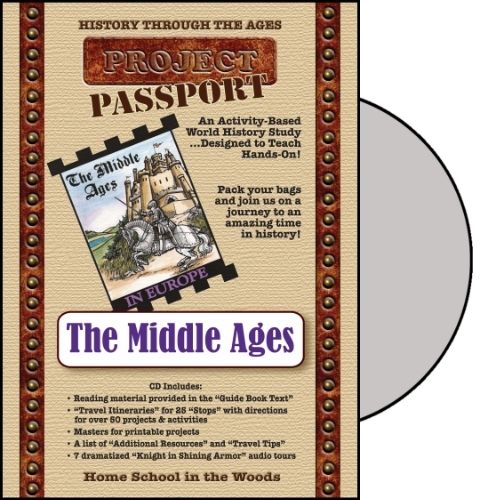
Ok, maybe we didn't truly travel back in time, and, honestly, we haven't even left the house, but Home School in the Woods has made us feel that we've gone on a thrilling and educational journey through Project Passport World History Study: The Middle Ages. 


Home School in the Woods is a family business that was started as a way to make history real, understandable, and applicable. Using timelines and realistic illustrations as a foundation, they've created many resources to make learning history an enjoyable process. I, like Amy the driving force of the company, did not enjoy the boring textbooks in high school. It wasn't until we started our own homeschooling journey that I started to realize that learning history wasn't boring, but, in fact, could be quite interesting. I was excited to download this study and travel to the Middle Ages.

The download (also available as a CD) comes as a zip file. Once you open it, and see the multiple folders, click on the "start" file. At that point, the entire program will open in your browser, making it very easy to use. Instead of clicking through multiple folders, trying to bounce back and forth among the resources, everything is laid out as you need it.  


Using Project Passport is like taking an actual trip to a specific time period. The program is divided into 25 stops or destinations:
  • Stops 1-3 Laying the Foundation
  • Stops 4-7 Everyday Life
  • Stops 8-9 Business
  • Stop 10 Science & Invention
  • Stop 11 Education
  • Stop 12 The Arts
  • Stop 13 Medicine & Disease
  • Stops 14-16 The Church
  • Stops 17-18 The Crusades
  • Stop 19 Knights & Chivalry
  • Stops 20-21 The Vikings
  • Stops 22-24 Battles, Wars, & Conflicts
  • Stop 25 Packing Up


The first few stops require a bit of work. What makes this study so well-done, also makes it so much work. Laying the Foundation is where you create many of the things you'll need for the trip: a realistic passport, a luggage folder complete with tag, a scrapbook of sights, a postcard rack, a newspaper, timeline, and more. This study is recommended for grades 3-8, but, as with many things, we adapted it to be used as a family project. That means that I was completing each step for a 4th grader, 2nd grader, and kindergartener. It required much paper and cardstock and even more preparation. Since we are doing the trip together, I printed certain things (souvenir cards, newspaper, Medieval cookbook, etc.) only once and keep it in a separate 3-ring binder to be used by all. Other things (timelines, maps, puppets, postcards, etc.) I printed a set for each child to be kept in their own binders.     

For each stop, there is a guide book text, which contains all the reading material for learning, and a travel itinerary, which gives thorough step-by-step instructions for the activities. A sample stop might be like this: reading text, adding snapshot moments to the timeline, writing a newspaper article or a postcard, and one or more other activities like playing a game or creating a souvenir craft. Another impressive feature at some of the stops is the audio tours, where the "tour guide" and background noises make you feel like you're really in Medieval times.    


I am amazed at this study. Truly. I have learned, after the first few stops, that we need to slow down to complete this. I had been trying to complete one stop a day, a few days a week. The problem is that along with the 3 older kids, my 3-year-old is usually with us as we're completing the lesson, and sometimes the baby is as well. It was taking well over an hour to get through the reading and activities. I'm sure we could fly through the stops quicker, but we've been enjoying expounding on the reading text while reenacting the Barbarian battles with toy army men and drawing out the feudal system on the dry erase board and  just sitting around and discussing various aspects about the time period. My little ones are soaking this up. We've skipped a few of the big activities for now, but fully intend to complete them all by the time we reach the end of our journey. 

Zac, 5 years: I like the activities. I can't wait to make the candy food-thingies (marzipan) that we're going to make!

Alyssa, 7 years: It's fun. I like making the castle, having the folder that holds our stuff, the passport, Technically, I like everything about it.

Jake, 9 years: It's cool. I like all the things that you make. I really like learning about the Middle Ages.


The only frustrating thing I have about this study is the breakdown of the PDFs. Because everything has very specific printing instructions (regular paper, colored paper, white cardstock, colored cardstock) each page is its own file. I understand that need for the "special" pages. The problem comes in when you have to print lengthy things like the timeline or newspaper. Because of the individual files, you have to open the file, print one page, turn it around, open another file, and print the back (yes, I "leap-frog" printed, but it still requires much work). To make things simpler, I would like to see those entire resources as one file so I can choose the double-sided printing option and my printer can do the work for me.

That issue aside, I love this program. The amount of information and the varying activities are astounding. Yes, it is a lot of work. Yes, it requires a lot of paper and supplies. But, yes, my kids are excited every day to learn history. And, yes, they are retaining the information and talking about it through the day. Yes, I can't say enough praise about this study. We will be taking another trip through history in the future, for sure.


You can connect with Home School in the Woods on the following social media sites:
Facebook
Twitter
Pinterest
Google+


If you'd like to read more reviews of this study or see how other homeschool families used the Ancient Egypt and the Renaissance and Reformation studies, go to the Schoolhouse Review Crew blog. 


Crew Disclaimer
Pin It