Showing posts with label ancient Rome. Show all posts

Tuesday, September 1, 2015

Dig-It! Games Review


We're year-round homeschoolers, and while summertime means that our workload is light and our schedule is flexible, the kids know that they have some sort of learning activity each day. It's exciting though when I tell them, "You have to play a game today." And when that game is played on the iPad or the computer? Well, that's a real treat.

Dig-It! Games is a company that focuses on game-based learning. In 2005, Suzi Wilczynski, founder, began to create fun, interactive learning experiences for middle school students by using her education and archaeology background. Not only are children naturally drawn to fun and games, but these games have "the potential to enhance learning by encouraging persistence, valuing effort over rote performance, and rewarding success without punishing failure." Depending on the game, they also learn important facts along the way. We've been learning the last several weeks by playing Roman Town (iOS App) and Mayan Mysteries (Online Game).


Roman Town is set in the ancient city of Pompeii. It is your job to help catch Ladrone, a master thief, by using strategic thinking, spatial reasoning, memory, logic, math skills, and problem solving. On your quest through the city, you play game with people you meet along the way. If you win the game, they give you a clue to help solve the case. 

Along with learning facts about Pompeii, you'll also learn about Roman life, experience ancient Roman games, and play 35 unique puzzles. The game teaches social studies, math, and literacy skills.


Jake, my 9-year-old, tested this app for me. He was thrilled to play the games and find the clues. Had I not put a limit on his game time, he probably would have completed the entire game in one sitting!
There were a couple times when he asked for my help (like the Roman numerals game), but otherwise played it by himself.


Mayan Mysteries is an online game in which Ladrone is back on the loose. You along with Professor Alex Quinn, Fiona, and Charlie make Team Q and try to figure out who is digging up Maya sites, looking for ancient artifacts. On your mission to save the mythical city of Ich'aak from looters, you'll discover 7 Maya sites and play more than 25 challenging puzzles.

The game teaches skills in social studies, math, language arts, geography, critical thinking, and reading enrichment. It is historically accurate, aligned to National Standards, and offers built-in assessments.

Since this game is best for grades 5-9, Jake played this one, too. He's actually a tad young for this, and it showed in both his understanding and enjoyment of it. There is a lot of information involved. You can either read the text yourself or choose the option to allow the characters to speak aloud to you. If Jake read it, he lost interest; if he listened, he stopped paying attention. The game is very fact-heavy. That can be a good thing for learning, but it just frustrated him. Every day after playing for a while, he'd ask, "Can I be done now?" It was a very different experience from Roman Town.


This conversation sums up his feelings about the games:

Me: What did you like about the Mayan game?

Jake: Nothing really. There were too many quizzes and so much information that you needed to remember.

Me: So, it didn't really feel like a game?

Jake: Not at all.

Me: What did you think about the Roman game?

Jake: Oh, that one was awesome! That had a lot of fun games.


I was in contact with customer support several times because of both a game-related issue and a user-caused issue. Each time, the service was prompt, helpful, and extremely understanding. I was very pleased and confident in the company.

Both games are full of historical facts and bring a fun element to learning. Jake might appreciate Mayan Mysteries as he gets older, but his 9-year-old self loves Roman Town.


You can connect with Dig-It! Games on the following social media sites:


If you'd like to see how other homeschool families used these games, you can read more reviews on the Schoolhouse Review Crew blog. 


Crew Disclaimer
Pin It

Tuesday, July 21, 2015

Project Passport Review


Have you ever wanted to go on an exotic vacation? Visit someplace exciting and experience the culture? Or how about travel back in time and witness events as they took place? We've had that opportunity to do just that the past few weeks.

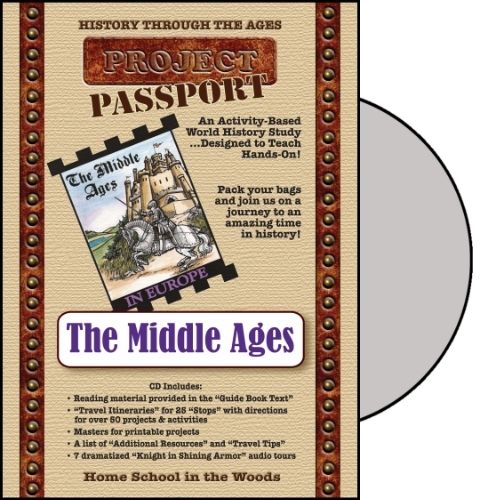
Ok, maybe we didn't truly travel back in time, and, honestly, we haven't even left the house, but Home School in the Woods has made us feel that we've gone on a thrilling and educational journey through Project Passport World History Study: The Middle Ages. 


Home School in the Woods is a family business that was started as a way to make history real, understandable, and applicable. Using timelines and realistic illustrations as a foundation, they've created many resources to make learning history an enjoyable process. I, like Amy the driving force of the company, did not enjoy the boring textbooks in high school. It wasn't until we started our own homeschooling journey that I started to realize that learning history wasn't boring, but, in fact, could be quite interesting. I was excited to download this study and travel to the Middle Ages.

The download (also available as a CD) comes as a zip file. Once you open it, and see the multiple folders, click on the "start" file. At that point, the entire program will open in your browser, making it very easy to use. Instead of clicking through multiple folders, trying to bounce back and forth among the resources, everything is laid out as you need it.  


Using Project Passport is like taking an actual trip to a specific time period. The program is divided into 25 stops or destinations:
  • Stops 1-3 Laying the Foundation
  • Stops 4-7 Everyday Life
  • Stops 8-9 Business
  • Stop 10 Science & Invention
  • Stop 11 Education
  • Stop 12 The Arts
  • Stop 13 Medicine & Disease
  • Stops 14-16 The Church
  • Stops 17-18 The Crusades
  • Stop 19 Knights & Chivalry
  • Stops 20-21 The Vikings
  • Stops 22-24 Battles, Wars, & Conflicts
  • Stop 25 Packing Up


The first few stops require a bit of work. What makes this study so well-done, also makes it so much work. Laying the Foundation is where you create many of the things you'll need for the trip: a realistic passport, a luggage folder complete with tag, a scrapbook of sights, a postcard rack, a newspaper, timeline, and more. This study is recommended for grades 3-8, but, as with many things, we adapted it to be used as a family project. That means that I was completing each step for a 4th grader, 2nd grader, and kindergartener. It required much paper and cardstock and even more preparation. Since we are doing the trip together, I printed certain things (souvenir cards, newspaper, Medieval cookbook, etc.) only once and keep it in a separate 3-ring binder to be used by all. Other things (timelines, maps, puppets, postcards, etc.) I printed a set for each child to be kept in their own binders.     

For each stop, there is a guide book text, which contains all the reading material for learning, and a travel itinerary, which gives thorough step-by-step instructions for the activities. A sample stop might be like this: reading text, adding snapshot moments to the timeline, writing a newspaper article or a postcard, and one or more other activities like playing a game or creating a souvenir craft. Another impressive feature at some of the stops is the audio tours, where the "tour guide" and background noises make you feel like you're really in Medieval times.    


I am amazed at this study. Truly. I have learned, after the first few stops, that we need to slow down to complete this. I had been trying to complete one stop a day, a few days a week. The problem is that along with the 3 older kids, my 3-year-old is usually with us as we're completing the lesson, and sometimes the baby is as well. It was taking well over an hour to get through the reading and activities. I'm sure we could fly through the stops quicker, but we've been enjoying expounding on the reading text while reenacting the Barbarian battles with toy army men and drawing out the feudal system on the dry erase board and  just sitting around and discussing various aspects about the time period. My little ones are soaking this up. We've skipped a few of the big activities for now, but fully intend to complete them all by the time we reach the end of our journey. 

Zac, 5 years: I like the activities. I can't wait to make the candy food-thingies (marzipan) that we're going to make!

Alyssa, 7 years: It's fun. I like making the castle, having the folder that holds our stuff, the passport, Technically, I like everything about it.

Jake, 9 years: It's cool. I like all the things that you make. I really like learning about the Middle Ages.


The only frustrating thing I have about this study is the breakdown of the PDFs. Because everything has very specific printing instructions (regular paper, colored paper, white cardstock, colored cardstock) each page is its own file. I understand that need for the "special" pages. The problem comes in when you have to print lengthy things like the timeline or newspaper. Because of the individual files, you have to open the file, print one page, turn it around, open another file, and print the back (yes, I "leap-frog" printed, but it still requires much work). To make things simpler, I would like to see those entire resources as one file so I can choose the double-sided printing option and my printer can do the work for me.

That issue aside, I love this program. The amount of information and the varying activities are astounding. Yes, it is a lot of work. Yes, it requires a lot of paper and supplies. But, yes, my kids are excited every day to learn history. And, yes, they are retaining the information and talking about it through the day. Yes, I can't say enough praise about this study. We will be taking another trip through history in the future, for sure.


You can connect with Home School in the Woods on the following social media sites:
Facebook
Twitter
Pinterest
Google+


If you'd like to read more reviews of this study or see how other homeschool families used the Ancient Egypt and the Renaissance and Reformation studies, go to the Schoolhouse Review Crew blog. 


Crew Disclaimer
Pin It

Thursday, June 4, 2015

Famous Men of Rome Review


Just 2 months ago I posted our first experience with Memoria Press (the program has been working so well that we are continuing to use it), and here we are with another curriculum to review

Memoria Press is known for its easy-to-use classical Christian materials. They believe in the "cultivation of wisdom and virtue through meditation on the Good, the True, and the Beautiful" by training in the liberal arts and studying great books and great thinkers of the Western Tradition. Their products are characterized by 3 things: simplicity, quality, and affordability. They are designed to be used by anyone from an inexperienced homeschool parent to a seasoned classroom teacher. Of all their fabulous programs, we've been using the Famous Men of Rome Set.


The Famous Men of Rome Set includes the following:
Famous Men of Rome textbook
Famous Men of Rome Student Guide
Famous Men of Rome Teacher's Guide

The Famous Men of Rome textbook is filled with 30 stories covering Ancient Roman history. You'll read about Romulus and the founding of Rome, Horatius and the defeat of the Etruscan army, Julius Caesar and his assassination, Nero and his rise to power, and about many lesser-known men. Each story is easy to read. It's geared toward grades 4-8, but I found myself caught up in the stories, as well. Each story has at least one colored illustration and many black and white drawings. The back of the book includes a glossary of people and places as a quick reference to important information along with full-color maps.

The Famous Men of Rome Student Guide has a corresponding lesson for each story of the textbook and there is a review after every 5th lesson  The lessons are broken into 4 parts: Facts to Know, Vocabulary, Comprehension Questions, and Activities.
  • Facts to Know: lists the most important facts, generally people and places, from the story. It often includes a quote. This is the foundation of the memory work.
  • Vocabulary: highlights more difficult words, pulled directly from the text in the book. There is space for the student to write the definition.
  • Comprehension Questions: helps the student find the most valuable information from the stories and recognize the virtues and indiscretions that took place. There is enough space to write the answers in complete sentences.
  • Activities: incorporates many exercises to enhance the lesson, including maps, timelines, discussion questions, and writing prompts. It integrates lessons from Bible stories, Greek mythology, and the modern world.
 The back of the book contains maps, drawing pages, timeline, a pronunciation guide, and other resources.    

The Famous Men of Rome Teacher's Guide is exactly the same as the student guide but with all the answers given. It also includes a test for every 5th lesson to be copied and given to the student.


My 9-year-old loves history. And battles. And weapons. And action. I knew he'd be drawn to this curriculum. While there are lesson plans you can purchase, it does not come with the set. We started doing 1 lesson a day: all 4 parts of the student guide along with reading the story. It took a while to complete, but he enjoyed it. The problem was that he was flying through the lessons without retaining the information. We slowed the lessons down. For our 4-day schooling week, we followed this schedule:

Day 1: He and I review the Facts to Know and discuss the Vocabulary.
Day 2: He reads the story.
Day 3: He completes the Comprehension Questions, getting help as needed.
Day 4: He and I complete the activities together.

This schedule has been working out much better for us. He absolutely loves the stories--loves them--but isn't so crazy about the accompanying questions, because they're "kinda hard." There really is a lot of information in this set and could easily fill and entire school year with the extra activities and resources that are listed. For us, personally, I think we're going to discuss the vocabulary words and just enjoy the action-filled stories. We'll work through the set again and focus on the comprehension questions when my guy is a little older.


You can connect with Memoria Press on Facebook and Twitter.

If you'd like to read more reviews of this study or are interested in the Latina Christiana or Ancient Romans sets, head to the Schoolhouse Review Crew blog.


Crew Disclaimer
Pin It